Most purchases don’t start with intent. They start with attention: a video watched, a product seen, a brand noticed in a crowded feed. Shoppers are consuming content constantly and often without an initial intent to buy.
Over time, attention builds awareness, and when shoppers are ready to buy, the familiar option becomes their default choice. A recent study found that among shoppers, 43% said digital video played a role in their path to purchase, sparking their interest in buying a product.
And that’s where the disconnect happens: as marketers, we’re making campaign decisions based on dashboards that only capture clicks, overlooking the growing number of customers who saw your ad, didn’t click immediately, and still converted later through another path.
Measuring the impact of that ad view is where click-based attribution falls short. And if you’re relying on click-based attribution alone, you’re likely underinvesting in the channels that are actually creating demand and driving upper-funnel growth.
Introducing Clicks & Deterministic Views
Traditional multi-touch attribution (MTA) models tend to be biased toward clicks and often ignore the role ad impressions play in driving purchases. Because of this, view-based channels and upper-funnel campaigns look inefficient in reporting, even when they’re doing the critical work.
The result is predictable: your awareness campaigns appear to underperform, leading you to cut spending on upper-funnel channels in favor of bottom-funnel tactics that simply harvest the demand another channel created.
This is exactly what Triple Whale’s Clicks & Deterministic Views Attribution model was built to solve.
Clicks & Deterministic Views is a new multi-touch attribution model that combines first-party click data with view-through data from the paid social platforms where modern discovery happens, including Meta, TikTok, and Pinterest with more integrations coming soon. Instead of only tracking what people clicked, Clicks & Deterministic Views captures both high-intent actions and qualified ad exposures, giving you a complete, accurate picture of how channels contribute to conversions across the full customer journey.
How Clicks & Deterministic Views Works
Clicks & Deterministic Views integrates directly with Meta, TikTok, and Pinterest, Vibe and AppLovin to pull in impression and conversion data. This isn’t probabilistic modeling or guesswork. It’s deterministic attribution built on the same first-party data ad platforms use to optimize their own campaigns, unified inside Triple Whale.
When someone sees an ad and later converts, the model matches that impression to the conversion at the user level, then distributes credit proportionally across all eligible touchpoints — including clicks and the most recent qualifying view within standard attribution windows (7-day view, 28-day click).
Built for How Customers Actually Buy
Here’s a simple example. If a shopper views a TikTok video, then later sees a Meta retargeting ad, and finally clicks a branded search ad right before purchasing, Clicks & Deterministic Views assigns more credit to the most recent qualifying interaction, while still recognizing the role earlier views played in building intent.
That’s because the model accounts for time sensitivity by giving more weight to recent touchpoints. It also factors in channel roles, reducing credit given to demand-capture channels (like coupon sites) when they appear late in the journey after top-of-funnel channels have already created demand. In other words, it recognizes the difference between a channel that creates intent and one that simply captures it.
Clicks & Deterministic Views also includes deduplication logic to prevent inflated reporting. If multiple touchpoints are eligible to receive credit for a conversion, the model distributes credit fractionally across them, ensuring every order is counted exactly once and total cross-channel contribution rolls up cleanly to your actual Shopify-reported revenue.
Most importantly, it prevents the common issue where platform-reported totals often exceed true revenue, making it difficult to confidently evaluate performance and scale spend.
Why This Matters Right Now
The reality is consumers don’t shop in straight lines anymore — they discover. Video, creators, and visual brand storytelling are now the front door to ecommerce. For today’s shopper, the first meaningful touchpoint is often a view, not a click.
Despite this, most attribution models continue to prioritize clicks as the primary signal of performance, making accurate measurement in the era of discovery impossible with click-based attribution alone. The campaigns shaping intent early in the journey are often undervalued, while bottom-funnel channels that capture the final interaction receive disproportionately more credit.
And that attribution gap is widening.
Meta is prioritizing Reels. TikTok has trained consumers to buy through discovery. Pinterest is built on visual intent. Across the board, ad platforms are rewarding creative that captures attention, and platform measurement frameworks are beginning to evolve to reflect this shift: Meta recently updated its attribution to account for engaged views and non-click interactions, signaling that understanding ad impact now requires measuring influence beyond the click.
If platforms are optimizing based on views and attention, but marketers are optimizing budgets based on clicks, it creates a fundamental mismatch between what platforms reward and what attribution tools measure. Now, your demand creation looks inefficient, demand capture looks exceptional, and budgets continue to get misallocated.
Attribution as a Competitive Advantage
As platforms optimize toward short-form video engagement, creator-driven storytelling, algorithmic discovery feeds, and immersive browsing experiences, marketers need measurement frameworks that capture how influence actually happens.
Clicks & Deterministic Views closes that gap.
At the same time, the measurement landscape has become more complex. Privacy changes have made attribution harder than ever, which means the brands that figure out better measurement will have a massive competitive advantage over those still flying blind.
The ability to measure view-through impact alongside clicks is no longer a “nice to have.” It’s now the baseline for better marketing performance.
Clicks & Deterministic Views was built for this reality.
Customer Use Case: Hat Club
Let's look at this from a brand’s perspective.
Hat Club is a premium sports lifestyle hat brand investing in view-heavy touchpoints. Their team produces lifestyle videos, vertical video content, and branded campaigns designed to immerse customers in and around the product — the kind of campaigns that drive demand before a customer is ready to buy.
With multiple view-based touchpoints across platforms, the customer journey rarely looks like a clean line to conversion. A shopper might watch a video on Instagram, scroll past a product drop teaser, see a retargeting carousel later, and only then convert.
Click-based attribution couldn’t fully capture that reality. Internally, it made it difficult to tell a clear story about what was actually driving growth, especially when explaining performance to leadership.
When Hat Club adopted Clicks & Deterministic Views, that gap started to close. Instead of forcing view-heavy campaigns into click-dominant frameworks, they had a model that reflected how their customers actually discovered and converted. Awareness campaigns began to show up with impact that made sense. The results weren’t inflated, they were clarified.
Clicks & Deterministic Views revealed that campaigns Hat Club had been considering cutting were actually driving significant assisted conversions through views. With a clearer picture of full-funnel contribution, Hat Club was able to scale budget more effectively, and with confidence in demand creation while still maintaining their demand capture tactics.
“I use Clicks & Deterministic Views to optimize within channels because that shows what’s actually happening,” says Steve Berman, Director of Paid Media and Analytics at Hat Club. “Total Impact, on the other hand, tells me what’s happening plus what people believe influenced their purchase. Clicks & Views is for someone like me to see what happened across the journey."
Teams like Hat Club make smarter decisions by using both click and view-through signals. They don’t waste budget cutting channels that appear inefficient but are true conversion drivers. They don’t overinvest in last-click channels that look great in reporting, but aren’t creating new customers. The brands winning right now aren’t guessing which channels work — they know.
What You Can Actually Do With Clicks & Deterministic Views
Stop guessing which campaigns are working and start knowing.
With Clicks & Deterministic Views, you can finally validate your awareness campaigns by seeing the full story of what’s driving sales, even when shoppers don’t click immediately. You’ll understand how channels work together — how your social ads create demand and how search and email capture it— so you can build a marketing strategy that optimizes across the full customer journey instead of just the last click.
And this impact isn’t hypothetical. Platform optimization decisions improve dramatically when you’re scaling based on full-funnel contribution rather than bottom-of-funnel metrics alone.
Take it from Triple Whale customer EVRYJEWELS, who’s using Clicks & Deterministic Views to bring more clarity into day-to-day optimization decisions:
"I use Clicks & Deterministic Views almost every day. It's helpful to see the full picture beyond our click-only attribution. We optimize most of our Meta campaigns for one-day click attribution only, so Clicks & Deterministic Views helps us understand the weight and impact of view-through conversions we'd otherwise miss. It's also closer to what I see on the Meta platform itself, which builds confidence in the data.” — Alaa Rhouma, Head of Growth at EVRYJEWELS
If you’re a marketer who’s trying to answer questions like:
“What’s actually driving conversions?”
“Are my upper-funnel campaigns working?” or
“Why does Meta, Pinterest or TikTok feel under-credited?”
Then, Clicks & Deterministic Views is for you.
Get Started in Minutes
Turning on Clicks & DeterministicViews takes only a few minutes. You’ll see click data in real-time and view-through data refreshed daily. If you’ve already connected Meta, TikTok, and Pinterest to Triple Whale and have the Triple Pixel installed, you’re almost there — just enable the integration and start seeing a clearer picture of your cross-channel performance.
More complete measurement leads to smarter, more confident decisions. Better decisions lead to more efficient growth. And right now, that might be the only sustainable advantage that actually matters.
Clicks & Deterministic Views Attribution is now generally available to all Triple Whale customers on a paid subscription plan. Book a demo today.
Component Sales
5.32K
Benchmark your ecommerce brand against industry leaders
Most purchases don’t start with intent. They start with attention: a video watched, a product seen, a brand noticed in a crowded feed. Shoppers are consuming content constantly and often without an initial intent to buy.
Over time, attention builds awareness, and when shoppers are ready to buy, the familiar option becomes their default choice. A recent study found that among shoppers, 43% said digital video played a role in their path to purchase, sparking their interest in buying a product.
And that’s where the disconnect happens: as marketers, we’re making campaign decisions based on dashboards that only capture clicks, overlooking the growing number of customers who saw your ad, didn’t click immediately, and still converted later through another path.
Measuring the impact of that ad view is where click-based attribution falls short. And if you’re relying on click-based attribution alone, you’re likely underinvesting in the channels that are actually creating demand and driving upper-funnel growth.
Introducing Clicks & Deterministic Views
Traditional multi-touch attribution (MTA) models tend to be biased toward clicks and often ignore the role ad impressions play in driving purchases. Because of this, view-based channels and upper-funnel campaigns look inefficient in reporting, even when they’re doing the critical work.
The result is predictable: your awareness campaigns appear to underperform, leading you to cut spending on upper-funnel channels in favor of bottom-funnel tactics that simply harvest the demand another channel created.
This is exactly what Triple Whale’s Clicks & Deterministic Views Attribution model was built to solve.
Clicks & Deterministic Views is a new multi-touch attribution model that combines first-party click data with view-through data from the paid social platforms where modern discovery happens, including Meta, TikTok, and Pinterest with more integrations coming soon. Instead of only tracking what people clicked, Clicks & Deterministic Views captures both high-intent actions and qualified ad exposures, giving you a complete, accurate picture of how channels contribute to conversions across the full customer journey.
How Clicks & Deterministic Views Works
Clicks & Deterministic Views integrates directly with Meta, TikTok, and Pinterest, Vibe and AppLovin to pull in impression and conversion data. This isn’t probabilistic modeling or guesswork. It’s deterministic attribution built on the same first-party data ad platforms use to optimize their own campaigns, unified inside Triple Whale.
When someone sees an ad and later converts, the model matches that impression to the conversion at the user level, then distributes credit proportionally across all eligible touchpoints — including clicks and the most recent qualifying view within standard attribution windows (7-day view, 28-day click).
Built for How Customers Actually Buy
Here’s a simple example. If a shopper views a TikTok video, then later sees a Meta retargeting ad, and finally clicks a branded search ad right before purchasing, Clicks & Deterministic Views assigns more credit to the most recent qualifying interaction, while still recognizing the role earlier views played in building intent.
That’s because the model accounts for time sensitivity by giving more weight to recent touchpoints. It also factors in channel roles, reducing credit given to demand-capture channels (like coupon sites) when they appear late in the journey after top-of-funnel channels have already created demand. In other words, it recognizes the difference between a channel that creates intent and one that simply captures it.
Clicks & Deterministic Views also includes deduplication logic to prevent inflated reporting. If multiple touchpoints are eligible to receive credit for a conversion, the model distributes credit fractionally across them, ensuring every order is counted exactly once and total cross-channel contribution rolls up cleanly to your actual Shopify-reported revenue.
Most importantly, it prevents the common issue where platform-reported totals often exceed true revenue, making it difficult to confidently evaluate performance and scale spend.
Why This Matters Right Now
The reality is consumers don’t shop in straight lines anymore — they discover. Video, creators, and visual brand storytelling are now the front door to ecommerce. For today’s shopper, the first meaningful touchpoint is often a view, not a click.
Despite this, most attribution models continue to prioritize clicks as the primary signal of performance, making accurate measurement in the era of discovery impossible with click-based attribution alone. The campaigns shaping intent early in the journey are often undervalued, while bottom-funnel channels that capture the final interaction receive disproportionately more credit.
And that attribution gap is widening.
Meta is prioritizing Reels. TikTok has trained consumers to buy through discovery. Pinterest is built on visual intent. Across the board, ad platforms are rewarding creative that captures attention, and platform measurement frameworks are beginning to evolve to reflect this shift: Meta recently updated its attribution to account for engaged views and non-click interactions, signaling that understanding ad impact now requires measuring influence beyond the click.
If platforms are optimizing based on views and attention, but marketers are optimizing budgets based on clicks, it creates a fundamental mismatch between what platforms reward and what attribution tools measure. Now, your demand creation looks inefficient, demand capture looks exceptional, and budgets continue to get misallocated.
Attribution as a Competitive Advantage
As platforms optimize toward short-form video engagement, creator-driven storytelling, algorithmic discovery feeds, and immersive browsing experiences, marketers need measurement frameworks that capture how influence actually happens.
Clicks & Deterministic Views closes that gap.
At the same time, the measurement landscape has become more complex. Privacy changes have made attribution harder than ever, which means the brands that figure out better measurement will have a massive competitive advantage over those still flying blind.
The ability to measure view-through impact alongside clicks is no longer a “nice to have.” It’s now the baseline for better marketing performance.
Clicks & Deterministic Views was built for this reality.
Customer Use Case: Hat Club
Let's look at this from a brand’s perspective.
Hat Club is a premium sports lifestyle hat brand investing in view-heavy touchpoints. Their team produces lifestyle videos, vertical video content, and branded campaigns designed to immerse customers in and around the product — the kind of campaigns that drive demand before a customer is ready to buy.
With multiple view-based touchpoints across platforms, the customer journey rarely looks like a clean line to conversion. A shopper might watch a video on Instagram, scroll past a product drop teaser, see a retargeting carousel later, and only then convert.
Click-based attribution couldn’t fully capture that reality. Internally, it made it difficult to tell a clear story about what was actually driving growth, especially when explaining performance to leadership.
When Hat Club adopted Clicks & Deterministic Views, that gap started to close. Instead of forcing view-heavy campaigns into click-dominant frameworks, they had a model that reflected how their customers actually discovered and converted. Awareness campaigns began to show up with impact that made sense. The results weren’t inflated, they were clarified.
Clicks & Deterministic Views revealed that campaigns Hat Club had been considering cutting were actually driving significant assisted conversions through views. With a clearer picture of full-funnel contribution, Hat Club was able to scale budget more effectively, and with confidence in demand creation while still maintaining their demand capture tactics.
“I use Clicks & Deterministic Views to optimize within channels because that shows what’s actually happening,” says Steve Berman, Director of Paid Media and Analytics at Hat Club. “Total Impact, on the other hand, tells me what’s happening plus what people believe influenced their purchase. Clicks & Views is for someone like me to see what happened across the journey."
Teams like Hat Club make smarter decisions by using both click and view-through signals. They don’t waste budget cutting channels that appear inefficient but are true conversion drivers. They don’t overinvest in last-click channels that look great in reporting, but aren’t creating new customers. The brands winning right now aren’t guessing which channels work — they know.
What You Can Actually Do With Clicks & Deterministic Views
Stop guessing which campaigns are working and start knowing.
With Clicks & Deterministic Views, you can finally validate your awareness campaigns by seeing the full story of what’s driving sales, even when shoppers don’t click immediately. You’ll understand how channels work together — how your social ads create demand and how search and email capture it— so you can build a marketing strategy that optimizes across the full customer journey instead of just the last click.
And this impact isn’t hypothetical. Platform optimization decisions improve dramatically when you’re scaling based on full-funnel contribution rather than bottom-of-funnel metrics alone.
Take it from Triple Whale customer EVRYJEWELS, who’s using Clicks & Deterministic Views to bring more clarity into day-to-day optimization decisions:
"I use Clicks & Deterministic Views almost every day. It's helpful to see the full picture beyond our click-only attribution. We optimize most of our Meta campaigns for one-day click attribution only, so Clicks & Deterministic Views helps us understand the weight and impact of view-through conversions we'd otherwise miss. It's also closer to what I see on the Meta platform itself, which builds confidence in the data.” — Alaa Rhouma, Head of Growth at EVRYJEWELS
If you’re a marketer who’s trying to answer questions like:
“What’s actually driving conversions?”
“Are my upper-funnel campaigns working?” or
“Why does Meta, Pinterest or TikTok feel under-credited?”
Then, Clicks & Deterministic Views is for you.
Get Started in Minutes
Turning on Clicks & DeterministicViews takes only a few minutes. You’ll see click data in real-time and view-through data refreshed daily. If you’ve already connected Meta, TikTok, and Pinterest to Triple Whale and have the Triple Pixel installed, you’re almost there — just enable the integration and start seeing a clearer picture of your cross-channel performance.
More complete measurement leads to smarter, more confident decisions. Better decisions lead to more efficient growth. And right now, that might be the only sustainable advantage that actually matters.
Clicks & Deterministic Views Attribution is now generally available to all Triple Whale customers on a paid subscription plan. Book a demo today.
Share
Indera Sahadeo
Indera Sahadeo is a product marketing manager at Triple Whale, where she helps ecommerce brands turn performance data into smarter growth decisions. She’s passionate about connecting product innovation to the real-world challenges marketers face running DTC brands. Indera specializes in translating complex insights into clear, practical applications teams can confidently act on. She closely studies how the ecommerce landscape is evolving, and what smarter measurement means for brands building lasting competitive advantage.
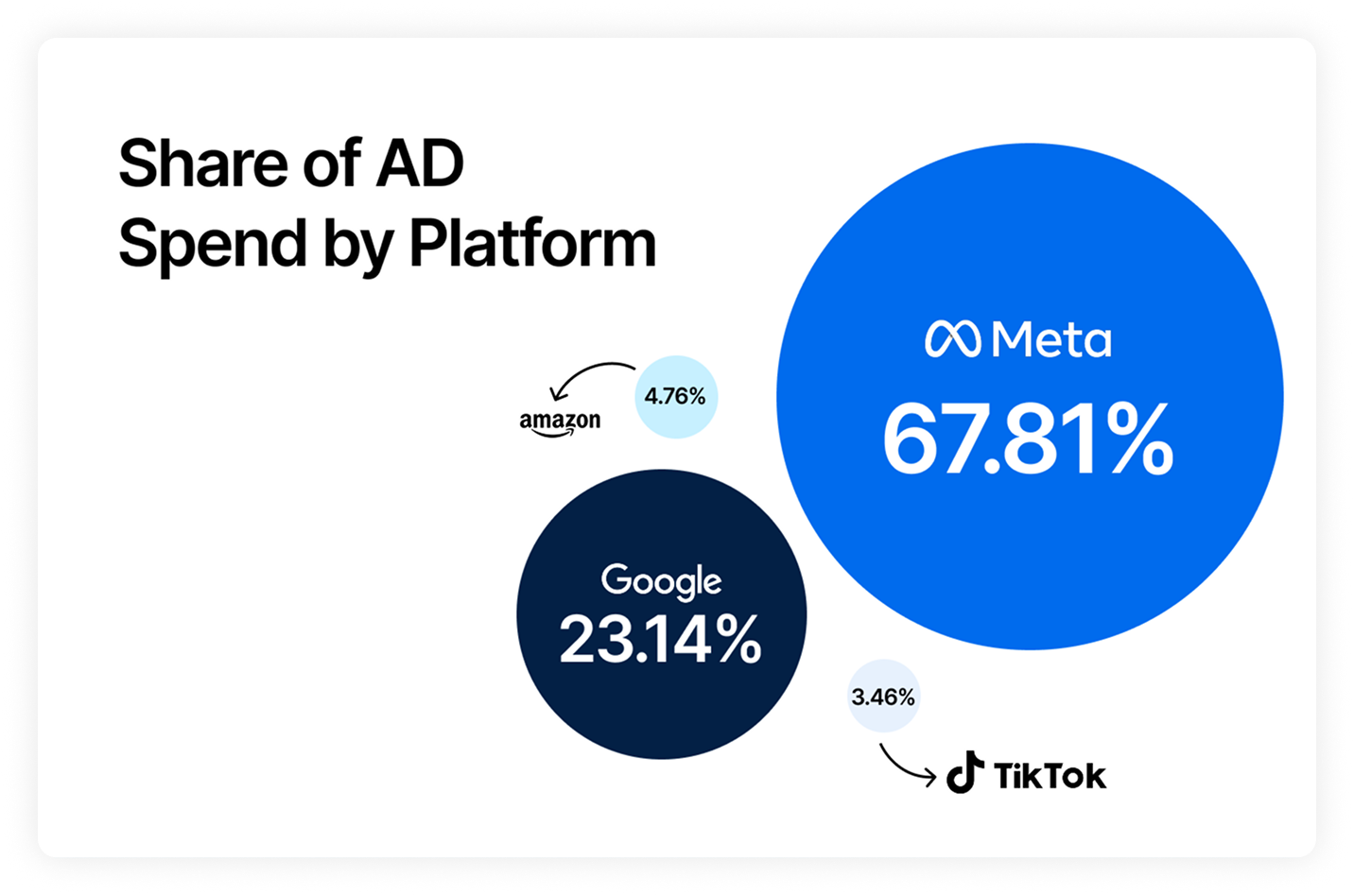
Body Copy: The following benchmarks compare advertising metrics from April 1-17 to the previous period. Considering President Trump first unveiled his tariffs on April 2, the timing corresponds with potential changes in advertising behavior among ecommerce brands (though it isn’t necessarily correlated).


 Moby AIAsk questions, analyze performance, and work with your business context.
 ActionsTake governed action across the tools that run your business.
 AutomationsSchedule recurring analysis and work that runs on your terms.
 Landing PagesCreative conversion-focused ecommerce pages with Moby.
 Creative StudioGenerate and refine creative grounded in your brand.


.png)
.png)


.png)





.webp)

.webp)
