Understanding how your online store performs compared to competitors is essential for growth. Ecommerce conversion rates globally hover around 1.7-2.66%, but this varies dramatically by industry, device, and channel. Whether you’re measuring conversion rates, average order value, or cart abandonment, knowing where you stand against the market helps you spot opportunities and set realistic goals.
This guide provides the most current ecommerce metric benchmarks across key metrics, breaks down performance by industry, and offers practical steps to improve underperforming areas.
What are ecommerce benchmarks?
Ecommerce benchmarks are standardized metrics that represent typical performance across online stores. They help you answer critical questions: Is a 2% conversion rate good? Should I be concerned about a 70% cart abandonment rate? How does my average order value compare to similar businesses?
These benchmarks serve as diagnostic tools rather than absolute targets. Your performance depends on factors including:
- Industry vertical: Apparel stores convert differently than Pet Supplies retailers
- Traffic quality: Paid ads will typically have lower conversion rates than email marketing
- Seasonality: Holiday periods dramatically shift all metrics
- Business model: B2B stores see higher AOVs but often lower conversion rates than B2C
Think of benchmarks as guardrails that help you identify funnel weaknesses and prioritize improvements. When your metrics fall significantly below industry benchmark averages, you’ve found your opportunity for improvement.
Ecommerce conversion rate benchmarks
What this measures: The percentage of website visitors who complete a purchase. Calculate it by dividing total orders by total sessions, then multiply by 100.
Current benchmark ranges
The global average ecommerce conversion rate stands at 2.66%, with 1.4% as the average Shopify store conversion rate. However, top-performing shops significantly exceed these numbers:
- Global average: 2.66%
- Shopify average: 1.40%
- Triple Whale median (for paid ads)*: 1.69%
- Top 20% of stores: 3.2% and up
- Top 10% of stores: 4.7% and up
*The Triple Whale median is the median conversion rate taken from August 2025 to July 2026.
Conversion Rate by Source Data, 2026
CVR
Shopify
Triple Whale
Global
Top 20%
Top 10%
How conversion rates vary
- By device: Desktop users convert at 1.9% compared to mobile’s 1.2%. Even though mobile sessions account for 73% of traffic, mobile ecommerce statistics underperform compared to desktop conversion because of smaller screens, harder-to-complete forms, and browsing behavior.
- By industry: Conversion rates vary across different industries. Triple Whale data shows that Food & Beverage has one of the highest conversion rates at 2.60%, with Pets & Animals at 2.39% and Health & Beauty at 2.38%.
- By region: The Americas lead globally at a 3.14% conversion rate, outpacing other regions due to established ecommerce infrastructure and consumer confidence.
What this means for your business
If your conversion rate sits below 1.5%, you likely have significant friction in your funnel. Two to three percent puts you in the average range, where there’s room for improvement but it’s not yet critical. Above 3.2% means you’re outperforming most competitors.
But don’t panic if you’re below average, as context matters. A luxury brand converting at 1.2% might be performing excellently, while a beauty brand at the same rate needs urgent attention.
How to improve conversion rate
- Ramp up site speed. Slow websites increase abandonment rates by 75%. Compress images, leverage browser caching, and minimize redirects.
- Optimize for mobile. With mobile traffic dominant but conversions lagging, focus on larger tap targets, simplified forms, and mobile payment options like Apple Pay, Google Pay, and Shop Pay.
- Add trust signals. Display security badges, customer reviews, and clear return policies. Trust badges and clear return policies reduce abandonment by up to 28%.
- Simplify checkout. Reduce form fields, offer guest checkout, and show progress indicators. Every extra step costs you conversions.
- Display transparent pricing. Show shipping costs and taxes early. According to the Baymard Institute, 40% of shoppers abandon carts because of unexpected checkout costs.
Add-to-cart rate benchmarks
What this measures: The percentage of visitors who add at least one item to their cart. It’s a leading indicator of product appeal and site usability.
Current benchmark ranges
The average add-to-cart rate is approximately 5.98%, though this will vary by category:
- Average range: 4-7%
- Strong performance: 8%+
- Excellent performance: 10%+
Industry breakdown
Food & Beverage leads with 9.65-13.14%, while Apparel is around 6.33-7.12%. The lower price points of Food & Beverage products, plus frequent purchases, drive higher add-to-cart behavior, while products with longer consideration phases, like Apparel, have lower add-to-cart rates.
What this means for your business
Add-to-cart rate below 2% signals an issue with product pages, whether it’s unclear pricing, poor imagery, or weak value propositions. Between 7-10% is healthy, indicating visitors find products appealing enough to consider purchasing.
A low ATC rate combined with high bounce rates often means mismatched traffic. You’re attracting the wrong audience or setting incorrect expectations in your marketing.
How to improve add-to-cart rate
- Enhance product imagery. Use high-quality photos from multiple angles. Add zoom functionality and lifestyle images that show the product in use.
- Clarify pricing upfront. Hide-and-seek pricing kills conversions. Display prices prominently along with any applicable discounts.
- Leverage social proof. Visitors who interact with user-generated content convert at a 102.4% higher rate.
- Optimize for speed. If your product page drags, mobile users leave — usually for Instagram or TikTok. Compress images and eliminate render-blocking resources.
- Make the button obvious. Ensure your add-to-cart button stands out with contrasting colors and clear placement.
Cart abandonment benchmarks
What this measures: The percentage of shoppers who add items to their cart but leave without purchasing.
Current benchmark ranges
Cart abandonment remains one of ecommerce’s biggest challenges. The average abandoned cart rate is 70.22%, with seven out of every ten customers bailing before making the sale.
Shopping cart abandonment rates are much higher on mobile (73-75%) than on desktop (65-68%). Since mobile devices drive more traffic than desktop, optimizing the checkout experience is imperative.
Industry variations
The Beauty industry has the highest abandonment rate at 81.71%, while Pet Supplies is lowest at 53.06%. Higher-priced categories and those requiring more consideration naturally see more abandonment.
What this means for your business
If your abandonment rate exceeds 80%, friction exists in your checkout flow. Between 70-75% is average, but still represents massive opportunity. Below 65% indicates a well-optimized experience.
Remember that not all abandonment is negative. Many users window shop, compare prices, or save items for later — normal browsing behavior that inflates these numbers.
How to improve abandonment rate
- Remove unexpected costs. 48% of customers abandon due to extra costs like shipping fees or taxes. Display all-inclusive pricing or offer free shipping thresholds.
- Streamline your checkout. Sites using one-page checkouts or express payment options see up to 21% better conversion than standard flows.
- Deploy recovery emails. Abandoned cart emails achieve 41.8% open rates and 10.7% conversion rates. Send a sequence of 2-3 emails to recover lost sales.
- Add exit-intent offers: Display a discount or free shipping offer when users attempt to leave. This can significantly reduce bounce rates, especially on mobile.
Average order value (AOV) benchmarks
What this measures: The average amount customers spend per transaction. Calculate it by dividing total revenue by the number of orders.
Current benchmark ranges
Average order values globally reached approximately $150-180 in 2025, representing a 5-8% growth over 2024. For Triple Whale brands, the median AOV from August 2025 to July 2026 was $61.22 across paid advertising channels, up 3.88% from the previous period.
Industry breakdown
Average order value by industry varies dramatically by product category, with differences reflected in product pricing structures and purchase patterns. Luxury items naturally command higher order values, while pet supplies and beauty products see more frequent, smaller purchases.
Median Average Order Value by Industry, 2026
AOV ($)
Elearning & Online Courses
Books & Music
Pets & Animals
Beauty
Health & Wellness
Food & Beverage
Lifestyle & Boutique
Toys, Art, & Collectibles
Baby
Apparel & Accessories
Electronics
Sports & Outdoors
Home & Garden
Automotive
Travel Accessories & Luggage
What this means for your business
Your ideal AOV depends entirely on your product mix and pricing strategy. A low AOV isn’t inherently bad if margins are healthy and purchase frequency is high.
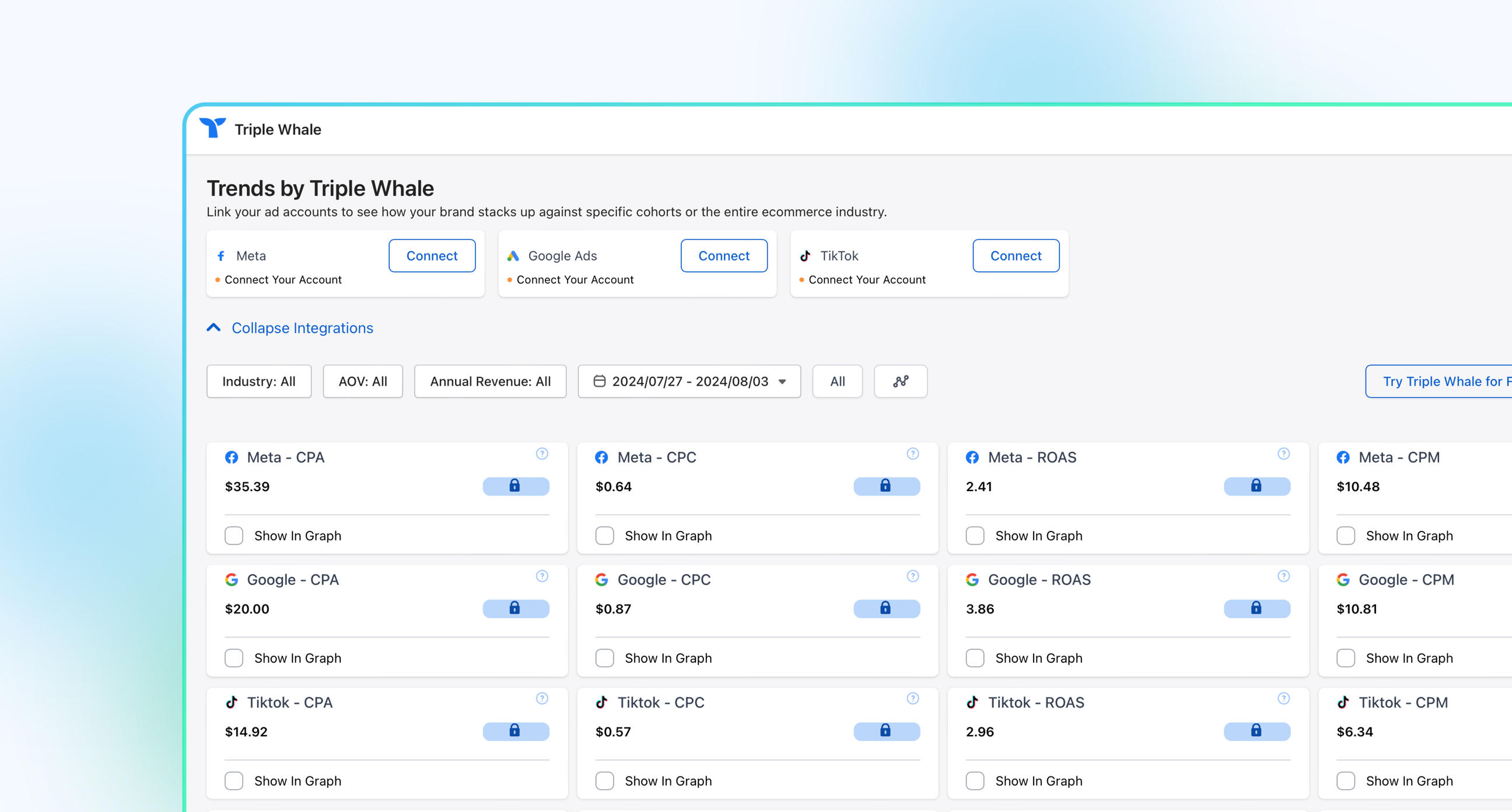
Focus on AOV improvements when advertising costs are rising — the median CPA for Meta ads was $31.26 for over 40,000 Triple Whale brands in our dataset. Higher order values can help offset acquisition costs.
How to improve AOV
- Implement product bundles. Create compelling package deals that offer clear value and encourage customers to add more products to their cart.
- Establish free shipping thresholds. 75% of customers prefer free shipping over fast shipping. If your AOV is around $35, bumping it to $50 encourages customers to add more items to get free shipping.
- Leverage cross-selling. Cross-selling alone generates 10-30% of ecommerce sales. Recommend complementary products at strategic touchpoints.
- Offer Buy Now, Pay Later. BNPL options drive 40%+ improvements in AOV, and payment flexibility reduces price sensitivity.
Channel benchmarks for ecommerce
Paid ads
Paid advertising faces rising costs, but remains essential for scaling. Some of the key paid ads median metrics for over 53,000 Triple Whale brands from August 2025 to July 2026:
- Click-through rate (CTR): 1.93% (+11.43% from August 2024 to July 2025)
- Conversion rate (CVR): 1.69% (-4.63%)
- Cost per acquisition (CPA): $23.20 (+5.1%)
How to improve
- Tighten audience targeting
- Test ad creative continuously
- Optimize landing pages
- Consider retargeting campaigns that often convert higher than cold traffic
Ecommerce benchmarks by industry sector
When evaluating performance, note that benchmarks differ by industry. Here’s how metrics stacked up across verticals from August 2025 to July 2026.
| Industry |
ROAS |
CPA |
AOV |
CVR |
CPM |
CTR |
| Automotive |
3.27 |
$33.83 |
$116.34 |
1.59% |
$11.66 |
1.98% |
| Sports & Outdoors |
3.01 |
$35.80 |
$113.93 |
1.77% |
$12.38 |
1.74% |
| Travel Accessories & Luggage |
2.80 |
$42.07 |
$130.91 |
1.53% |
$15.03 |
2.02% |
| Home & Garden |
2.72 |
$41.62 |
$114.43 |
1.64% |
$14.16 |
1.78% |
| Baby |
2.71 |
$26.65 |
$75.33 |
2.26% |
$11.75 |
1.72% |
| Apparel & Accessories |
2.70 |
$31.44 |
$89.17 |
1.80% |
$11.72 |
1.95% |
| Toys, Art, & Collectibles |
2.31 |
$29.89 |
$71.68 |
1.94% |
$11.84 |
1.91% |
| Lifestyle & Boutique |
2.31 |
$28.03 |
$67.05 |
1.98% |
$12.35 |
1.91% |
| Electronics |
2.28 |
$44.12 |
$113.41 |
1.49% |
$14.11 |
1.91% |
| Food & Beverage |
2.03 |
$29.48 |
$63.32 |
2.60% |
$14.55 |
1.67% |
| Pets & Animals |
1.89 |
$31.26 |
$60.12 |
2.39% |
$16.71 |
1.96% |
| Beauty |
1.82 |
$31.68 |
$61.18 |
2.38% |
$16.90 |
1.88% |
| Books & Music |
1.78 |
$26.76 |
$52.56 |
2.01% |
$12.79 |
2.11% |
| Health & Wellness |
1.55 |
$37.85 |
$62.99 |
1.83% |
$20.34 |
2.44% |
| Elearning & Online Courses |
1.27 |
$28.19 |
$42.79 |
1.53% |
$14.91 |
2.52% |
Why industries differ
AOV patterns reflect purchase behavior:
- High AOV categories (Travel Accessories & Luggage: $130.91, Automotive: $116, and Home & Garden: $114.43): Considered purchases with premium pricing power and infrequent replacement cycles. Higher transaction values support aggressive acquisition costs.
- Low AOV categories (Elearning & Online Courses: $42.79, Books & Music: $52.56, and Pets & Animals: $60.12): Consumable products with high reorder rates or low-priced items. Lower transaction values require exceptional efficiency or strong LTV to achieve profitability.
Conversion rates separate need-based from want-based:
- Top converters (Food & Beverage: 2.60%, Pets & Animals: 2.39%, and Beauty: 2.38%): Essential or replenishment purchases where customers already know what they need. Emotional drivers and urgency reduce hesitation.
- Lower converters (Electronics: 1.49%, Travel Accessories & Luggage: 1.53%, and Automotive: 1.59%): High-consideration purchases requiring research and comparison. Extended decision cycles suppress immediate conversion despite strong eventual ROAS.
CPM variance shows audience competition:
- Expensive impressions (Health & Wellness: $20.34, Beauty: $16.90, and Pets & Animals: $16.71): Affluent, high-LTV audiences with intense competitive bidding. Platforms charge premiums for demographics with proven purchasing power.
- Affordable impressions (Automotive: $11.66, Apparel & Accessories: $11.72, and Baby: $11.75): Broad demographic appeal creates abundant inventory. Mass-market products avoid scarcity pricing.
ROAS leaders combine high AOV with manageable costs:
- Top performers (Automotive: 3.27, Sports & Outdoors: 3.01, and Travel Accessories & Luggage: 2.80): Maintain AOV/CPA ratios above 2.7x, which creates a margin cushion for profitable scaling.
- Bottom performers (Elearning & Online Courses: 1.27, Health & Wellness: 1.55, and Books & Music: 1.78): Struggle with ratios below 2.0x, where even perfect execution leaves minimal profit margin.
How to interpret and apply ecommerce benchmarks
- Evaluate your performance. Start by comparing your metrics to your specific industry vertical, not global averages. A 1.5% conversion rate is concerning for Beauty, but strong for Consumer Electronics).
- Look at the full funnel, not isolated metrics. High traffic with low add-to-cart might signal product page issues, where high add-to-cart with poor conversion points to checkout problems.
- Consider your traffic sources. Sites driving high volumes from ads or blog posts typically show lower conversion rates than those relying on email or repeat customers.
- Prioritize based on impact. Focus improvements where you’re furthest below benchmarks and where changes offer the biggest revenue potential:
- Conversion rate below 1.5%: Critical priority — deal with fundamental trust, pricing, or checkout issues
- Add-to-cart rate below 5%: High priority — product pages need work
- Abandonment rate above 80%: Medium priority — checkout friction or pricing concerns
- AOV below industry average: Lower priority unless margins are very thin
When benchmarks don’t apply
Benchmarks lose relevance in certain situations:
- New stores: Early-stage businesses often underperform benchmarks while building brand awareness and refining product-market fit.
- Niche markets: Highly specialized products may show different patterns than broader categories.
- Heavy content sites: Blogs and educational content naturally show lower conversion rates. Segment this traffic separately.
- Seasonal businesses: Compare to your own historical performance during similar periods, not annual averages.
Key takeaways
1. Conversion rate benchmarks depend on context
- Global averages sit at 2.66%, while the average Shopify store converts at 1.40%.
- Triple Whale’s median paid ad conversion rate was 1.69% from August 2025 through July 2026.
- Top performers reach 3.2-4.7% and above, but industry and traffic mix materially affect what constitutes strong performance.
2. Add-to-cart rates reveal product page effectiveness
- The average add-to-cart rate is 5.98%, with 4% to 7% representing the typical range.
- Food & Beverage leads at 9.65% to 13.14%, while Apparel reaches 6.33% to 7.12%.
- A below-average add-to-cart rate can indicate problems with product positioning, imaging, pricing, traffic quality, or usability.
3. Cart abandonment remains a major opportunity
- The average cart abandonment rate is 70.22%.
- Mobile abandonment ranges from 73% to 75%, compared with 65% to 68% on desktop.
- Beauty has the highest abandonment rate at 81.71%, while Pet Supplies is lowest at 53.06%.
- Transparent costs, a streamlined checkout, and recovery campaigns remain the most immediate opportunities for improvement.
4. AOV varies 3x across industries
- Triple Whale’s median AOV across paid channels was $61.22 from August 2025 through July 2026, up 3.88% from the previous period.
- Industry AOV ranges from $42.79 for Elearning & Online Courses to $130.91 for Travel Accessories & Luggage.
- Automotive reached $116.34, while Home & Garden reached $114.43.
- These differences materially affect how much each industry can afford to spend on acquisition.
5. Compare within your vertical, not against global averages
- Triple Whale’s overall paid-ad medians were 1.93% CTR, 1.69% CVR, and $23.20 CPA across more than 53,000 brands.
- Industry performance varies significantly: Automotive produced the highest ROAS at 3.27, while Elearning & Online Courses produced 1.27.
- Use global benchmarks to identify broad gaps, but make optimization and budget decisions using your industry, product economics, traffic mix, and historical performance.
Ready to move beyond guessing and start optimizing with confidence? Triple Whale provides real-time analytics and benchmarking tools specifically designed for ecommerce businesses. Track your KPIs against industry standards, identify improvement opportunities, and measure the impact of your optimizations — all in one platform. Get started today for free.
Ecommerce benchmarks FAQs
What is considered a good ecommerce conversion rate for my industry?
It depends on your vertical, traffic mix, and measurement method. The current global ecommerce conversion benchmark is 2.66%, while the average Shopify store converts at 1.40%. Triple Whale’s median paid-ad conversion rate was 1.69% from August 2025 through July 2026.
Industry performance varies considerably. Food & Beverage converted at 2.60%, while Electronics converted at 1.49%. Use the closest industry benchmark as context, but focus on improving your store’s own baseline.
What is the average cart abandonment rate in 2025?
The average cart abandonment rate is 70.22%. Mobile abandonment ranges from 73% to 75%, compared with 65% to 68% on desktop.
Rates also vary by industry. Beauty has the highest abandonment rate at 81.71%, while Pet Supplies is lowest at 53.06%. Product price, purchase frequency, device mix, and checkout friction can all affect abandonment.
How do ecommerce benchmarks vary by industry?
Significantly. In Triple Whale’s August 2025–July 2026 paid-ad benchmark data, conversion rates range from 1.49% for Electronics to 2.60% for Food & Beverage.
Median AOV ranges from $42.79 for Elearning & Online Courses to $130.91 for Travel Accessories & Luggage. High-consideration categories often convert at lower rates but generate larger orders, while replenishment categories tend to convert more frequently with smaller baskets.
How can I improve KPIs if my store is below ecommerce benchmarks?
Start with your biggest gaps. If conversion rate is low, optimize checkout flow and add trust signals. Poor add-to-cart rate means improving product pages with better imagery and clearer pricing. High abandonment calls for transparent pricing and recovery emails. Test changes systematically and measure results against your baseline, not just industry averages.


 Moby AIAsk questions, analyze performance, and work with your business context.
 ActionsTake governed action across the tools that run your business.
 AutomationsSchedule recurring analysis and work that runs on your terms.
 Landing PagesCreative conversion-focused ecommerce pages with Moby.
 Creative StudioGenerate and refine creative grounded in your brand.












.webp)

.webp)
