Everyone's looking for the one thing that broke their ads.
"It's Andromeda." "It's creative fatigue." "It's the algorithm."
Here's the truth... it's not one thing. It's four things working together. And anyone telling you they've "cracked the code" is either lying, oversimplifying, or selling you a course.
David nailed it. Meta didn't roll out a single algorithm update. They built an entire AI framework... four interlocking systems that work together in ways that make the old "hacks" obsolete.
The old Meta? You could game it. Find one exploit in one silo, scale it, print money until it stopped working. Then find the next one.
The new Meta? Every system talks to every other system. Every signal informs every model. There's no single lever to pull anymore.
And if you're still running three hooks on one body of content and calling it "creative diversity"... the algorithm sees right through it.
Let me break this down simply. And more importantly, let me explain why nobody has actually cracked this yet... and why that might be a good thing.
The Four Systems
Four systems. Not five. Not one.
You might have seen "Sequence Learning" listed separately elsewhere. Here's the thing: Sequence Learning is a capability within Lattice, not a standalone system. When Meta talks about understanding the customer journey? That's Lattice doing its job.
And here's what Meta just announced in January 2026: they're tripling Andromeda's compute efficiency and doubled the GPUs for GEM training in Q4 2025. This isn't slowing down.
How These Systems Actually Work Together
Not all four systems are equal. They're not just "four updates Meta shipped." They work in a hierarchy.
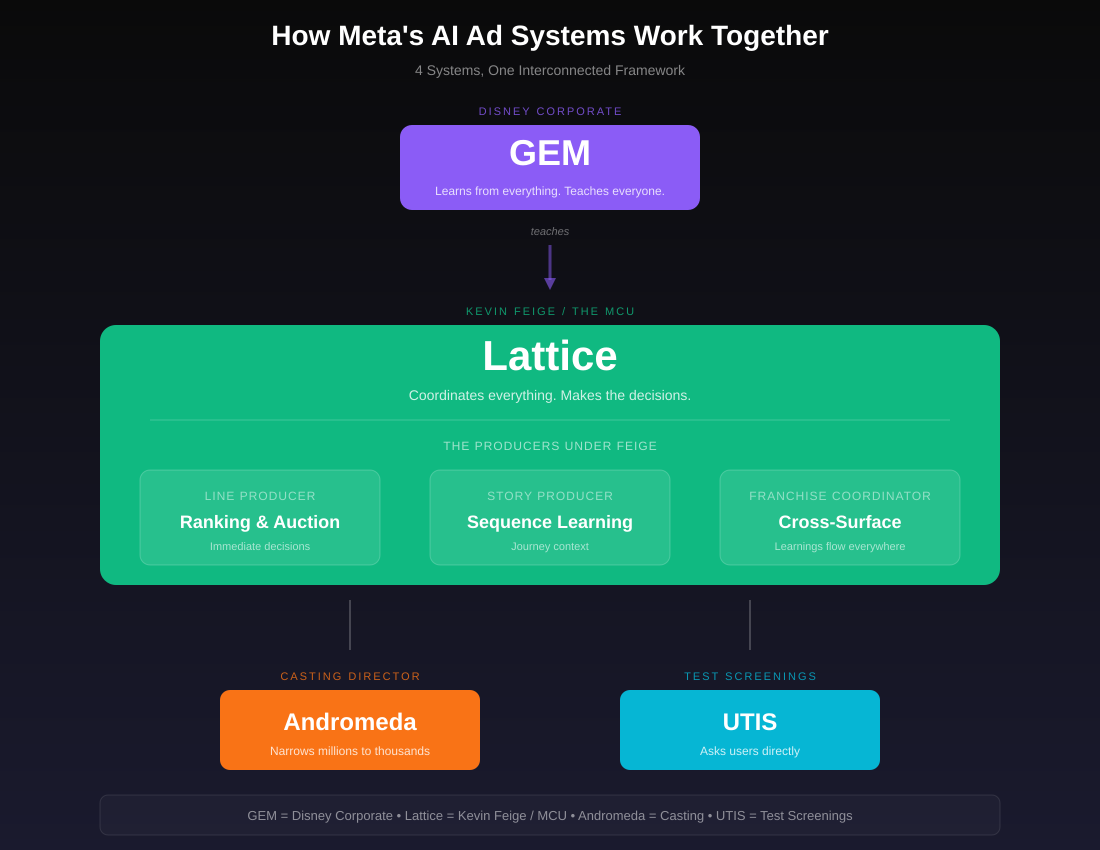
GEM sits at the top. It's not serving ads directly... it's TEACHING all the other models how to be smarter. It learns from Meta's entire ecosystem. Ads AND organic content, across ALL surfaces.
Lattice is the unified architecture that coordinates ad delivery. It's the decision-maker. It handles ranking, understands your customer journey, and ensures learnings flow between surfaces.
Andromeda is the retrieval engine that narrows millions of ads down to thousands worth considering.
UTIS is the feedback mechanism that asks users directly what they actually care about.
The Disney Analogy
Think of Meta's ad system like The Walt Disney Company:
GEM = Disney Corporate
Not Bob Iger personally. Think of the entire Disney corporate apparatus that oversees everything.
Disney doesn't just own Marvel. They own Pixar, Lucasfilm (Star Wars), Disney Animation, Disney+, ESPN, ABC, theme parks, cruise lines... the list goes on.
What makes Disney powerful isn't any single property. It's that learnings flow between ALL of them. What resonates with families at Pixar informs Disney Animation. What works on Disney+ influences theatrical release strategies. Marvel's success with interconnected storytelling influenced Star Wars.
That's GEM.
GEM is Meta's foundation model. It doesn't serve ads directly. It trains on ad content AND organic engagement from across Meta's entire ecosystem. Then it TEACHES all the downstream models what "good" looks like.
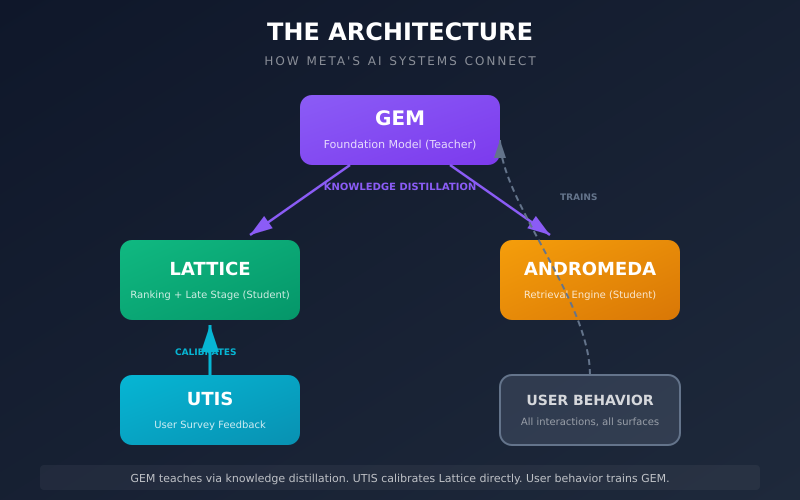
Meta calls this "knowledge distillation." GEM is the teacher. Everyone else is the student.
Lattice = Kevin Feige & The MCU
Kevin Feige is the Executive Producer who coordinates the Marvel Cinematic Universe. He doesn't run all of Disney. He runs Marvel. But within Marvel, he's the one ensuring everything connects.
That's Lattice. It's the active decision-maker that coordinates everything within Meta's ad system with the full picture in mind.
And Feige doesn't work alone. He has producers and department heads under him. Think of Lattice as having three key "producers":
Line Producer = Ranking & Auction (makes the immediate "what gets shown" decision)
Story Producer = Sequence Learning (understands where someone is in their customer journey)
When Marvel is casting a role, they don't bring every actor in Hollywood to the audition. The Casting Director looks at thousands of options, assesses fit, narrows to a shortlist worth considering. Then the Director makes the final call.
That's Andromeda. Out of tens of millions of ads, Andromeda narrows down to a few thousand candidates worth considering for you.
UTIS = Test Screenings
Marvel doesn't just look at box office numbers. They do test screenings to understand real audience satisfaction. Sometimes the numbers lie.
That's UTIS. UTIS literally asks users: "How well does this video match your interests?" on a 1-5 scale. Because watch time and engagement don't always capture what people actually care about.
Why Nobody Has Cracked It (Yet)
Let me be direct about something.
Every few months, someone posts a thread claiming they've "figured out the new algorithm." And it works... for a while. For some accounts. Under certain conditions.
Then it stops working. Or it never worked for anyone else in the first place.
Here's why: The old Meta ad system was designed in a way that COULD be cracked. The new one isn't.
The Old System (Pre-2023)
Rule-based: If you figured out the rules, you could exploit them. Siloed: Feed didn't share data with Stories. Instagram and Facebook were separate. Independent: Each optimization objective had its own model. No interconnectivity: What worked in one silo stayed in that silo.
The New System (2023-Present)
ML-driven: You can't figure out a model that's constantly retraining. Unified: Lattice consolidated hundreds of separate models into one. Interconnected: GEM learns from the ENTIRE ecosystem. Full interoperability: The systems actively teach each other.
This is why the "hacks" don't last.
When someone discovers a tactic that works, GEM sees it. GEM learns from it. GEM teaches Andromeda and Lattice what's happening. And the system adapts. Not in months. Not in weeks. In days. Sometimes hours.
And honestly? This might be a good thing. The old game rewarded whoever could exploit loopholes fastest. The new game rewards whoever can actually do good marketing.
1. GEM: Disney Corporate
Shipped: November 2025 (running since Q2 2025)
GEM stands for Generative Ads Model. "Generative" doesn't mean it's making your ads. It means the model GENERATES predictions, not content.
But more importantly... GEM doesn't serve ads directly. At all.
GEM is the foundation model that teaches everyone else.
GEM trains on: Ad content AND organic engagement (not just ads), All surfaces (Feed, Stories, Reels, Messenger, WhatsApp), All objectives (conversions, reach, engagement, awareness).
Then it TRANSFERS that knowledge to downstream models through "knowledge distillation."
The results:
5% increase in Instagram conversions
3% increase in Facebook conversions
4x more efficient than previous models
Q4 2025: Meta doubled GPUs for GEM training
2. Lattice: Kevin Feige & The MCU (Deep Dive)
Shipped: May 2023
This is the backbone. The infrastructure that connects everything within Meta's ad system. And the decision-maker that runs the show.
Lattice isn't just infrastructure. It actively makes decisions.
The results:
10% revenue improvement
11.5% user satisfaction increase
6% conversion boost
Q4 2025: 12% increase in ads quality after consolidating Facebook Stories
3. Andromeda: The Casting Director
Shipped: December 2024 (Global rollout October 2025)
Andromeda is the one everyone talks about. But most people misunderstand what it actually does.
Out of tens of millions of ads, Andromeda narrows down to a few thousand candidates that are even WORTH considering for you. Everything downstream only sees what Andromeda lets through.
Key stats from Meta:
6% recall improvement
8% ads quality improvement on selected segments
10,000x increase in model capacity for personalization
2026 guidance: Meta is tripling Andromeda's compute efficiency
4. UTIS: Test Screenings
Shipped: January 2026
This one is brand new and most people haven't heard of it yet.
UTIS = User True Interest Survey
Meta realized that engagement signals (likes, watch time, shares) don't always capture what people actually care about. So they started asking directly. They literally ask users: "How well does this video match your interests?" on a 1-5 scale.
The results:
Old heuristics: 48.3% precision
UTIS model: 63.2% precision
+5.4% increase in high satisfaction ratings
-6.84% reduction in low ratings
How GEM Learns and Teaches
Here's the critical part most people miss. This isn't a simple sequential loop. GEM is at the center of everything.
GEM learns from: All user behavior (ads and organic), all surfaces, billions of daily user-ad interactions.
GEM teaches (via knowledge distillation): Lattice, Andromeda, and all downstream models.
UTIS specifically: Calibrates Lattice's ranking decisions in the Late Stage Ranking.
GEM is too computationally expensive to serve ads directly. So Meta built a teacher-student architecture. GEM is the teacher. Lattice, Andromeda, and all the vertical models are the students. And UTIS calibrates how Lattice applies what it learned.
The New Reality: Creator Identity = Targeting
Here's something that isn't getting enough attention.
This is why partnership ads are winning. It's not just about "social proof"... it's about unlocking new entity IDs. Same angle + same format through a different creator = entirely new pockets of reach.
His key metric: First-Time Impression Ratio (FTI). What percentage of impressions are going to new users vs. repeat users? Aim for 10-20% of impressions to be truly incremental each month.
What You Should Actually Do
I'm not going to give you a "7-step playbook to beat Andromeda." That's not how this works.
Meta has their own advice: "Go broad." "Use Advantage+." "Let the AI do its thing."
Here's what Meta won't tell you: They benefit when you give them full control. More control for Meta = more auction dynamics in their favor.
I've seen accounts where broad targeting destroyed performance. I've seen accounts where manual targeting still wins. I've seen accounts where Advantage+ is magic and others where it's a money pit.
Every ad account is different. Every brand is different. Every business model is different.
YOU are the strategist. YOU are the tactician. YOU are the marketer.
The Bottom Line
It's not one thing.
It's four systems working together:
GEM (Disney Corporate) - Learns from everything, teaches all the models
Lattice (Kevin Feige / MCU) - Coordinates the ad system, makes ranking decisions
Andromeda (Casting Director) - Retrieves the right candidates from millions
UTIS (Test Screenings) - Calibrates based on real user satisfaction
The system rewards real marketing... unique selling propositions, diverse creative angles, and messages that meet people where they are in their journey.
The AI didn't break your ads. It just stopped rewarding lazy tactics.
And honestly? That's probably a good thing.
But remember: Meta's advice isn't gospel. "Go broad" isn't universal. Every account is different. Test for YOUR business, not for what worked in someone else's case study.
You're the marketer. Own it.
Component Sales
5.32K
Benchmark your ecommerce brand against industry leaders
Everyone's looking for the one thing that broke their ads.
"It's Andromeda." "It's creative fatigue." "It's the algorithm."
Here's the truth... it's not one thing. It's four things working together. And anyone telling you they've "cracked the code" is either lying, oversimplifying, or selling you a course.
David nailed it. Meta didn't roll out a single algorithm update. They built an entire AI framework... four interlocking systems that work together in ways that make the old "hacks" obsolete.
The old Meta? You could game it. Find one exploit in one silo, scale it, print money until it stopped working. Then find the next one.
The new Meta? Every system talks to every other system. Every signal informs every model. There's no single lever to pull anymore.
And if you're still running three hooks on one body of content and calling it "creative diversity"... the algorithm sees right through it.
Let me break this down simply. And more importantly, let me explain why nobody has actually cracked this yet... and why that might be a good thing.
The Four Systems
Four systems. Not five. Not one.
You might have seen "Sequence Learning" listed separately elsewhere. Here's the thing: Sequence Learning is a capability within Lattice, not a standalone system. When Meta talks about understanding the customer journey? That's Lattice doing its job.
And here's what Meta just announced in January 2026: they're tripling Andromeda's compute efficiency and doubled the GPUs for GEM training in Q4 2025. This isn't slowing down.
How These Systems Actually Work Together
Not all four systems are equal. They're not just "four updates Meta shipped." They work in a hierarchy.
GEM sits at the top. It's not serving ads directly... it's TEACHING all the other models how to be smarter. It learns from Meta's entire ecosystem. Ads AND organic content, across ALL surfaces.
Lattice is the unified architecture that coordinates ad delivery. It's the decision-maker. It handles ranking, understands your customer journey, and ensures learnings flow between surfaces.
Andromeda is the retrieval engine that narrows millions of ads down to thousands worth considering.
UTIS is the feedback mechanism that asks users directly what they actually care about.
The Disney Analogy
Think of Meta's ad system like The Walt Disney Company:
GEM = Disney Corporate
Not Bob Iger personally. Think of the entire Disney corporate apparatus that oversees everything.
Disney doesn't just own Marvel. They own Pixar, Lucasfilm (Star Wars), Disney Animation, Disney+, ESPN, ABC, theme parks, cruise lines... the list goes on.
What makes Disney powerful isn't any single property. It's that learnings flow between ALL of them. What resonates with families at Pixar informs Disney Animation. What works on Disney+ influences theatrical release strategies. Marvel's success with interconnected storytelling influenced Star Wars.
That's GEM.
GEM is Meta's foundation model. It doesn't serve ads directly. It trains on ad content AND organic engagement from across Meta's entire ecosystem. Then it TEACHES all the downstream models what "good" looks like.
Meta calls this "knowledge distillation." GEM is the teacher. Everyone else is the student.
Lattice = Kevin Feige & The MCU
Kevin Feige is the Executive Producer who coordinates the Marvel Cinematic Universe. He doesn't run all of Disney. He runs Marvel. But within Marvel, he's the one ensuring everything connects.
That's Lattice. It's the active decision-maker that coordinates everything within Meta's ad system with the full picture in mind.
And Feige doesn't work alone. He has producers and department heads under him. Think of Lattice as having three key "producers":
Line Producer = Ranking & Auction (makes the immediate "what gets shown" decision)
Story Producer = Sequence Learning (understands where someone is in their customer journey)
When Marvel is casting a role, they don't bring every actor in Hollywood to the audition. The Casting Director looks at thousands of options, assesses fit, narrows to a shortlist worth considering. Then the Director makes the final call.
That's Andromeda. Out of tens of millions of ads, Andromeda narrows down to a few thousand candidates worth considering for you.
UTIS = Test Screenings
Marvel doesn't just look at box office numbers. They do test screenings to understand real audience satisfaction. Sometimes the numbers lie.
That's UTIS. UTIS literally asks users: "How well does this video match your interests?" on a 1-5 scale. Because watch time and engagement don't always capture what people actually care about.
Why Nobody Has Cracked It (Yet)
Let me be direct about something.
Every few months, someone posts a thread claiming they've "figured out the new algorithm." And it works... for a while. For some accounts. Under certain conditions.
Then it stops working. Or it never worked for anyone else in the first place.
Here's why: The old Meta ad system was designed in a way that COULD be cracked. The new one isn't.
The Old System (Pre-2023)
Rule-based: If you figured out the rules, you could exploit them. Siloed: Feed didn't share data with Stories. Instagram and Facebook were separate. Independent: Each optimization objective had its own model. No interconnectivity: What worked in one silo stayed in that silo.
The New System (2023-Present)
ML-driven: You can't figure out a model that's constantly retraining. Unified: Lattice consolidated hundreds of separate models into one. Interconnected: GEM learns from the ENTIRE ecosystem. Full interoperability: The systems actively teach each other.
This is why the "hacks" don't last.
When someone discovers a tactic that works, GEM sees it. GEM learns from it. GEM teaches Andromeda and Lattice what's happening. And the system adapts. Not in months. Not in weeks. In days. Sometimes hours.
And honestly? This might be a good thing. The old game rewarded whoever could exploit loopholes fastest. The new game rewards whoever can actually do good marketing.
1. GEM: Disney Corporate
Shipped: November 2025 (running since Q2 2025)
GEM stands for Generative Ads Model. "Generative" doesn't mean it's making your ads. It means the model GENERATES predictions, not content.
But more importantly... GEM doesn't serve ads directly. At all.
GEM is the foundation model that teaches everyone else.
GEM trains on: Ad content AND organic engagement (not just ads), All surfaces (Feed, Stories, Reels, Messenger, WhatsApp), All objectives (conversions, reach, engagement, awareness).
Then it TRANSFERS that knowledge to downstream models through "knowledge distillation."
The results:
5% increase in Instagram conversions
3% increase in Facebook conversions
4x more efficient than previous models
Q4 2025: Meta doubled GPUs for GEM training
2. Lattice: Kevin Feige & The MCU (Deep Dive)
Shipped: May 2023
This is the backbone. The infrastructure that connects everything within Meta's ad system. And the decision-maker that runs the show.
Lattice isn't just infrastructure. It actively makes decisions.
The results:
10% revenue improvement
11.5% user satisfaction increase
6% conversion boost
Q4 2025: 12% increase in ads quality after consolidating Facebook Stories
3. Andromeda: The Casting Director
Shipped: December 2024 (Global rollout October 2025)
Andromeda is the one everyone talks about. But most people misunderstand what it actually does.
Out of tens of millions of ads, Andromeda narrows down to a few thousand candidates that are even WORTH considering for you. Everything downstream only sees what Andromeda lets through.
Key stats from Meta:
6% recall improvement
8% ads quality improvement on selected segments
10,000x increase in model capacity for personalization
2026 guidance: Meta is tripling Andromeda's compute efficiency
4. UTIS: Test Screenings
Shipped: January 2026
This one is brand new and most people haven't heard of it yet.
UTIS = User True Interest Survey
Meta realized that engagement signals (likes, watch time, shares) don't always capture what people actually care about. So they started asking directly. They literally ask users: "How well does this video match your interests?" on a 1-5 scale.
The results:
Old heuristics: 48.3% precision
UTIS model: 63.2% precision
+5.4% increase in high satisfaction ratings
-6.84% reduction in low ratings
How GEM Learns and Teaches
Here's the critical part most people miss. This isn't a simple sequential loop. GEM is at the center of everything.
GEM learns from: All user behavior (ads and organic), all surfaces, billions of daily user-ad interactions.
GEM teaches (via knowledge distillation): Lattice, Andromeda, and all downstream models.
UTIS specifically: Calibrates Lattice's ranking decisions in the Late Stage Ranking.
GEM is too computationally expensive to serve ads directly. So Meta built a teacher-student architecture. GEM is the teacher. Lattice, Andromeda, and all the vertical models are the students. And UTIS calibrates how Lattice applies what it learned.
The New Reality: Creator Identity = Targeting
Here's something that isn't getting enough attention.
This is why partnership ads are winning. It's not just about "social proof"... it's about unlocking new entity IDs. Same angle + same format through a different creator = entirely new pockets of reach.
His key metric: First-Time Impression Ratio (FTI). What percentage of impressions are going to new users vs. repeat users? Aim for 10-20% of impressions to be truly incremental each month.
What You Should Actually Do
I'm not going to give you a "7-step playbook to beat Andromeda." That's not how this works.
Meta has their own advice: "Go broad." "Use Advantage+." "Let the AI do its thing."
Here's what Meta won't tell you: They benefit when you give them full control. More control for Meta = more auction dynamics in their favor.
I've seen accounts where broad targeting destroyed performance. I've seen accounts where manual targeting still wins. I've seen accounts where Advantage+ is magic and others where it's a money pit.
Every ad account is different. Every brand is different. Every business model is different.
YOU are the strategist. YOU are the tactician. YOU are the marketer.
The Bottom Line
It's not one thing.
It's four systems working together:
GEM (Disney Corporate) - Learns from everything, teaches all the models
Lattice (Kevin Feige / MCU) - Coordinates the ad system, makes ranking decisions
Andromeda (Casting Director) - Retrieves the right candidates from millions
UTIS (Test Screenings) - Calibrates based on real user satisfaction
The system rewards real marketing... unique selling propositions, diverse creative angles, and messages that meet people where they are in their journey.
The AI didn't break your ads. It just stopped rewarding lazy tactics.
And honestly? That's probably a good thing.
But remember: Meta's advice isn't gospel. "Go broad" isn't universal. Every account is different. Test for YOUR business, not for what worked in someone else's case study.
You're the marketer. Own it.
Share
Bryant Garvin
Bryant Garvin is Operator in Residence at Triple Whale. Previously Head of Growth at Ozlo Sleep, CMO at Groove Life and early Director of Marketing at Purple. He writes about what actually works in ecommerce growth, not the vibes.
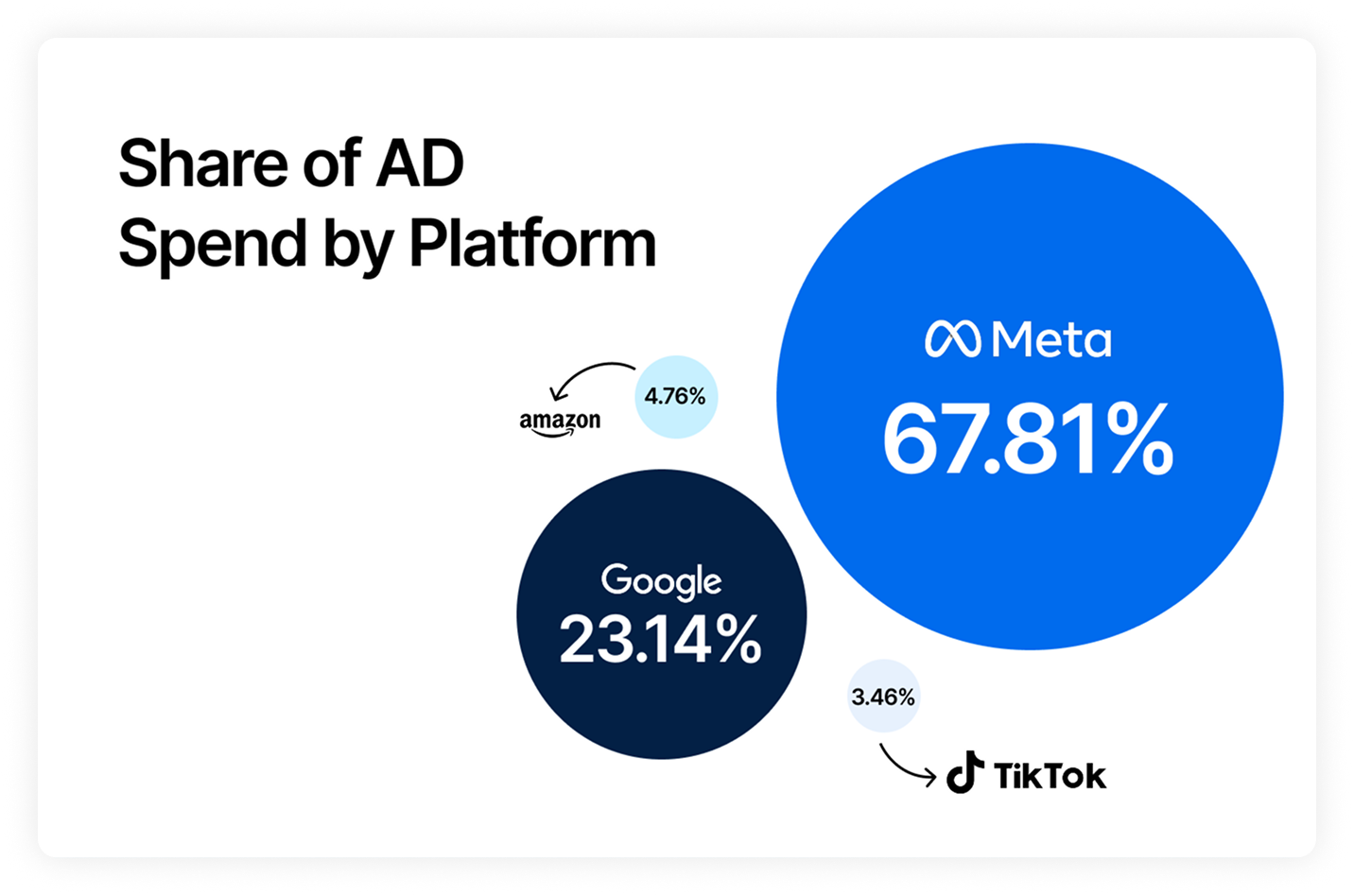
Body Copy: The following benchmarks compare advertising metrics from April 1-17 to the previous period. Considering President Trump first unveiled his tariffs on April 2, the timing corresponds with potential changes in advertising behavior among ecommerce brands (though it isn’t necessarily correlated).


 Moby AIAsk questions, analyze performance, and work with your business context.
 ActionsTake governed action across the tools that run your business.
 AutomationsSchedule recurring analysis and work that runs on your terms.
 Landing PagesCreative conversion-focused ecommerce pages with Moby.
 Creative StudioGenerate and refine creative grounded in your brand.








.webp)

.webp)
