Ecommerce has moved from mobile-friendly websites and faster checkouts to AI tools that help people find, compare, and buy products online. For many brands, AI is already part of daily work. More than 80% of retail and consumer packaged goods (CPG) companies use or are testing generative AI.
Customer support is one clear example. Among brands already using conversational AI, 96% use it for customer support. Beyond answering customer questions, 67% of retailers use AI to create marketing and ad content.
Businesses also use AI to suggest products and predict how much stock they need. These tools can help brands turn more visits into sales, keep customers, and save time. But getting value from AI takes more than adding a new tool.
This article covers the different types of AI for ecommerce. It also explores practical use cases, best practices, benefits, risks, and what’s next as AI becomes a bigger part of how brands operate.
Key Takeaways
What’s changed: Ecommerce brands now use AI to handle more daily tasks, beyond chatbots and tailored shopping experiences. They also focus on AI Visibility: helping shoppers find their products and get suggestions through tools like ChatGPT or Perplexity.
Why it matters now: More shoppers research and buy products in AI chats instead of using a search bar or visiting a store’s website.
Where to start: Choose a starting point that fits your business. You could use an AI assistant for daily tasks, bring scattered data together, or test AI in one area. Start with one task you can manage before adding more.
4 types of AI in ecommerce
AI includes several types of technology. These four are among the most common in ecommerce.
1. Natural language processing (NLP)
Natural language processing helps computers understand the language people speak and write. It lets them read or listen to a request and respond in human language.
Examples of NLP applications:
Customer support chatbots: Answering questions like “How do I return this?” with useful advice.
Product search: Understanding requests like “a lightweight jacket for rainy hikes” to find products that fit.
Customer review analysis: Spotting positive or negative feedback and common issues, such as sizing or delivery delays.
Language translation: Translating product details and customer messages so brands can serve shoppers in different languages.
2. Generative AI
Generative AI creates new content, such as audio, code, images, text, simulations, and videos. These models learn from large amounts of data and use what they learn to create a response.
Example tools using generative AI:
Triple Whale’s Moby: Creating and editing ads from plain-language requests. For example, it can place a product in a new setting or make versions of an existing ad.
Claude: Drafting product descriptions, marketing emails, and ad copy.
Midjourney: Creating images from text prompts to help teams explore campaign ideas.
Runway: Creating video clips from text prompts or images for ads and social content.
3. Machine learning (ML)
Machine Learning (ML) helps computers learn from data and improve a task. As they learn from new data, their results can become more accurate. Traditional ML needs experts to prepare the data and guide how the model learns.
Example tools using ML:
Klaviyo predictive analytics: Predicting when a customer may order again so brands can time follow-up messages.
Stripe Radar: Spotting patterns in payment data that may point to fraud.
Amazon Personalize: Suggesting products based on what a customer does and likes.
4. Deep learning
Deep Learning is a type of machine learning. It uses artificial neural networks inspired by how the human brain works. These networks learn patterns from data. They can solve many kinds of problems, such as sorting items into groups and learning which details matter.
Examples of deep learning tools:
Google Lens: Helping shoppers find products with photos instead of a written description.
Amazon Rekognition: Finding objects in images and flagging content in customer uploads that may be inappropriate.
Amazon Transcribe: Turning support calls into text so teams can review them and spot common issues.
AI use cases in ecommerce
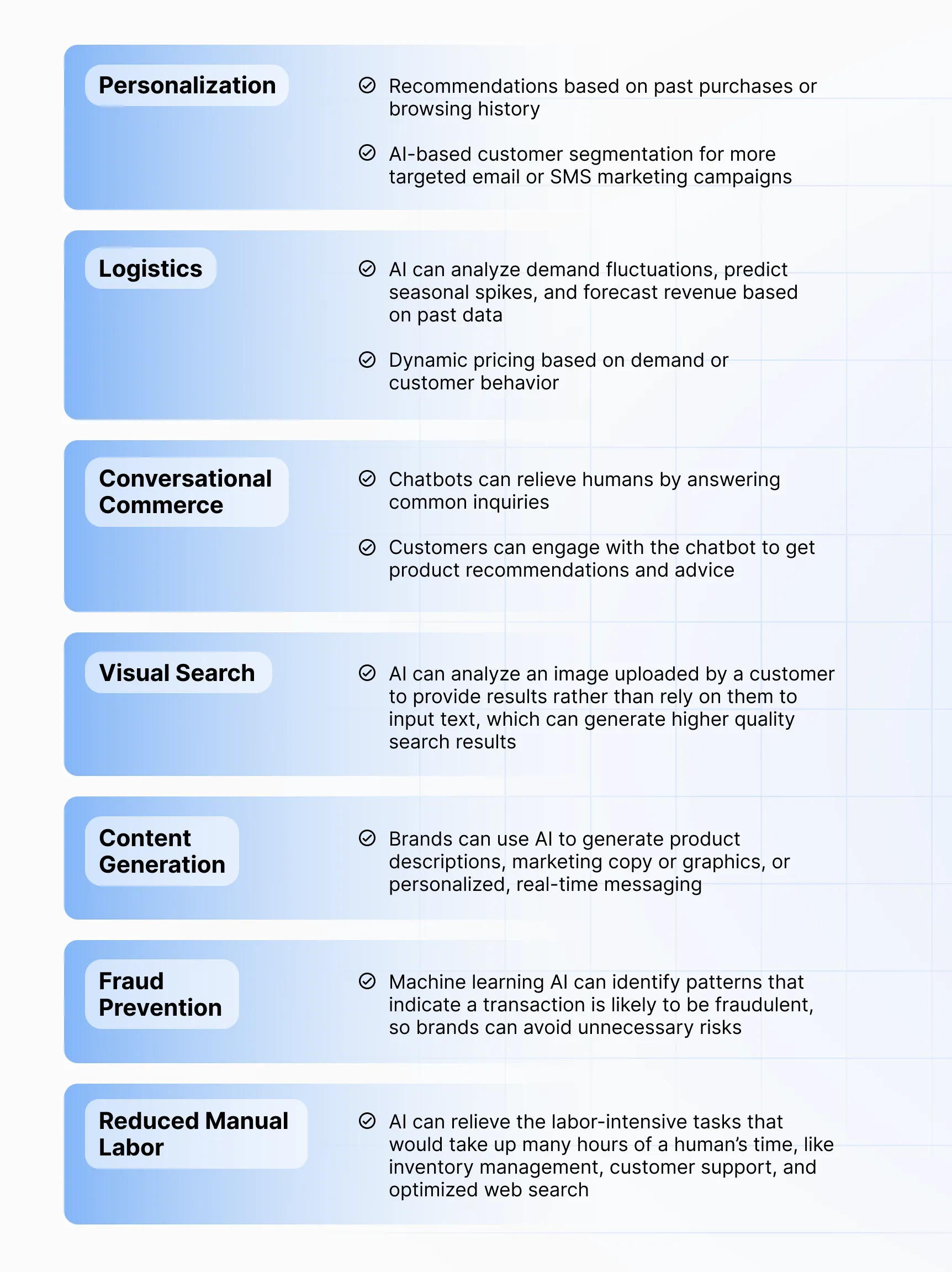
Ecommerce brands can use the AI types described above for many tasks. Here, we’ll cover some of the main applications for AI in ecommerce:
Personalization
Customer data helps brands understand their shoppers. The more you know about a customer, the more you can tailor their shopping experience.
Product recommendations
AI can study which ads lead to a sale and the steps a shopper takes before buying. Brands can use this information to make buying easier and also suggest products based on past orders and browsing history.
Brands can increase sales by suggesting related items (cross-selling) or higher-priced options (upselling).
Marketing and email automation
AI for ecommerce can study how customers interact with a brand to predict the best time to send an email and drive a sale. It can also group similar customers to help brands reach the right people with each campaign.
For example, Triple Whale’s Sonar Sendand Sonar Optimizeuse AI to decide which channel, message, and moment will actually convert a given customer, then activate that decision automatically across email, SMS, and paid social.
Logistics and forecasts
A reliable supply chain helps brands deliver a smooth shopper experience. AI helps teams plan for changes, such as a jump in demand at launch or a shipment that may fall short. Brands can then act before problems affect customers.
Managing stock
AI analyzes demand changes to help brands decide how much stock to keep. It can flag when more stock may be needed to avoid running out.
AI can also spot items that sell too slowly, helping brands avoid overbuying. Reliable forecasts help teams manage stock and plan their supply chain.
Predicting seasonal demand
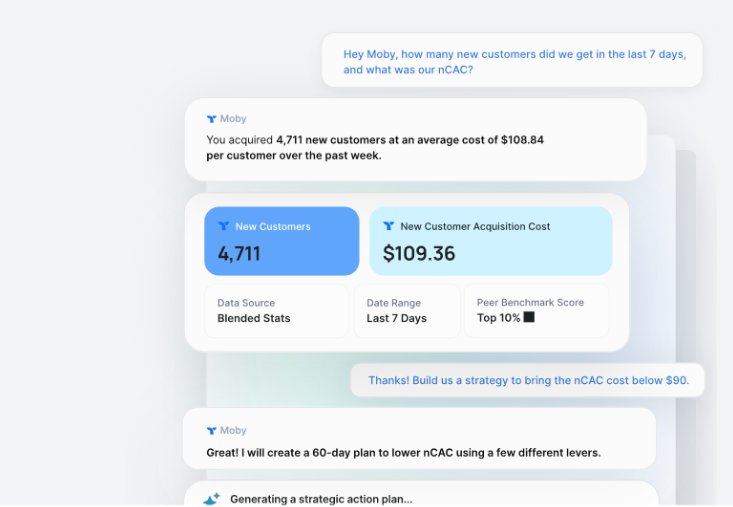
AI uses historical and real-time data to anticipate and predict busy seasons. This helps brands prepare for rising demand. With Triple Whale’s Moby, a simple question about anticipated revenue can generate a forecast for the year ahead.
Adjusting prices
Ecommerce brands can use AI to change product prices based on demand, shopper behavior, or competitors’ prices. This is called dynamic pricing. It can help brands earn more during busy periods and stay competitive when fewer people are shopping.
Conversational commerce
Chatbots have changed the game for ecommerce. They offer 24/7 customer support, giving shoppers quick answers and reducing work for support teams. As AI improves, chatbots can also collect customer data and handle simple tasks like orders and refunds.
Visual search
Visual search lets shoppers use pictures instead of words. They can upload an image or screenshot of an item they want. AI studies the image and finds similar products.
Some benefits of visual search include:
Faster searches. Shoppers can show the item they want instead of describing it.
New ideas. Visual search can help shoppers find products they didn’t know about. This is especially useful for fashion brands, where shoppers may find styles they would have missed.
Easier comparisons. On a marketplace site, shoppers can compare similar items from different brands.
Creating content
With AI, ecommerce brands can generate content like text, product descriptions, marketing content, and more. It can greatly cut the time teams spend on writing and other creative work. But human oversight is still necessary to ensure the content is high-quality.
Fraud prevention
AI can review purchase data to spot possible fraud. It checks details such as order cost, what the customer has bought before, and how often they buy it. It can also compare shipping and billing details, with any differences pointing to possible identity theft.
Less manual labor
Brands can save time on these tasks by using AI, especially repetitive work. It can help manage stock, answer customer questions, improve web search, and suggest products for each shopper.
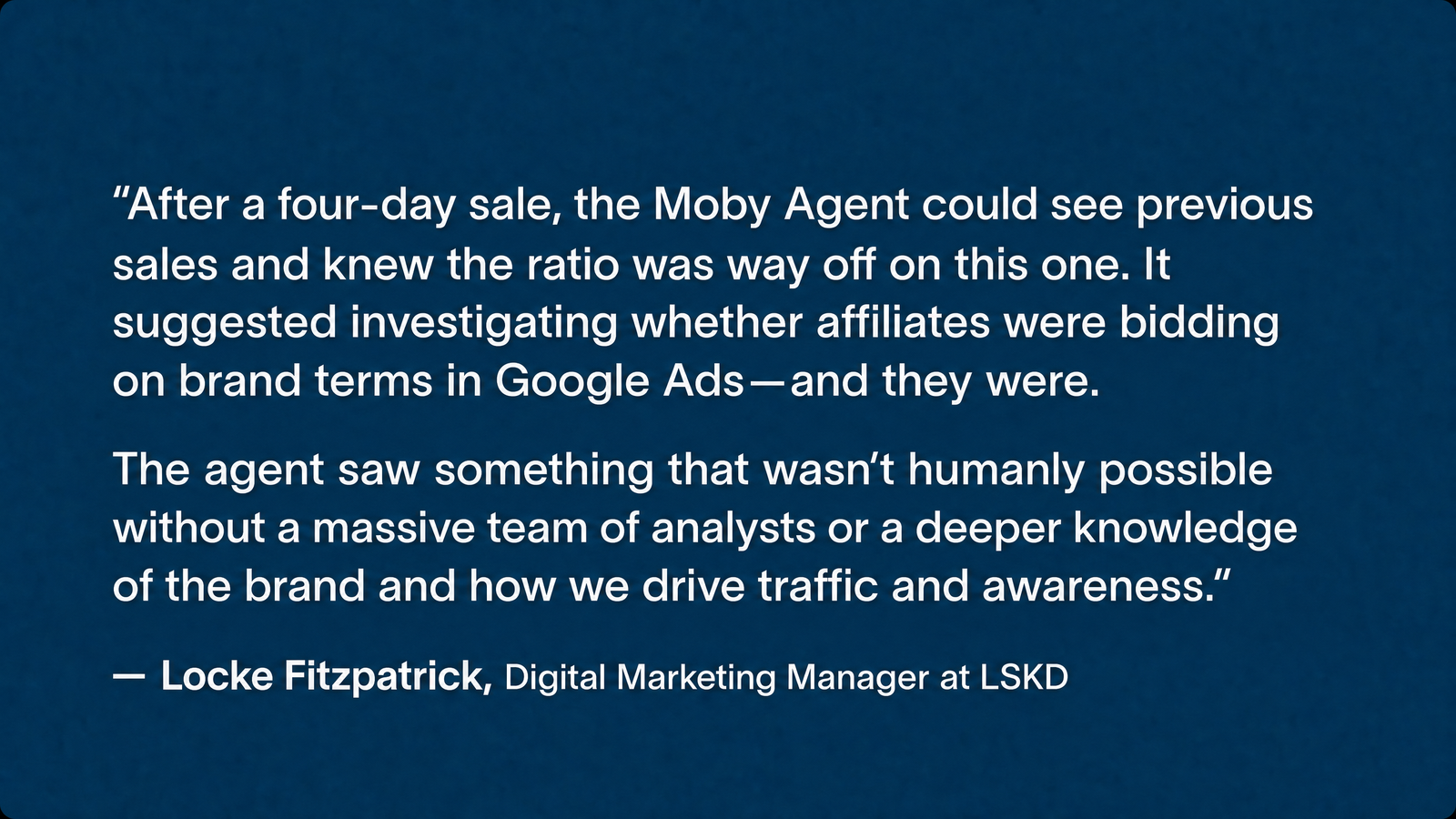
Many of these tools help customers directly. AI can also reduce work behind the scenes. LSKD used AI to catch more than $100,000 in affiliate fraud while lifting ROAS by 40% without spending more on ads.
Benefits of AI for ecommerce
These uses of AI can help ecommerce brands in several ways.
Increased sales
Sales data can help you tailor the steps a shopper takes before buying and turn more visits into sales. Simba Sleep improved their return on ad spend (ROAS) by 30% on their Meta ads by using Triple Whale’s RFM (Recency, Frequency, Monetary Value) audiences to better target their high-value customers. They synchronized the audience created via Triple Whale’s AI algorithm to Meta, created a lookalike audience, and were able to generate a boost in sales.
Improved operational efficiency
By using AI tools for ecommerce, like Triple Whale’s Summary Page, ecommerce brands can significantly improve efficiency and make more strategic decisions. Origin was able to recover 40% of their Business Analytics team’s time by utilizing Triple Whale, allowing them to focus on other parts of the business.
Happier customers
AI customer support is available 24/7, so shoppers can get help anytime. This can improve their experience.
Quick answers help customers feel seen and heard. As shoppers use support bots more, the AI gets better at answering their questions. Useful product suggestions and offers tailored to each shopper can also keep them engaged and encourage them to return.
Drawbacks and risks of AI for ecommerce
While AI offers many benefits for ecommerce, it also carries risks. Below are a few drawbacks and potential solutions to mitigate them.
1. Security concerns
AI systems can use large amounts of customer data, including personal, financial, or medical details. This raises privacy and data security concerns.
Online stores collect names, addresses, order histories, and payment details. If this data isn’t secure and AI tools can access it, brands risk data breaches or identity theft.
How to reduce security risks:
Store all data used by your AI system securely
Use encryption to protect data and check security regularly
Limit who can access sensitive data
2. Ethical concerns
AI can create a lifelike video, write a fake five-star review, or produce a finished image in seconds. This raises concerns for brands: how AI content can mislead people and who owns the work it helps create.
Misleading content
Concerns exist about AI generating deepfakes: fake images or videos that look real. These often feature celebrities and make it seem as though they’ve said things they haven’t. Without careful review, AI content can mislead shoppers. False claims and fake customer reviews can get brands into trouble and damage trust.
Creativity and ownership
Someone can create digital art by typing a prompt into an AI system. But who owns the result? Concerns remain that the data used to train AI copies artists’ work without permission. Laws have struggled to keep up with AI, so clearer rules are needed to define ownership.
3. Data biases
Because algorithms are trained on historical data, they carry an inherent risk of bias. Data may be biased if it was collected poorly or doesn’t reflect a wide range of people. This can lead to mistakes, such as suggesting products to the wrong shoppers.
How to reduce ethical risks:
Be aware of the potential for manipulated content
Don’t create false reviews for your products, as it will cause customers to lose trust
Stay up to date with current legislation to ensure you are operating in legal compliance
Ensure you have diverse and representative data, and implement bias-aware algorithms
4. Job displacement in AI for ecommerce
As AI improves, it may replace more jobs in customer service, warehouses, or marketing. AI is good at studying data and predicting trends, but people still need to check its work. In the future, it may be able to handle ecommerce tasks on its own, which could leave more people without work.
How to reduce the risk of job losses:
Use AI to complement human activity, and not as a replacement
Train employees on how to use AI to support their job functions
What’s next in AI and ecommerce
The "future trends" from a couple of years ago — hyper-personalization, AI-generated content, visual search, dynamic pricing — are already table stakes. Brands that haven't adopted them are behind, not ahead. Here's what's actually next in AI and ecommerce.
Trend
What It Means
What It Looks Like
Agentic Commerce
AI agents research and complete purchases on a shopper's behalf, inside ChatGPT, Perplexity, or a brand's own AI assistant.
In-chat checkout; AI agents comparison shopping across brands from a single prompt; products need clean, structured feed data to even be considered.
AI Visibility as a Core Marketing Discipline
Being cited and recommended by AI models becomes as important as ranking in Google.
Brands tracking mention share and sentiment across ChatGPT, Claude, Gemini, and Perplexity; content built to answer the exact comparison questions AI models are asked.
Multi-Agent Operations
Instead of one chatbot, brands run a coordinated set of AI agents, each handling a specific job, with humans approving key decisions.
Recurring automations that check campaigns and queue changes for review; agents that hand work to each other, forecasting feed inventory, inventory feeding purchase orders.
Attribution and Incrementality Converge
Brands stop trusting a single attribution model and validate spend against modeled, incremental impact instead.
Marketing mix modeling and geo-testing running alongside pixel-based attribution; budget decisions backed by a confidence score, not one ROAS number.
Agentic commerce
Shopping is starting to happen inside AI conversations, not just on a website. Shoppers can already research and complete some purchases directly inside tools like ChatGPT, and that surface will keep expanding.
For ecommerce brands, this means product data, reviews, and pricing all need to be accurate and structured enough for an AI agent to act on confidently, because the agent, not a human, may be the one clicking "buy."
AI Visibility as a core marketing discipline
SEO isn't disappearing, but it's no longer the only discovery channel that matters. Brands now need to know how often they show up when someone asks ChatGPT or Perplexity a shopping question, and whether the answer is even accurate. Expect AI Visibility tracking to become as standard as web analytics within the next couple of years, not a specialty tool a handful of brands run.
Multi-agent operations
Instead of a single assistant answering questions, brands are running coordinated sets of agents, each owning a job: one drilling into forecasting, one watching ad accounts, one flagging creative fatigue. Triple Whale's Moby Automations is one example. A marketer describes a workflow in plain language, like pausing any Meta ad that spends $150 without a sale, and Moby builds and runs it, then queues the recommended action for a human to approve. The work doesn't disappear. Where a person spends their time does.
Attribution and incrementality converge
Pixel-based attribution alone has always had blind spots, and more brands are pairing it with marketing mix modeling and geo-based incrementality testing to see what's actually driving growth versus what's just getting credit. Expect fewer brands treating a single ROAS number as gospel, and more treating it as one input into a confidence-scored decision.
How to get started with AI in ecommerce today
You don’t need to introduce AI across your whole business at once. Start with one thing you want to make easier, then build from there.
Choose a task worth improving. Look for something that takes up time or causes frustration for you, your team, or your customers. It could be writing emails or answering repeat questions.
Find a tool that fits the need. That might be a general AI assistant or a tool built for a specific job. Check the AI features in software you already use first.
Run a small test. Try drafting one email or preparing answers to a few common questions before changing an entire workflow.
Review the results. Check for mistakes and ask whether the tool actually saves time or improves the work. Keep a person involved in reviewing the output.
Expand when you’re ready. Keep what works, adjust what doesn’t, and try another task once you feel comfortable.
Outcast took this gradual approach with AI. Initially unsure how much to trust it, the team focused on automating one task per month and validating the results. You don’t need to move faster than you can confidently review.
Conclusion
Advancements in AI for ecommerce continue to enhance a brand’s ability to streamline operations, generate content, personalize marketing campaigns, and get discovered in the first place, whether that’s a Google search or a ChatGPT answer.
While there are significant benefits to using AI for ecommerce, including driving revenue and enhanced customer satisfaction, brands should also be aware of the drawbacks: security and ethical concerns, data biases, and potential job displacement. By adopting AI tools for ecommerce responsibly and strategically, ecommerce brands can make significant advances in their marketing efforts and drive revenue.
Ready to see where you stand? Book a demo to see how Moby can work with your own store’s data.
How can ecommerce brands use AI to increase sales?
AI can analyze customer purchase history and browsing behavior to generate personalized product recommendations, power dynamic pricing strategies, and create targeted marketing campaigns.
What are the most common AI use cases in ecommerce?
The most widely used applications include AI chatbots for customer service, personalization engines, inventory forecasting, fraud detection, visual search, and AI-powered content generation for product descriptions and marketing.
How do AI chatbots benefit ecommerce stores?
AI chatbots provide 24/7 customer support, answer product questions in real time, suggest relevant items, and can even handle simple transactions like orders and refunds, reducing the load on human support teams.
Component Sales
5.32K
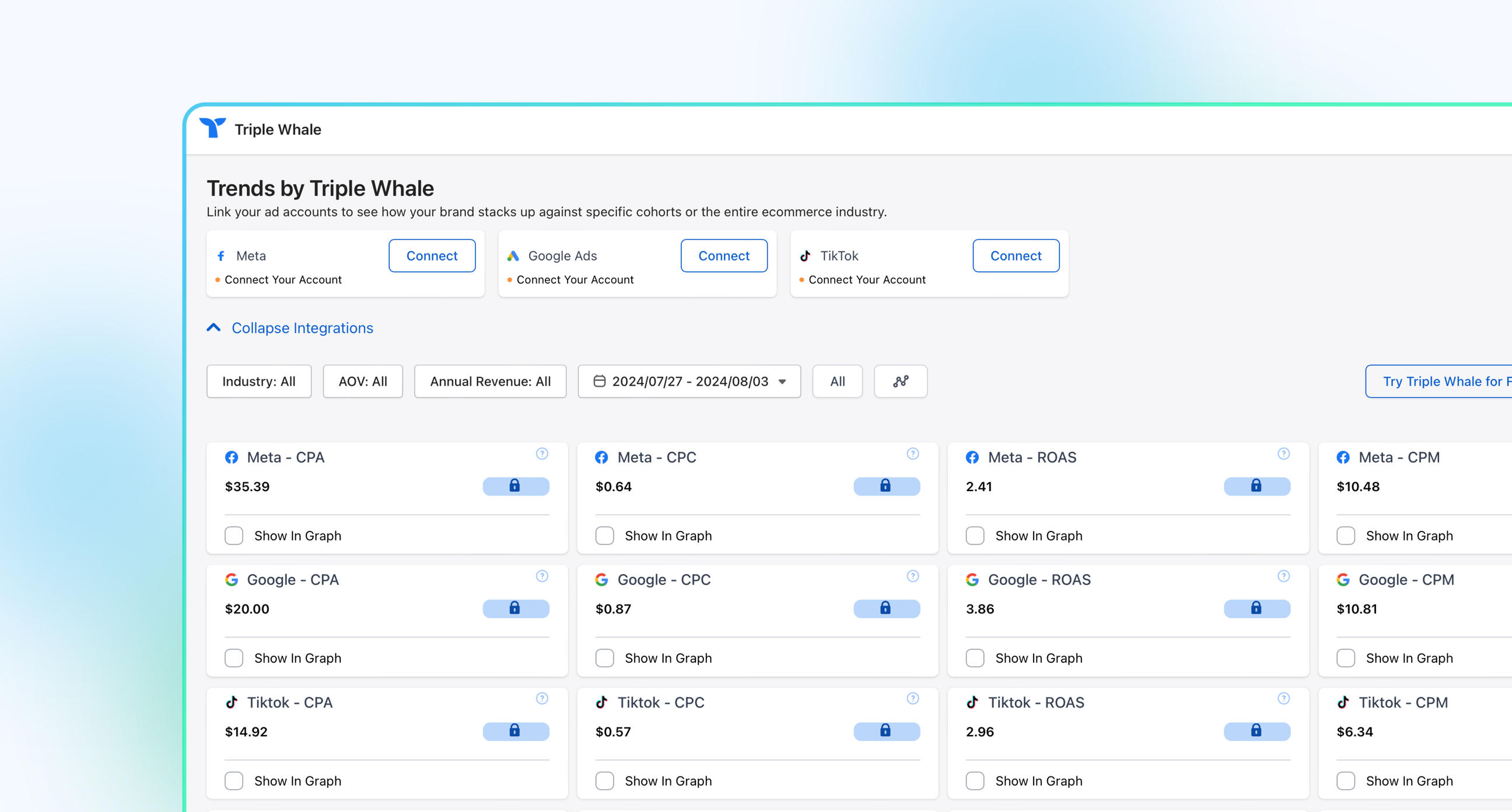
Benchmark your ecommerce brand against industry leaders
Ecommerce has moved from mobile-friendly websites and faster checkouts to AI tools that help people find, compare, and buy products online. For many brands, AI is already part of daily work. More than 80% of retail and consumer packaged goods (CPG) companies use or are testing generative AI.
Customer support is one clear example. Among brands already using conversational AI, 96% use it for customer support. Beyond answering customer questions, 67% of retailers use AI to create marketing and ad content.
Businesses also use AI to suggest products and predict how much stock they need. These tools can help brands turn more visits into sales, keep customers, and save time. But getting value from AI takes more than adding a new tool.
This article covers the different types of AI for ecommerce. It also explores practical use cases, best practices, benefits, risks, and what’s next as AI becomes a bigger part of how brands operate.
Key Takeaways
What’s changed: Ecommerce brands now use AI to handle more daily tasks, beyond chatbots and tailored shopping experiences. They also focus on AI Visibility: helping shoppers find their products and get suggestions through tools like ChatGPT or Perplexity.
Why it matters now: More shoppers research and buy products in AI chats instead of using a search bar or visiting a store’s website.
Where to start: Choose a starting point that fits your business. You could use an AI assistant for daily tasks, bring scattered data together, or test AI in one area. Start with one task you can manage before adding more.
4 types of AI in ecommerce
AI includes several types of technology. These four are among the most common in ecommerce.
1. Natural language processing (NLP)
Natural language processing helps computers understand the language people speak and write. It lets them read or listen to a request and respond in human language.
Examples of NLP applications:
Customer support chatbots: Answering questions like “How do I return this?” with useful advice.
Product search: Understanding requests like “a lightweight jacket for rainy hikes” to find products that fit.
Customer review analysis: Spotting positive or negative feedback and common issues, such as sizing or delivery delays.
Language translation: Translating product details and customer messages so brands can serve shoppers in different languages.
2. Generative AI
Generative AI creates new content, such as audio, code, images, text, simulations, and videos. These models learn from large amounts of data and use what they learn to create a response.
Example tools using generative AI:
Triple Whale’s Moby: Creating and editing ads from plain-language requests. For example, it can place a product in a new setting or make versions of an existing ad.
Claude: Drafting product descriptions, marketing emails, and ad copy.
Midjourney: Creating images from text prompts to help teams explore campaign ideas.
Runway: Creating video clips from text prompts or images for ads and social content.
3. Machine learning (ML)
Machine Learning (ML) helps computers learn from data and improve a task. As they learn from new data, their results can become more accurate. Traditional ML needs experts to prepare the data and guide how the model learns.
Example tools using ML:
Klaviyo predictive analytics: Predicting when a customer may order again so brands can time follow-up messages.
Stripe Radar: Spotting patterns in payment data that may point to fraud.
Amazon Personalize: Suggesting products based on what a customer does and likes.
4. Deep learning
Deep Learning is a type of machine learning. It uses artificial neural networks inspired by how the human brain works. These networks learn patterns from data. They can solve many kinds of problems, such as sorting items into groups and learning which details matter.
Examples of deep learning tools:
Google Lens: Helping shoppers find products with photos instead of a written description.
Amazon Rekognition: Finding objects in images and flagging content in customer uploads that may be inappropriate.
Amazon Transcribe: Turning support calls into text so teams can review them and spot common issues.
AI use cases in ecommerce
Ecommerce brands can use the AI types described above for many tasks. Here, we’ll cover some of the main applications for AI in ecommerce:
Personalization
Customer data helps brands understand their shoppers. The more you know about a customer, the more you can tailor their shopping experience.
Product recommendations
AI can study which ads lead to a sale and the steps a shopper takes before buying. Brands can use this information to make buying easier and also suggest products based on past orders and browsing history.
Brands can increase sales by suggesting related items (cross-selling) or higher-priced options (upselling).
Marketing and email automation
AI for ecommerce can study how customers interact with a brand to predict the best time to send an email and drive a sale. It can also group similar customers to help brands reach the right people with each campaign.
For example, Triple Whale’s Sonar Sendand Sonar Optimizeuse AI to decide which channel, message, and moment will actually convert a given customer, then activate that decision automatically across email, SMS, and paid social.
Logistics and forecasts
A reliable supply chain helps brands deliver a smooth shopper experience. AI helps teams plan for changes, such as a jump in demand at launch or a shipment that may fall short. Brands can then act before problems affect customers.
Managing stock
AI analyzes demand changes to help brands decide how much stock to keep. It can flag when more stock may be needed to avoid running out.
AI can also spot items that sell too slowly, helping brands avoid overbuying. Reliable forecasts help teams manage stock and plan their supply chain.
Predicting seasonal demand
AI uses historical and real-time data to anticipate and predict busy seasons. This helps brands prepare for rising demand. With Triple Whale’s Moby, a simple question about anticipated revenue can generate a forecast for the year ahead.
Adjusting prices
Ecommerce brands can use AI to change product prices based on demand, shopper behavior, or competitors’ prices. This is called dynamic pricing. It can help brands earn more during busy periods and stay competitive when fewer people are shopping.
Conversational commerce
Chatbots have changed the game for ecommerce. They offer 24/7 customer support, giving shoppers quick answers and reducing work for support teams. As AI improves, chatbots can also collect customer data and handle simple tasks like orders and refunds.
Visual search
Visual search lets shoppers use pictures instead of words. They can upload an image or screenshot of an item they want. AI studies the image and finds similar products.
Some benefits of visual search include:
Faster searches. Shoppers can show the item they want instead of describing it.
New ideas. Visual search can help shoppers find products they didn’t know about. This is especially useful for fashion brands, where shoppers may find styles they would have missed.
Easier comparisons. On a marketplace site, shoppers can compare similar items from different brands.
Creating content
With AI, ecommerce brands can generate content like text, product descriptions, marketing content, and more. It can greatly cut the time teams spend on writing and other creative work. But human oversight is still necessary to ensure the content is high-quality.
Fraud prevention
AI can review purchase data to spot possible fraud. It checks details such as order cost, what the customer has bought before, and how often they buy it. It can also compare shipping and billing details, with any differences pointing to possible identity theft.
Less manual labor
Brands can save time on these tasks by using AI, especially repetitive work. It can help manage stock, answer customer questions, improve web search, and suggest products for each shopper.
Many of these tools help customers directly. AI can also reduce work behind the scenes. LSKD used AI to catch more than $100,000 in affiliate fraud while lifting ROAS by 40% without spending more on ads.
Benefits of AI for ecommerce
These uses of AI can help ecommerce brands in several ways.
Increased sales
Sales data can help you tailor the steps a shopper takes before buying and turn more visits into sales. Simba Sleep improved their return on ad spend (ROAS) by 30% on their Meta ads by using Triple Whale’s RFM (Recency, Frequency, Monetary Value) audiences to better target their high-value customers. They synchronized the audience created via Triple Whale’s AI algorithm to Meta, created a lookalike audience, and were able to generate a boost in sales.
Improved operational efficiency
By using AI tools for ecommerce, like Triple Whale’s Summary Page, ecommerce brands can significantly improve efficiency and make more strategic decisions. Origin was able to recover 40% of their Business Analytics team’s time by utilizing Triple Whale, allowing them to focus on other parts of the business.
Happier customers
AI customer support is available 24/7, so shoppers can get help anytime. This can improve their experience.
Quick answers help customers feel seen and heard. As shoppers use support bots more, the AI gets better at answering their questions. Useful product suggestions and offers tailored to each shopper can also keep them engaged and encourage them to return.
Drawbacks and risks of AI for ecommerce
While AI offers many benefits for ecommerce, it also carries risks. Below are a few drawbacks and potential solutions to mitigate them.
1. Security concerns
AI systems can use large amounts of customer data, including personal, financial, or medical details. This raises privacy and data security concerns.
Online stores collect names, addresses, order histories, and payment details. If this data isn’t secure and AI tools can access it, brands risk data breaches or identity theft.
How to reduce security risks:
Store all data used by your AI system securely
Use encryption to protect data and check security regularly
Limit who can access sensitive data
2. Ethical concerns
AI can create a lifelike video, write a fake five-star review, or produce a finished image in seconds. This raises concerns for brands: how AI content can mislead people and who owns the work it helps create.
Misleading content
Concerns exist about AI generating deepfakes: fake images or videos that look real. These often feature celebrities and make it seem as though they’ve said things they haven’t. Without careful review, AI content can mislead shoppers. False claims and fake customer reviews can get brands into trouble and damage trust.
Creativity and ownership
Someone can create digital art by typing a prompt into an AI system. But who owns the result? Concerns remain that the data used to train AI copies artists’ work without permission. Laws have struggled to keep up with AI, so clearer rules are needed to define ownership.
3. Data biases
Because algorithms are trained on historical data, they carry an inherent risk of bias. Data may be biased if it was collected poorly or doesn’t reflect a wide range of people. This can lead to mistakes, such as suggesting products to the wrong shoppers.
How to reduce ethical risks:
Be aware of the potential for manipulated content
Don’t create false reviews for your products, as it will cause customers to lose trust
Stay up to date with current legislation to ensure you are operating in legal compliance
Ensure you have diverse and representative data, and implement bias-aware algorithms
4. Job displacement in AI for ecommerce
As AI improves, it may replace more jobs in customer service, warehouses, or marketing. AI is good at studying data and predicting trends, but people still need to check its work. In the future, it may be able to handle ecommerce tasks on its own, which could leave more people without work.
How to reduce the risk of job losses:
Use AI to complement human activity, and not as a replacement
Train employees on how to use AI to support their job functions
What’s next in AI and ecommerce
The "future trends" from a couple of years ago — hyper-personalization, AI-generated content, visual search, dynamic pricing — are already table stakes. Brands that haven't adopted them are behind, not ahead. Here's what's actually next in AI and ecommerce.
Trend
What It Means
What It Looks Like
Agentic Commerce
AI agents research and complete purchases on a shopper's behalf, inside ChatGPT, Perplexity, or a brand's own AI assistant.
In-chat checkout; AI agents comparison shopping across brands from a single prompt; products need clean, structured feed data to even be considered.
AI Visibility as a Core Marketing Discipline
Being cited and recommended by AI models becomes as important as ranking in Google.
Brands tracking mention share and sentiment across ChatGPT, Claude, Gemini, and Perplexity; content built to answer the exact comparison questions AI models are asked.
Multi-Agent Operations
Instead of one chatbot, brands run a coordinated set of AI agents, each handling a specific job, with humans approving key decisions.
Recurring automations that check campaigns and queue changes for review; agents that hand work to each other, forecasting feed inventory, inventory feeding purchase orders.
Attribution and Incrementality Converge
Brands stop trusting a single attribution model and validate spend against modeled, incremental impact instead.
Marketing mix modeling and geo-testing running alongside pixel-based attribution; budget decisions backed by a confidence score, not one ROAS number.
Agentic commerce
Shopping is starting to happen inside AI conversations, not just on a website. Shoppers can already research and complete some purchases directly inside tools like ChatGPT, and that surface will keep expanding.
For ecommerce brands, this means product data, reviews, and pricing all need to be accurate and structured enough for an AI agent to act on confidently, because the agent, not a human, may be the one clicking "buy."
AI Visibility as a core marketing discipline
SEO isn't disappearing, but it's no longer the only discovery channel that matters. Brands now need to know how often they show up when someone asks ChatGPT or Perplexity a shopping question, and whether the answer is even accurate. Expect AI Visibility tracking to become as standard as web analytics within the next couple of years, not a specialty tool a handful of brands run.
Multi-agent operations
Instead of a single assistant answering questions, brands are running coordinated sets of agents, each owning a job: one drilling into forecasting, one watching ad accounts, one flagging creative fatigue. Triple Whale's Moby Automations is one example. A marketer describes a workflow in plain language, like pausing any Meta ad that spends $150 without a sale, and Moby builds and runs it, then queues the recommended action for a human to approve. The work doesn't disappear. Where a person spends their time does.
Attribution and incrementality converge
Pixel-based attribution alone has always had blind spots, and more brands are pairing it with marketing mix modeling and geo-based incrementality testing to see what's actually driving growth versus what's just getting credit. Expect fewer brands treating a single ROAS number as gospel, and more treating it as one input into a confidence-scored decision.
How to get started with AI in ecommerce today
You don’t need to introduce AI across your whole business at once. Start with one thing you want to make easier, then build from there.
Choose a task worth improving. Look for something that takes up time or causes frustration for you, your team, or your customers. It could be writing emails or answering repeat questions.
Find a tool that fits the need. That might be a general AI assistant or a tool built for a specific job. Check the AI features in software you already use first.
Run a small test. Try drafting one email or preparing answers to a few common questions before changing an entire workflow.
Review the results. Check for mistakes and ask whether the tool actually saves time or improves the work. Keep a person involved in reviewing the output.
Expand when you’re ready. Keep what works, adjust what doesn’t, and try another task once you feel comfortable.
Outcast took this gradual approach with AI. Initially unsure how much to trust it, the team focused on automating one task per month and validating the results. You don’t need to move faster than you can confidently review.
Conclusion
Advancements in AI for ecommerce continue to enhance a brand’s ability to streamline operations, generate content, personalize marketing campaigns, and get discovered in the first place, whether that’s a Google search or a ChatGPT answer.
While there are significant benefits to using AI for ecommerce, including driving revenue and enhanced customer satisfaction, brands should also be aware of the drawbacks: security and ethical concerns, data biases, and potential job displacement. By adopting AI tools for ecommerce responsibly and strategically, ecommerce brands can make significant advances in their marketing efforts and drive revenue.
Ready to see where you stand? Book a demo to see how Moby can work with your own store’s data.
How can ecommerce brands use AI to increase sales?
AI can analyze customer purchase history and browsing behavior to generate personalized product recommendations, power dynamic pricing strategies, and create targeted marketing campaigns.
What are the most common AI use cases in ecommerce?
The most widely used applications include AI chatbots for customer service, personalization engines, inventory forecasting, fraud detection, visual search, and AI-powered content generation for product descriptions and marketing.
How do AI chatbots benefit ecommerce stores?
AI chatbots provide 24/7 customer support, answer product questions in real time, suggest relevant items, and can even handle simple transactions like orders and refunds, reducing the load on human support teams.
Share
Emily Kordys
Emily is a Content Writer at Triple Whale, where she creates data-driven content for ecommerce marketers. She has spent nearly a decade in content marketing across the B2B SaaS and ecommerce industries, helping brands turn complex topics into engaging, actionable content.
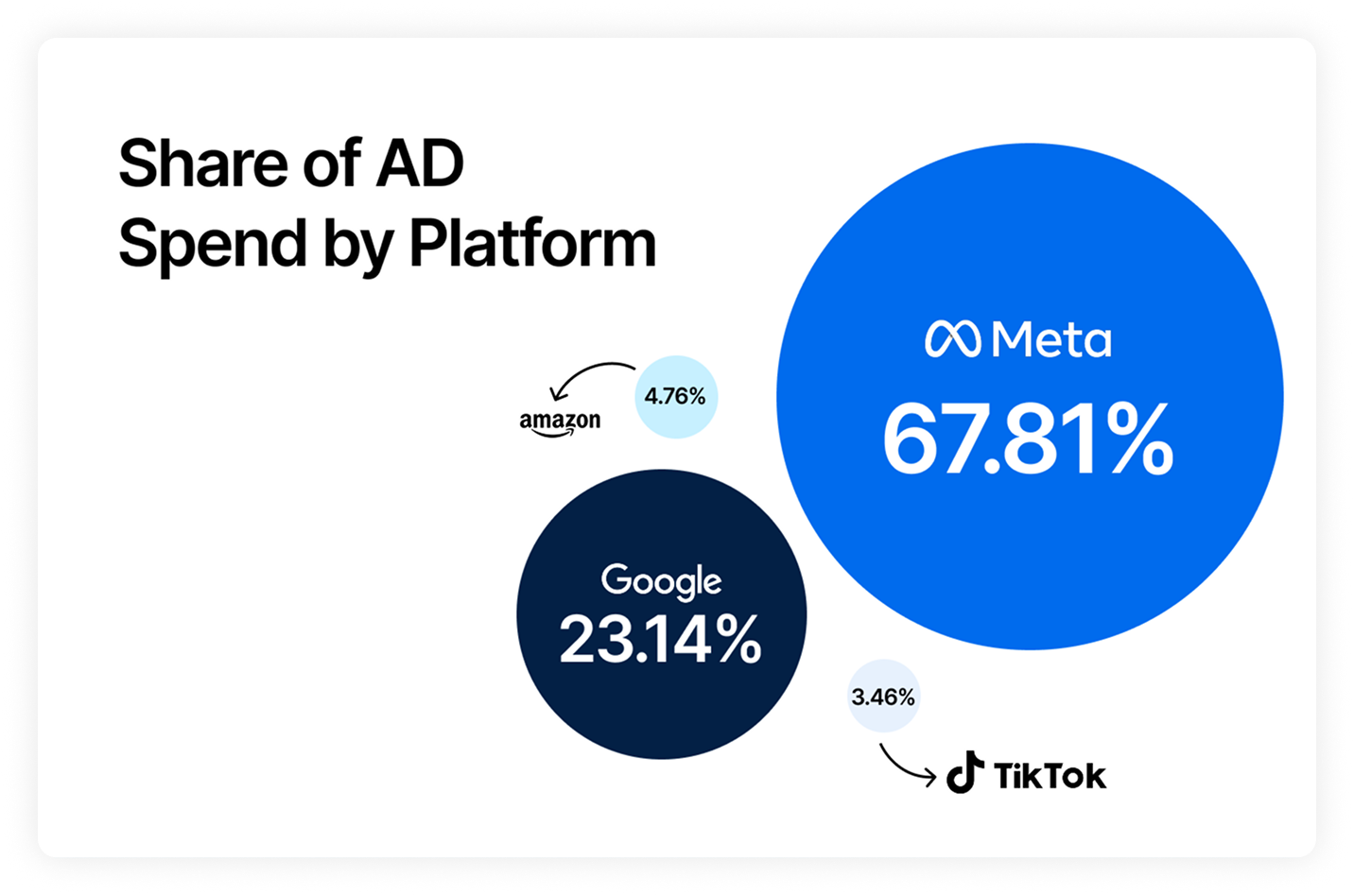
Body Copy: The following benchmarks compare advertising metrics from April 1-17 to the previous period. Considering President Trump first unveiled his tariffs on April 2, the timing corresponds with potential changes in advertising behavior among ecommerce brands (though it isn’t necessarily correlated).


 Moby AIAsk questions, analyze performance, and work with your business context.
 ActionsTake governed action across the tools that run your business.
 AutomationsSchedule recurring analysis and work that runs on your terms.
 Landing PagesCreative conversion-focused ecommerce pages with Moby.
 Creative StudioGenerate and refine creative grounded in your brand.













.webp)

.webp)
