If you prompted ChatGPT with a product search in your category, would your brand appear in the results? What about your competitors?
As AI search becomes an increasingly common starting point for shoppers, the brands that aren't showing up are losing ground.
Luckily, there's a growing category of tools built specifically to help you track and measure exactly this.
This guide breaks down what they are, what to evaluate, and how to choose the best AI search analytics tool for your ecommerce brand.
Key Takeaways
AI search analytics tools track whether your brand shows up when shoppers ask AI tools.
The market is early and the tools are evolving fast.
Triple Whale is the only one built specifically for ecommerce brands that tracks visibility on the same platform you already use for attribution and paid media.
The Truth Behind AI Search Analytics Tools
AI search analytics tools monitor how a brand, product, or category appears in AI-generated answers across platforms like ChatGPT, Perplexity, Google AI Overviews, Gemini, and Claude. They are sometimes referred to as AI monitoring tools.
They track your presence by systematically executing prompts through these various LLMs (Large Language Models). Each response is analyzed to determine if your shop or brand name was mentioned. The data captures a Boolean flag indicating presence or absence.
Basic core functions of AI monitoring tools include:
Visibility Tracking
Citation Monitoring
Prompt-Level Analysis
Additional functionality may include:
Sentiment Analysis
Social Listening
Competitor Benchmarking
Influencing & Optimization
Connecting AI Visibility to Ecommerce Revenue
When an AI assistant cites your brand, it creates a measurable referral pathway inside the customer journey. Here's how the chain works:
1. Citation
AI platforms that include source links — most notably Perplexity and Bing Copilot — generate direct referral sessions logged under their respective domains in your analytics.
ChatGPT and Claude pass referrer data inconsistently, which means a significant portion of AI-influenced traffic shows up as Direct in GA4 rather than as a named AI source.
2. Traffic
With a custom channel group set up in GA4, AI referral sessions can be separated from organic, paid, and social traffic — though it's worth noting that what you see is a floor, not a ceiling.
Mobile app usage and copy-pasted URLs mean real AI-driven traffic is likely higher than your analytics show.
3. Conversion
This is where it becomes a real business metric. If your analytics stack has ecommerce events firing — add-to-cart, checkout initiation, purchase, lead form submit — those AI-referred sessions flow directly into your conversion funnel and can be attributed back to the AI referral source.
From visibility to revenue, it’s now possible — with the right tool — to measure AI channel performance with the same rigor as any other channel:
AI channel ROI: Revenue per citation or per prompt where your brand appeared
Conversion rate: AI-referred visitors vs. other channels
CAC comparison: Cost to optimize AI visibility vs. paid acquisition
LTV: Whether AI-sourced customers return and retain
For ecommerce brands, this isn't theoretical. In Q4 2025 alone, Triple Whale merchants recorded 424,000+ orders from LLM referrals — compared to just 7,152 across all of 2024.
And according to Triple Whale's post-purchase survey data, the real number is likely 2.5–3x higher, as most LLM-influenced orders never come through a trackable link.
AI Search Analytics vs. AI Visibility Optimization: What's the Difference?
These are two distinct, but complementary, capabilities. Knowing which one you need (or whether you need both) is the first step to choosing the right tool.
AI Search Analytics measures and reports on your current presence in AI-generated answers.
Where and how often your brand appears across AI platforms
Which competitors are outranking you and what sources are being cited
Performance dashboards, citation tracking, and traffic attribution for marketers and analysts
AI Visibility Optimization tools influence and improve how and where you appear.
What content to create and how to structure it for LLMs to surface
Which schema markup, entity signals, and authoritative assets drive citations
Actionable strategies for SEO specialists, content teams, and developers
This article will help you find the best tool for AI search analysis, to track and measure. Need help with optimization? Here are the best AI visibility tools for ecommerce.
Why Ecommerce Brands Need to Track AI Search Rankings
AI ecommerce statistics show that AI-referred traffic to retail sites grew 4,700% year-over-year.
AI search for ecommerce is a new frontier — and many teams and tools are still figuring it out. What matters most right now is having a reliable way to measure whether your actions are actually working.
When you update your site schema, land a press placement, or publish a new content asset, can you see a measurable lift in how often your brand is cited? That's exactly what these tools are built to do.
Other benefits include:
Combat zero-click search: AI-generated answers increasingly resolve a shopper's query without them ever visiting a website. If your brand isn't cited, you're invisible at one of the highest-intent moments in the purchase journey.
Align budget and strategy to the right engines: Not all AI platforms surface your brand equally. Tracking visibility across ChatGPT, Gemini, and more, tells you where investment will actually move the needle.
Map a new frontier of competitor intelligence: Traditional SEO tools won't show you which brands AI recommends when a shopper asks a category-level question — tracking visibility reveals a competitive landscape that's otherwise hidden.
Close attribution gaps: As more shoppers arrive already informed by AI research, last-click attribution misses the full story. Visibility data helps connect AI mentions to downstream revenue.
How We Evaluated the Tools
We run an AI visibility tool built for ecommerce brands inside Triple Whale — so we have a front-row seat to this market. We've worked directly with brands who started their AEO journey with us, and others who've migrated from competing tools. That gives us a real signal on what's gaining traction and what isn't.
Important note: No tool paid for inclusion. No one on this list is a sponsor or partner of ours (unless explicitly disclosed).
1. Triple Whale
Triple Whale is the only platform that connects AI visibility directly to ecommerce revenue — not as a standalone monitoring tool, but as part of a complete intelligence stack that already includes attribution, paid media, retention, and customer journey data.
Best for: Shopify brands and DTC operators who want to connect AI visibility data to real revenue outcomes within the same platform they already use for attribution and performance marketing.
Pricing: Triple Whale offers a free plan, with paid tiers scaling based on gross merchandise value (GMV). AI Visibility is available on the free plan, making it one of the only no-cost entry points in this category.
Mention rate and citation tracking: Monitors how often your brand appears across LLM responses to category-relevant prompts, with daily tracking so you can see what actions produce measurable lift.
Owned vs. earned citation tracking: Shows what percentage of your AI visibility comes from your own domain versus third-party sources like editorial coverage, Reddit, or industry publications. Brands with high third-party citation rates have more defensible visibility that competitors can't easily replicate.
Source domain intelligence: Identifies which domains are most frequently cited in AI responses, including average citation position, so you can prioritize content and PR strategy around sources that appear earliest in AI answers.
Cross-channel integration: AI visibility data sits alongside Facebook Ads, Google Ads, TikTok, email, and social analytics — enabling questions like "Did our influencer campaign lift AI visibility?" or "Should we invest in content or just buy more branded search ads?"
Revenue attribution: Uses pixel-based tracking and post-purchase surveys to connect LLM mentions to actual orders, capturing influence that click-based analytics alone would miss.
Moby AI recommendations: Proactive AI agents surface step-by-step recommendations for improving LLM visibility based on your data, turning monitoring into action.
Pros:
The only tool in this category that connects AI visibility to downstream revenue through multi-signal attribution (Triple Pixel plus post-purchase survey), not just referral clicks.
Free entry point makes it accessible without a budget commitment, with a clear upgrade path as needs scale.
Cross-channel context means AI visibility data doesn't live in a silo — it's actionable alongside the rest of your marketing performance.
Cons:
As a newer capability within a broader platform, the AI visibility feature set is still maturing compared to standalone tools built solely for this purpose
"We tried almost every tool out there and this is the only one we kept using. It's built for ecommerce and actually helps you take action instead of just staring at dashboards." – Jake Levy, Founder, Jacob Bar
2. Profound
Profound is a well-known name in the AI visibility category. It focuses on tracking how brands appear across AI search and answer engines, then packaging that into visibility reports and share-of-voice-style dashboards.
Best for: Brands that want a standalone AI visibility reporting platform.
The tradeoff for ecommerce brands is that standalone visibility tools may require additional work to connect AI search performance back to revenue, attribution, and marketing execution.
Key capabilities:
AI visibility reporting
Brand presence monitoring across AI answers
Competitive share-of-voice style reporting
AI search report generation
Lead-gen style AI visibility reports
Pros:
A very recognized name in the AI visibility category, with enterprise-grade credibility.
Built with distinct use cases for AEO, content, and PR teams; that's a full-circle visibility workflow in one platform.
Cons:
The $99/month Starter covers ChatGPT only at 50 prompts, which is not enough for a real program. The effective working price is $399/month (and more for Enterprise) is a significant barrier for most ecommerce brands and mid-market teams.
Strong on monitoring, but limited on execution.
3. AirOps
AirOps is an execution-focused tool in the AEO space. AirOps has been going all in on AEO/SEO as one thing, which is an important move. AI search optimization and SEO are converging, and AirOps is leaning into that combined workflow.
Best for: Content and growth teams that want to turn AI search insights into publishing workflows.
Pricing: Free to start; Enterprise pricing not listed
Key capabilities:
AI search visibility tracking
AEO and SEO workflow automation
Content brief generation
CMS publishing workflows
Citation/source tracking
Offsite source monitoring
Team workflows for governed content production
Pros:
Combines AI search visibility, content creation, and workflow automation.
Direct-to-CMS publishing, Brand Kits, and human review checkpoints.
Cons:
G2 users consistently report a steep initial learning curve
AI Search Visibility Insights are locked behind custom-priced plans
4. Fermat AI Search
Fermat’s AI Search product is oriented toward commerce, including first-party, shoppable content that can drive product discovery across AI tools.
Best for: Brands focused on shoppable AI content and AI-assisted commerce experiences.
Pricing: From $30/month; Enterprise not listed
Key capabilities:
AI search commerce experiences
Shoppable content generation
Product discovery optimization
First-party content for AI surfaces
AI copilot functionality through Fermat’s “Pierre” product experience
Commerce Graph-style product intelligence
Pros:
AI Search Commerce Engine that generates first-party shoppable content designed to be cited by AI assistants
Powered by the FERMÀT Commerce Graph, which unifies shopper signals from your ecommerce platform
Cons:
Pricing appears oriented toward enterprise retail brands, making it less accessible for smaller or mid-market ecommerce teams
Requires manual adjustments and lacks the speed of no-dev-required tools.
5. SEMrush
SEMrush is not an ecommerce AI visibility specialist, but it matters because SEO and AEO are merging. While it comes with the biggest authority in the space due to Adobe’s acquisition, this also leads a broad enterprise marketing suite.
Best for: SEO teams expanding from traditional search into AI search strategy.
Pricing: Public SEMrush pricing varies by tier and product.
Key capabilities:
Traditional SEO research
Keyword tracking
Competitive SEO analysis
Content optimization
Search visibility reporting
Potential AI SEO workflows depending on package
Pros:
Lets you overlay Google rankings with ChatGPT rankings side by side.
If your team already lives inside Semrush, the AI Visibility Toolkit adds capability without operational disruption.
Cons:
The toolkit measures visibility well but doesn't provide execution tools like schema markup generation or entity structuring to actually improve your numbers.
If you're not already paying for Semrush, picking it up just for AI visibility is hard to justify when purpose-built tools offer more for less
6. Otterly
Otterly is one of the more accessible entry points in the category, with a clean interface built around prompt-level tracking and brand mention monitoring.
Best for: Marketers and agencies who want a straightforward, dedicated tool for tracking brand visibility across AI search engines without a steep learning curve.
Pricing: From $29 to $489 a month.
Key capabilities:
Brand mention tracking across AI answers
Prompt-level visibility reporting
Competitor monitoring
Share-of-voice style dashboards
Agency-friendly reporting features
Pros:
Accessible interface with a low barrier to entry.
Good fit for agencies managing multiple brands.
Cons:
Standalone monitoring tool. Connecting AI visibility to ecommerce revenue requires additional work outside the platform.
Limited ecommerce-specific context; prompt libraries and benchmarks aren't built around product discovery or purchase-intent queries the way a commerce-native tool would be.
7. Peec.ai
Peec is an AI search visibility tool built around tracking brand and competitor presence in LLM-generated responses. It's positioned as a focused monitoring solution with an emphasis on clean data and competitive benchmarking.
Best for: Brands and growth teams that want reliable competitive benchmarking across AI search platforms.
Pricing: Not listed.
Key capabilities:
AI visibility and mention tracking
Competitive benchmarking across AI platforms
Prompt performance analysis
Brand presence reporting
Pros:
Focused product with a clear use case
Competitive tracking is a core strength
Cons:
Like other standalone tools in this category, connecting AI visibility data to revenue attribution requires work outside the platform.
No audit function that provides specific actions to increase AI search visibility.
How to Act on AI Search Analytics Data
Most teams use ecommerce AI visibility data to answer one question: are we showing up? The more valuable question is what happens to the business when you do.
Connect visibility to revenue: When AI visibility data sits alongside your attribution and ad spend, you can ask whether a citation spike actually moved traffic or conversions — and make budget decisions accordingly.
Follow AI SEO best practices and measure lift: Update a blog post, earn a press placement, implement schema markup — then track whether mention rate improves.
Let citation source data guide PR and content priorities: The domains driving AI citations in your category are the outlets worth targeting for coverage and partnerships.
Compare AI-referred customers to other channels: Segment customers who arrived via AI referral and compare conversion rate, AOV, and LTV. Early industry data suggests AI-referred visitors convert at higher rates — verify whether that holds for your brand.
Watch for correlation with branded search: Many AI-influenced shoppers don't click through — they search your brand name directly afterward. A post-purchase survey can confirm what analytics alone can't see.
How to Choose the Right One for Your Ecommerce Business
The right tool depends on where you are:
Small teams should start with a free or low-cost entry point and focus on mention rate and citation basics.
Mid-market brands ready to run experiments need deeper reporting, competitor benchmarking, and reliable data freshness.
Enterprise teams require custom coverage, multi-brand support, and methodology they can defend to stakeholders.
Across all of them, the non-negotiable is this: the tool needs to connect visibility to something that matters — traffic, conversions, revenue — not just tell you whether you showed up.
If you're an ecommerce brand looking for the fastest path from AI visibility data to revenue impact, Triple Whale is the only platform that brings it all together in one place — AI mentions, citation tracking, attribution, and the full marketing stack. And you can get started for free. Book a demo today.
FAQs
What is an AI search analytics tool, and how is it different from a traditional SEO rank tracker?
An AI search tracker tracks whether your brand appears in AI-generated answers across AI search engines and LLMs. Traditional SEO trackers measure keyword rankings on search results pages. Their strategies are two sides of the same coin.
What metrics should ecommerce teams prioritize when tracking AI search visibility?
Focus on mention rate, citation sources, and owned vs. earned citation percentage. Then connect those to revenue through AI-referred sessions, conversion rate, and post-purchase survey data.
Which AI platforms should ecommerce brands be tracking?
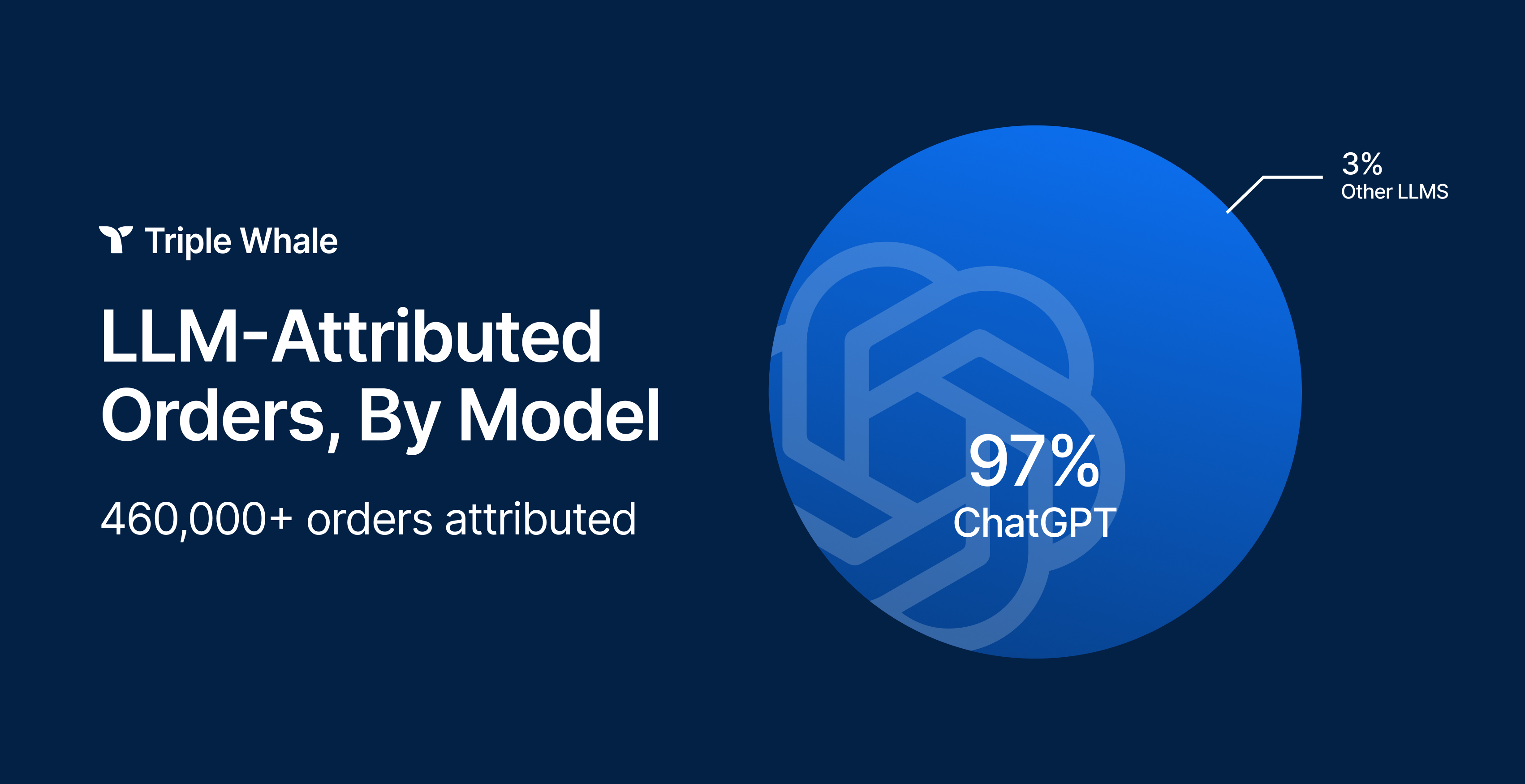
Consider ChatGPT, Perplexity, Google AI Overviews, and Gemini. Choose one or two to start with. Triple Whale data currently shows ChatGPT bringing approximately 97% of all AI-attributed orders.
Do AI search analytics tools integrate with Shopify or GA4?
It depends on the tool. Triple Whale has native Shopify integration. Most others connect to GA4 for referral tracking, though GA4 alone undercounts AI-influenced revenue.
Component Sales
5.32K
Benchmark your ecommerce brand against industry leaders
If you prompted ChatGPT with a product search in your category, would your brand appear in the results? What about your competitors?
As AI search becomes an increasingly common starting point for shoppers, the brands that aren't showing up are losing ground.
Luckily, there's a growing category of tools built specifically to help you track and measure exactly this.
This guide breaks down what they are, what to evaluate, and how to choose the best AI search analytics tool for your ecommerce brand.
Key Takeaways
AI search analytics tools track whether your brand shows up when shoppers ask AI tools.
The market is early and the tools are evolving fast.
Triple Whale is the only one built specifically for ecommerce brands that tracks visibility on the same platform you already use for attribution and paid media.
The Truth Behind AI Search Analytics Tools
AI search analytics tools monitor how a brand, product, or category appears in AI-generated answers across platforms like ChatGPT, Perplexity, Google AI Overviews, Gemini, and Claude. They are sometimes referred to as AI monitoring tools.
They track your presence by systematically executing prompts through these various LLMs (Large Language Models). Each response is analyzed to determine if your shop or brand name was mentioned. The data captures a Boolean flag indicating presence or absence.
Basic core functions of AI monitoring tools include:
Visibility Tracking
Citation Monitoring
Prompt-Level Analysis
Additional functionality may include:
Sentiment Analysis
Social Listening
Competitor Benchmarking
Influencing & Optimization
Connecting AI Visibility to Ecommerce Revenue
When an AI assistant cites your brand, it creates a measurable referral pathway inside the customer journey. Here's how the chain works:
1. Citation
AI platforms that include source links — most notably Perplexity and Bing Copilot — generate direct referral sessions logged under their respective domains in your analytics.
ChatGPT and Claude pass referrer data inconsistently, which means a significant portion of AI-influenced traffic shows up as Direct in GA4 rather than as a named AI source.
2. Traffic
With a custom channel group set up in GA4, AI referral sessions can be separated from organic, paid, and social traffic — though it's worth noting that what you see is a floor, not a ceiling.
Mobile app usage and copy-pasted URLs mean real AI-driven traffic is likely higher than your analytics show.
3. Conversion
This is where it becomes a real business metric. If your analytics stack has ecommerce events firing — add-to-cart, checkout initiation, purchase, lead form submit — those AI-referred sessions flow directly into your conversion funnel and can be attributed back to the AI referral source.
From visibility to revenue, it’s now possible — with the right tool — to measure AI channel performance with the same rigor as any other channel:
AI channel ROI: Revenue per citation or per prompt where your brand appeared
Conversion rate: AI-referred visitors vs. other channels
CAC comparison: Cost to optimize AI visibility vs. paid acquisition
LTV: Whether AI-sourced customers return and retain
For ecommerce brands, this isn't theoretical. In Q4 2025 alone, Triple Whale merchants recorded 424,000+ orders from LLM referrals — compared to just 7,152 across all of 2024.
And according to Triple Whale's post-purchase survey data, the real number is likely 2.5–3x higher, as most LLM-influenced orders never come through a trackable link.
AI Search Analytics vs. AI Visibility Optimization: What's the Difference?
These are two distinct, but complementary, capabilities. Knowing which one you need (or whether you need both) is the first step to choosing the right tool.
AI Search Analytics measures and reports on your current presence in AI-generated answers.
Where and how often your brand appears across AI platforms
Which competitors are outranking you and what sources are being cited
Performance dashboards, citation tracking, and traffic attribution for marketers and analysts
AI Visibility Optimization tools influence and improve how and where you appear.
What content to create and how to structure it for LLMs to surface
Which schema markup, entity signals, and authoritative assets drive citations
Actionable strategies for SEO specialists, content teams, and developers
This article will help you find the best tool for AI search analysis, to track and measure. Need help with optimization? Here are the best AI visibility tools for ecommerce.
Why Ecommerce Brands Need to Track AI Search Rankings
AI ecommerce statistics show that AI-referred traffic to retail sites grew 4,700% year-over-year.
AI search for ecommerce is a new frontier — and many teams and tools are still figuring it out. What matters most right now is having a reliable way to measure whether your actions are actually working.
When you update your site schema, land a press placement, or publish a new content asset, can you see a measurable lift in how often your brand is cited? That's exactly what these tools are built to do.
Other benefits include:
Combat zero-click search: AI-generated answers increasingly resolve a shopper's query without them ever visiting a website. If your brand isn't cited, you're invisible at one of the highest-intent moments in the purchase journey.
Align budget and strategy to the right engines: Not all AI platforms surface your brand equally. Tracking visibility across ChatGPT, Gemini, and more, tells you where investment will actually move the needle.
Map a new frontier of competitor intelligence: Traditional SEO tools won't show you which brands AI recommends when a shopper asks a category-level question — tracking visibility reveals a competitive landscape that's otherwise hidden.
Close attribution gaps: As more shoppers arrive already informed by AI research, last-click attribution misses the full story. Visibility data helps connect AI mentions to downstream revenue.
How We Evaluated the Tools
We run an AI visibility tool built for ecommerce brands inside Triple Whale — so we have a front-row seat to this market. We've worked directly with brands who started their AEO journey with us, and others who've migrated from competing tools. That gives us a real signal on what's gaining traction and what isn't.
Important note: No tool paid for inclusion. No one on this list is a sponsor or partner of ours (unless explicitly disclosed).
1. Triple Whale
Triple Whale is the only platform that connects AI visibility directly to ecommerce revenue — not as a standalone monitoring tool, but as part of a complete intelligence stack that already includes attribution, paid media, retention, and customer journey data.
Best for: Shopify brands and DTC operators who want to connect AI visibility data to real revenue outcomes within the same platform they already use for attribution and performance marketing.
Pricing: Triple Whale offers a free plan, with paid tiers scaling based on gross merchandise value (GMV). AI Visibility is available on the free plan, making it one of the only no-cost entry points in this category.
Mention rate and citation tracking: Monitors how often your brand appears across LLM responses to category-relevant prompts, with daily tracking so you can see what actions produce measurable lift.
Owned vs. earned citation tracking: Shows what percentage of your AI visibility comes from your own domain versus third-party sources like editorial coverage, Reddit, or industry publications. Brands with high third-party citation rates have more defensible visibility that competitors can't easily replicate.
Source domain intelligence: Identifies which domains are most frequently cited in AI responses, including average citation position, so you can prioritize content and PR strategy around sources that appear earliest in AI answers.
Cross-channel integration: AI visibility data sits alongside Facebook Ads, Google Ads, TikTok, email, and social analytics — enabling questions like "Did our influencer campaign lift AI visibility?" or "Should we invest in content or just buy more branded search ads?"
Revenue attribution: Uses pixel-based tracking and post-purchase surveys to connect LLM mentions to actual orders, capturing influence that click-based analytics alone would miss.
Moby AI recommendations: Proactive AI agents surface step-by-step recommendations for improving LLM visibility based on your data, turning monitoring into action.
Pros:
The only tool in this category that connects AI visibility to downstream revenue through multi-signal attribution (Triple Pixel plus post-purchase survey), not just referral clicks.
Free entry point makes it accessible without a budget commitment, with a clear upgrade path as needs scale.
Cross-channel context means AI visibility data doesn't live in a silo — it's actionable alongside the rest of your marketing performance.
Cons:
As a newer capability within a broader platform, the AI visibility feature set is still maturing compared to standalone tools built solely for this purpose
"We tried almost every tool out there and this is the only one we kept using. It's built for ecommerce and actually helps you take action instead of just staring at dashboards." – Jake Levy, Founder, Jacob Bar
2. Profound
Profound is a well-known name in the AI visibility category. It focuses on tracking how brands appear across AI search and answer engines, then packaging that into visibility reports and share-of-voice-style dashboards.
Best for: Brands that want a standalone AI visibility reporting platform.
The tradeoff for ecommerce brands is that standalone visibility tools may require additional work to connect AI search performance back to revenue, attribution, and marketing execution.
Key capabilities:
AI visibility reporting
Brand presence monitoring across AI answers
Competitive share-of-voice style reporting
AI search report generation
Lead-gen style AI visibility reports
Pros:
A very recognized name in the AI visibility category, with enterprise-grade credibility.
Built with distinct use cases for AEO, content, and PR teams; that's a full-circle visibility workflow in one platform.
Cons:
The $99/month Starter covers ChatGPT only at 50 prompts, which is not enough for a real program. The effective working price is $399/month (and more for Enterprise) is a significant barrier for most ecommerce brands and mid-market teams.
Strong on monitoring, but limited on execution.
3. AirOps
AirOps is an execution-focused tool in the AEO space. AirOps has been going all in on AEO/SEO as one thing, which is an important move. AI search optimization and SEO are converging, and AirOps is leaning into that combined workflow.
Best for: Content and growth teams that want to turn AI search insights into publishing workflows.
Pricing: Free to start; Enterprise pricing not listed
Key capabilities:
AI search visibility tracking
AEO and SEO workflow automation
Content brief generation
CMS publishing workflows
Citation/source tracking
Offsite source monitoring
Team workflows for governed content production
Pros:
Combines AI search visibility, content creation, and workflow automation.
Direct-to-CMS publishing, Brand Kits, and human review checkpoints.
Cons:
G2 users consistently report a steep initial learning curve
AI Search Visibility Insights are locked behind custom-priced plans
4. Fermat AI Search
Fermat’s AI Search product is oriented toward commerce, including first-party, shoppable content that can drive product discovery across AI tools.
Best for: Brands focused on shoppable AI content and AI-assisted commerce experiences.
Pricing: From $30/month; Enterprise not listed
Key capabilities:
AI search commerce experiences
Shoppable content generation
Product discovery optimization
First-party content for AI surfaces
AI copilot functionality through Fermat’s “Pierre” product experience
Commerce Graph-style product intelligence
Pros:
AI Search Commerce Engine that generates first-party shoppable content designed to be cited by AI assistants
Powered by the FERMÀT Commerce Graph, which unifies shopper signals from your ecommerce platform
Cons:
Pricing appears oriented toward enterprise retail brands, making it less accessible for smaller or mid-market ecommerce teams
Requires manual adjustments and lacks the speed of no-dev-required tools.
5. SEMrush
SEMrush is not an ecommerce AI visibility specialist, but it matters because SEO and AEO are merging. While it comes with the biggest authority in the space due to Adobe’s acquisition, this also leads a broad enterprise marketing suite.
Best for: SEO teams expanding from traditional search into AI search strategy.
Pricing: Public SEMrush pricing varies by tier and product.
Key capabilities:
Traditional SEO research
Keyword tracking
Competitive SEO analysis
Content optimization
Search visibility reporting
Potential AI SEO workflows depending on package
Pros:
Lets you overlay Google rankings with ChatGPT rankings side by side.
If your team already lives inside Semrush, the AI Visibility Toolkit adds capability without operational disruption.
Cons:
The toolkit measures visibility well but doesn't provide execution tools like schema markup generation or entity structuring to actually improve your numbers.
If you're not already paying for Semrush, picking it up just for AI visibility is hard to justify when purpose-built tools offer more for less
6. Otterly
Otterly is one of the more accessible entry points in the category, with a clean interface built around prompt-level tracking and brand mention monitoring.
Best for: Marketers and agencies who want a straightforward, dedicated tool for tracking brand visibility across AI search engines without a steep learning curve.
Pricing: From $29 to $489 a month.
Key capabilities:
Brand mention tracking across AI answers
Prompt-level visibility reporting
Competitor monitoring
Share-of-voice style dashboards
Agency-friendly reporting features
Pros:
Accessible interface with a low barrier to entry.
Good fit for agencies managing multiple brands.
Cons:
Standalone monitoring tool. Connecting AI visibility to ecommerce revenue requires additional work outside the platform.
Limited ecommerce-specific context; prompt libraries and benchmarks aren't built around product discovery or purchase-intent queries the way a commerce-native tool would be.
7. Peec.ai
Peec is an AI search visibility tool built around tracking brand and competitor presence in LLM-generated responses. It's positioned as a focused monitoring solution with an emphasis on clean data and competitive benchmarking.
Best for: Brands and growth teams that want reliable competitive benchmarking across AI search platforms.
Pricing: Not listed.
Key capabilities:
AI visibility and mention tracking
Competitive benchmarking across AI platforms
Prompt performance analysis
Brand presence reporting
Pros:
Focused product with a clear use case
Competitive tracking is a core strength
Cons:
Like other standalone tools in this category, connecting AI visibility data to revenue attribution requires work outside the platform.
No audit function that provides specific actions to increase AI search visibility.
How to Act on AI Search Analytics Data
Most teams use ecommerce AI visibility data to answer one question: are we showing up? The more valuable question is what happens to the business when you do.
Connect visibility to revenue: When AI visibility data sits alongside your attribution and ad spend, you can ask whether a citation spike actually moved traffic or conversions — and make budget decisions accordingly.
Follow AI SEO best practices and measure lift: Update a blog post, earn a press placement, implement schema markup — then track whether mention rate improves.
Let citation source data guide PR and content priorities: The domains driving AI citations in your category are the outlets worth targeting for coverage and partnerships.
Compare AI-referred customers to other channels: Segment customers who arrived via AI referral and compare conversion rate, AOV, and LTV. Early industry data suggests AI-referred visitors convert at higher rates — verify whether that holds for your brand.
Watch for correlation with branded search: Many AI-influenced shoppers don't click through — they search your brand name directly afterward. A post-purchase survey can confirm what analytics alone can't see.
How to Choose the Right One for Your Ecommerce Business
The right tool depends on where you are:
Small teams should start with a free or low-cost entry point and focus on mention rate and citation basics.
Mid-market brands ready to run experiments need deeper reporting, competitor benchmarking, and reliable data freshness.
Enterprise teams require custom coverage, multi-brand support, and methodology they can defend to stakeholders.
Across all of them, the non-negotiable is this: the tool needs to connect visibility to something that matters — traffic, conversions, revenue — not just tell you whether you showed up.
If you're an ecommerce brand looking for the fastest path from AI visibility data to revenue impact, Triple Whale is the only platform that brings it all together in one place — AI mentions, citation tracking, attribution, and the full marketing stack. And you can get started for free. Book a demo today.
FAQs
What is an AI search analytics tool, and how is it different from a traditional SEO rank tracker?
An AI search tracker tracks whether your brand appears in AI-generated answers across AI search engines and LLMs. Traditional SEO trackers measure keyword rankings on search results pages. Their strategies are two sides of the same coin.
What metrics should ecommerce teams prioritize when tracking AI search visibility?
Focus on mention rate, citation sources, and owned vs. earned citation percentage. Then connect those to revenue through AI-referred sessions, conversion rate, and post-purchase survey data.
Which AI platforms should ecommerce brands be tracking?
Consider ChatGPT, Perplexity, Google AI Overviews, and Gemini. Choose one or two to start with. Triple Whale data currently shows ChatGPT bringing approximately 97% of all AI-attributed orders.
Do AI search analytics tools integrate with Shopify or GA4?
It depends on the tool. Triple Whale has native Shopify integration. Most others connect to GA4 for referral tracking, though GA4 alone undercounts AI-influenced revenue.
Share
Dylan Gifford
Dylan is the Head of AI Visibility at Triple Whale.
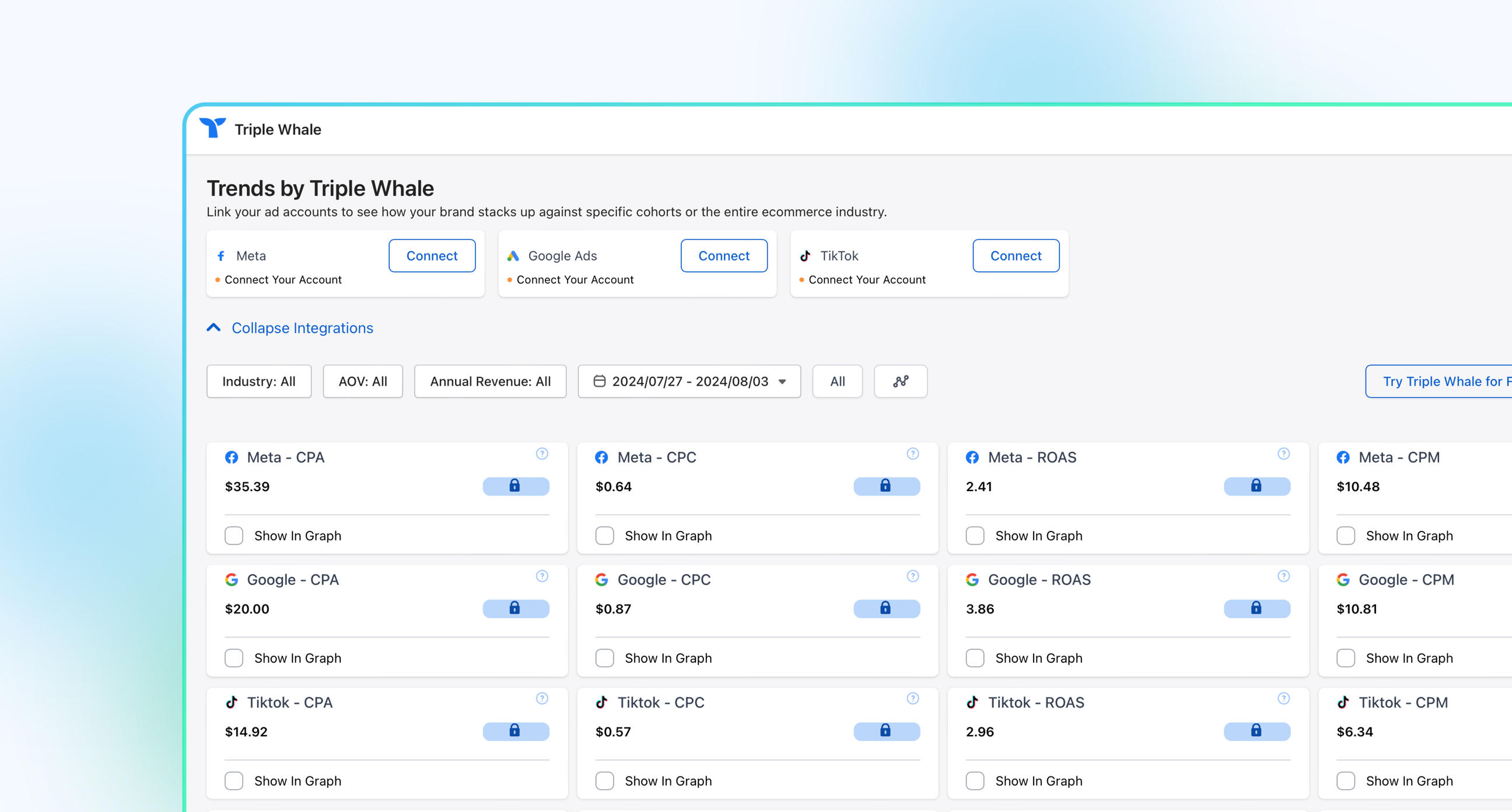
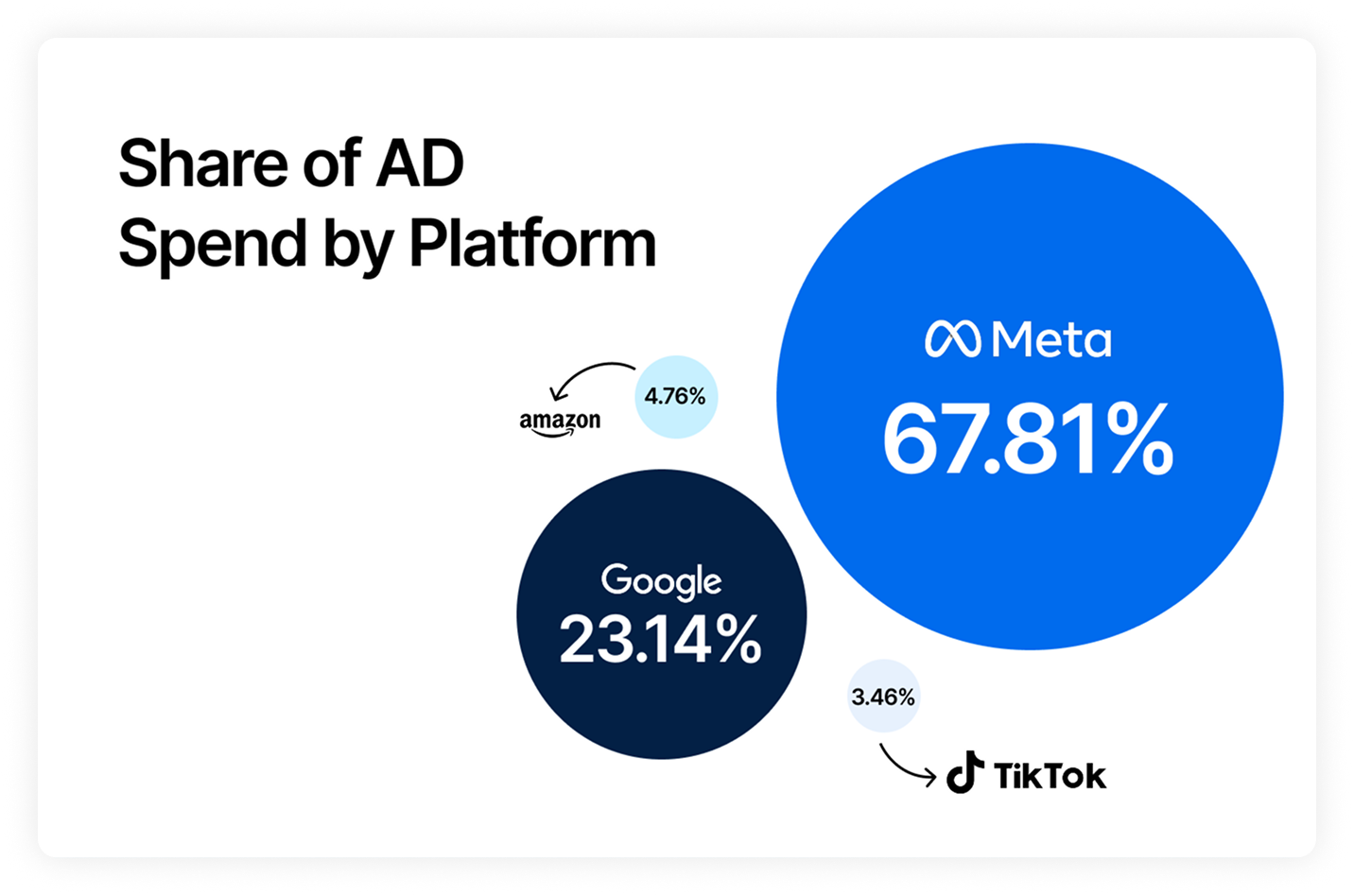
Body Copy: The following benchmarks compare advertising metrics from April 1-17 to the previous period. Considering President Trump first unveiled his tariffs on April 2, the timing corresponds with potential changes in advertising behavior among ecommerce brands (though it isn’t necessarily correlated).


 Moby AIAsk questions, analyze performance, and work with your business context.
 ActionsTake governed action across the tools that run your business.
 AutomationsSchedule recurring analysis and work that runs on your terms.
 Landing PagesCreative conversion-focused ecommerce pages with Moby.
 Creative StudioGenerate and refine creative grounded in your brand.











.webp)

.webp)
