In a world where consumers bounce between Google searches, Reddit reviews, newsletters, and in-store visits before making a purchase, traditional marketing metrics are no longer enough.
Cross-channel attribution helps identify and assign value to the multiple marketing channels that influence a customer’s decision to buy.
This guide provides everything you need to know about how cross-channel attribution works — its benefits, pitfalls, use cases, and more.
Key Takeaways:
Cross-channel attribution tracks customer interactions across different channels and assigns value to each touchpoint.
Cross-channel attribution helps you understand how different interactions work together to drive conversions.
You need to choose an attribution model for how credit is assigned and ensure the underlying data is accurate and complete.
What Is Cross-channel Attribution?
Cross-channel attribution is a marketing measurement strategy. This model analyzes customer interactions across multiple marketing channels — such as website visits, email, and paid media — to determine how each touchpoint contributes to conversions such as sign-ups or purchases.
For example, a customer might:
Click on an Instagram ad
Visit your website but take no action
See an Instagram retargeting ad
Return through a Google search and make a purchase
Cross-channel attribution helps you assign value to every part of such a customer journey, so you can determine exactly which channel contributes (and by how much) to the final purchase.
Why Does Cross-channel Attribution Matter?
Getting a complete picture of cross-channel touchpoints has a waterfall effect on your business. Here are the main benefits of implementing this type of marketing attribution.
Reveals Assisted Conversions
Many channels influence conversions without being the final touchpoint. Cross-channel attribution highlights these assist interactions, ensuring upper- and mid-funnel efforts receive appropriate credit.
Supports Full-funnel Decision-making
Cross-channel models look at the multifaceted nature of the customer's path to purchase. Done right, it gives you a clearer picture of the full journey, helping you optimize your marketing efforts.
Improves Budget Allocation
With a more complete understanding of the customer journey, you can allocate spend more strategically, shifting investment toward the channels that drive incremental impact and improving overall ROI.
Reduces Channel Bias
Branded search often shows the highest ROAS in last-click reporting, leading marketers to over-invest in it while cutting upper-funnel channels. Cross-channel attribution reduces this bias by revealing how demand-creation channels contribute to conversions — not just the channels that close them.
How Does Cross-channel Attribution Work?
At a high level, cross-channel attribution works by collecting signals across the customer journey and connecting those signals to real people or sessions. Then, the system assigns credit to each touchpoint using a defined model. Let’s define this further.
Signal Collection
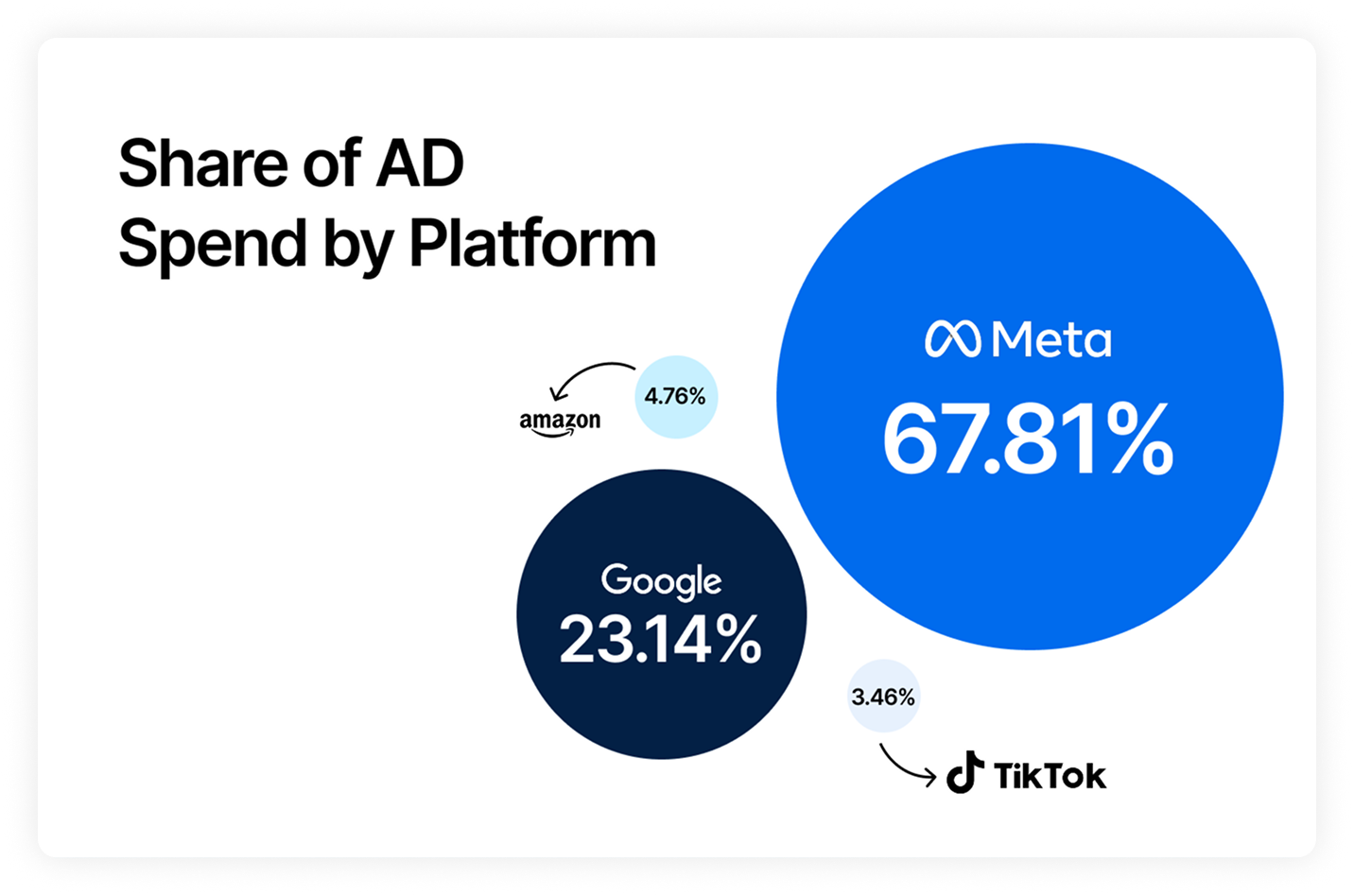
Everything starts with data. Cross-channel attribution relies on comprehensively gathering customer interaction signals across all marketing platforms (like Meta, Google, and TikTok), channels (like email and ads), touchpoints (like in-store visits, ad impressions, and website views) and devices (mobile, desktop).
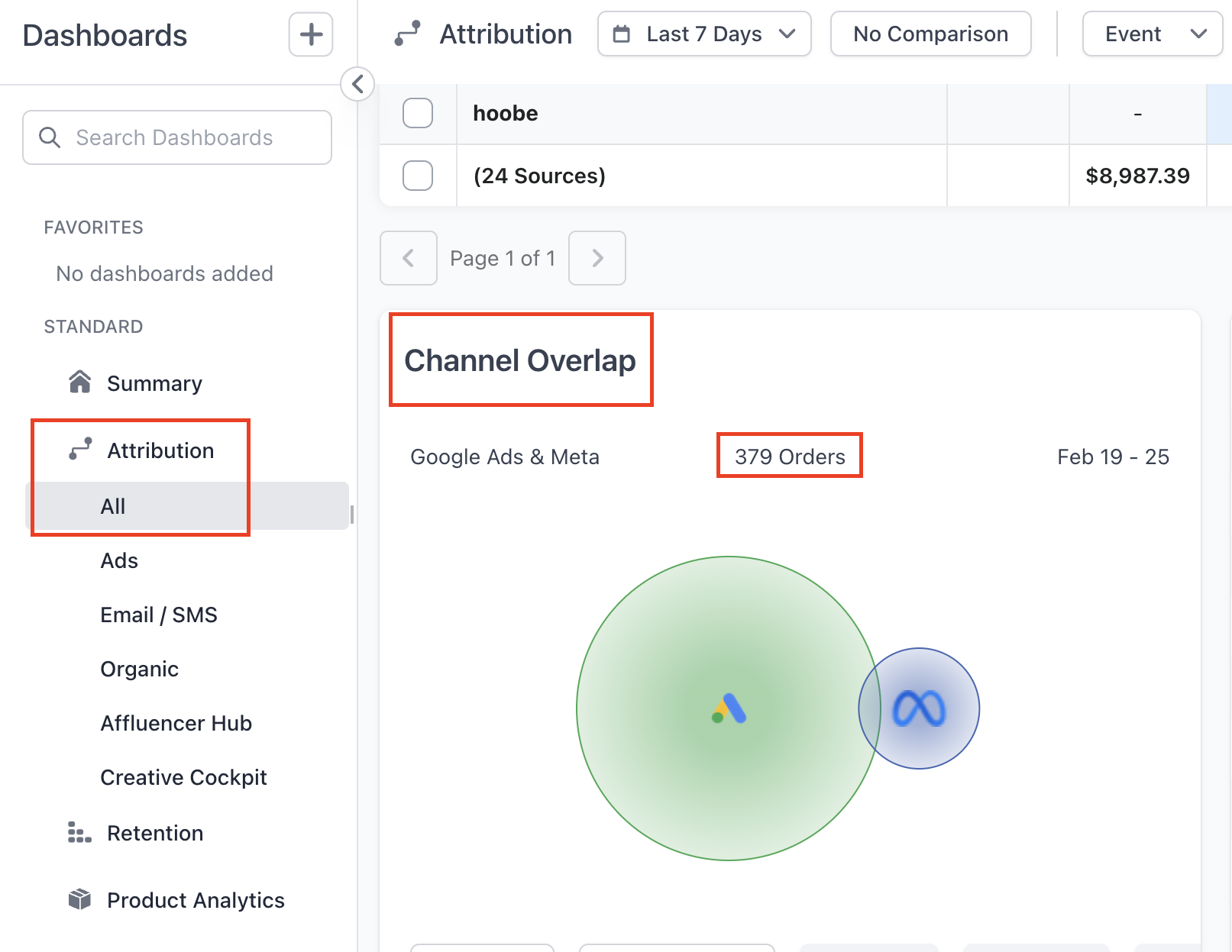
In the example above, the Triple Whale Channel Overlap section shows the total number of orders with a touchpoint from any other channel.
Identity Resolution
Once signals are collected, the next step is determining which interactions belong to the same customer. Identity resolution attempts to stitch together all the events (i.e., devices, sessions, and channels) into a single, comprehensive path to conversion.
This is typically done using a combination of deterministic signals (like logged-in users or hashed emails) and identity resolution technology.
Credit Assignment
After journeys are stitched, attribution models assign credit to each touchpoint involved in a conversion. Depending on the model, credit might be distributed evenly, weighted toward certain interactions, or influenced by timing, position, or historical performance patterns.
At the end of this process, you end up seeing a unified attribution view that ties every channel to conversions. Inside Triple Whale, for example, this ties to revenue, and profit — highlighting assist value, channel roles across the funnel, and blended performance metrics like MER and blended ROAS, all in one place.
What Are Common Cross-channel Attribution Models?
As mentioned, how the value is assigned depends on the attribution model you choose to use. Below is a look at common cross-channel attribution models.
Single-touch
First-click and last-click attribution assign 100% of the credit to a single touchpoint—either the first interaction or the final one, respectively. These are cross-channel in scope, but not cross-channel in insight.
Linear Attribution
Linear attribution equally credits all touchpoints, recognizing the importance of the entire customer journey but may dilute the impact of key interactions.
Time Decay Attribution
The time decay model places more value on interactions closer to the conversion. This model effectively highlights the most influential touchpoints but may undervalue the significance of initial awareness-building efforts.
Position-Based Attribution
Position-based models assign different weights to specific touchpoints based on where they occur during the customer journey. These provide a more balanced approach but might not be as precise in pinpointing the most impactful interactions.
There are three kinds:
U-shaped: This is like how you might remember a book you read a while ago: The beginning and the end stand out, but the middle is a little fuzzy. This model gives the majority of the credit to the first and last touchpoints, while still recognizing the touchpoints in between.
W-shaped: This model gives the most credit to three milestone touchpoints (the tops of your W) and weights everything in between evenly.
Z-shaped: Each zag of your Z symbolizes one of four milestone touchpoints that get the most credit in this model. Everything in between is credited evenly.
Algorithmic Attribution
This method is all about utilizing statistical algorithms to assign values to different touchpoints. Like all algorithms, it gets “smarter” with the more data you feed it.
One common type of algorithmic attribution is incremental attribution, which strives to identify the conversions that wouldn’t have happened if it weren’t for specific touchpoints and credit those touchpoints accordingly.
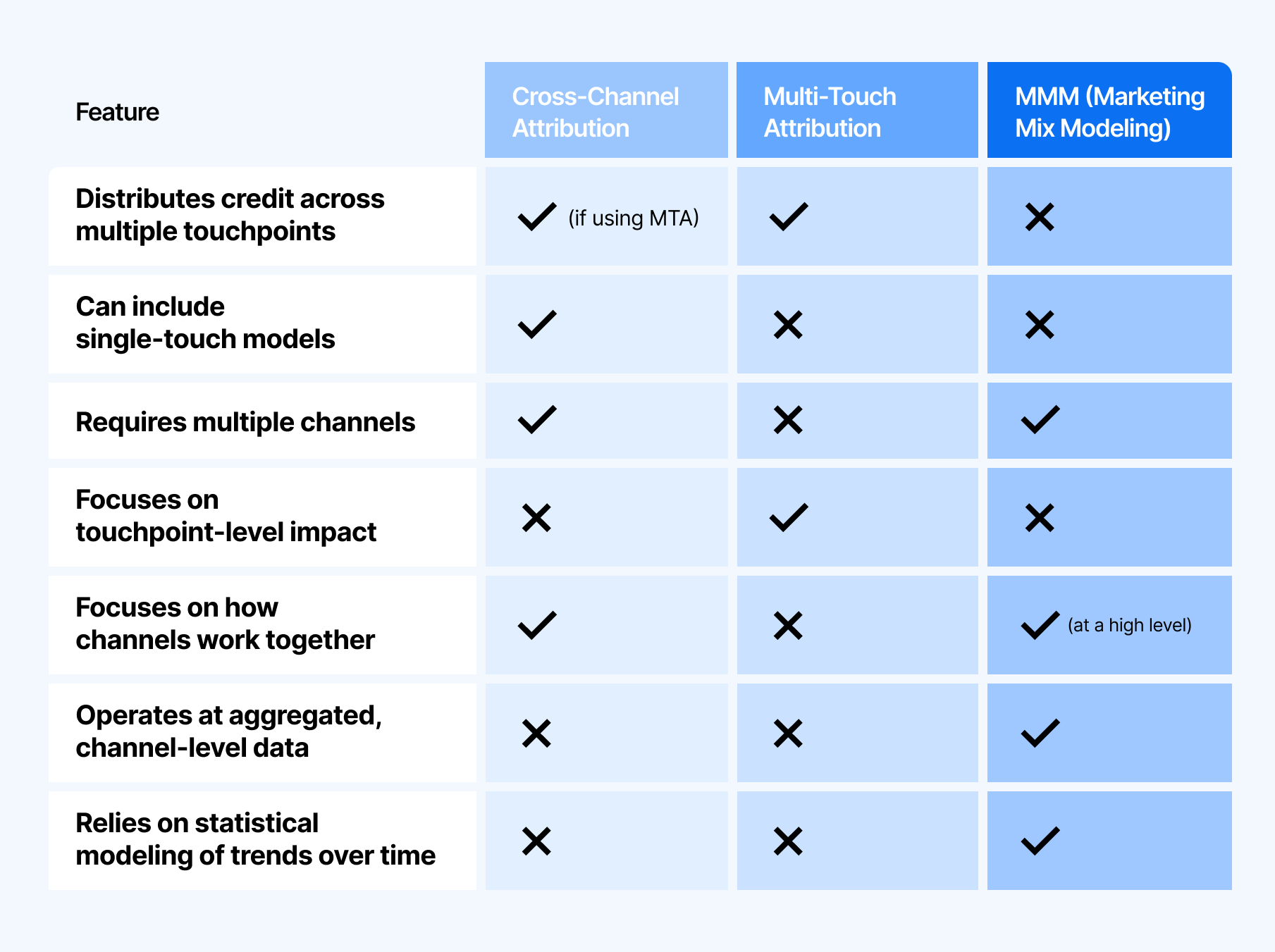
What’s the Difference Between Cross-channel Attribution, Multi-touch Attribution (MTA), and Marketing Mix Modeling (MMM)?
While these terms are often used interchangeably, they solve different measurement problems and operate at different levels of the marketing stack. Understanding the distinction is key to choosing the right method for your business.
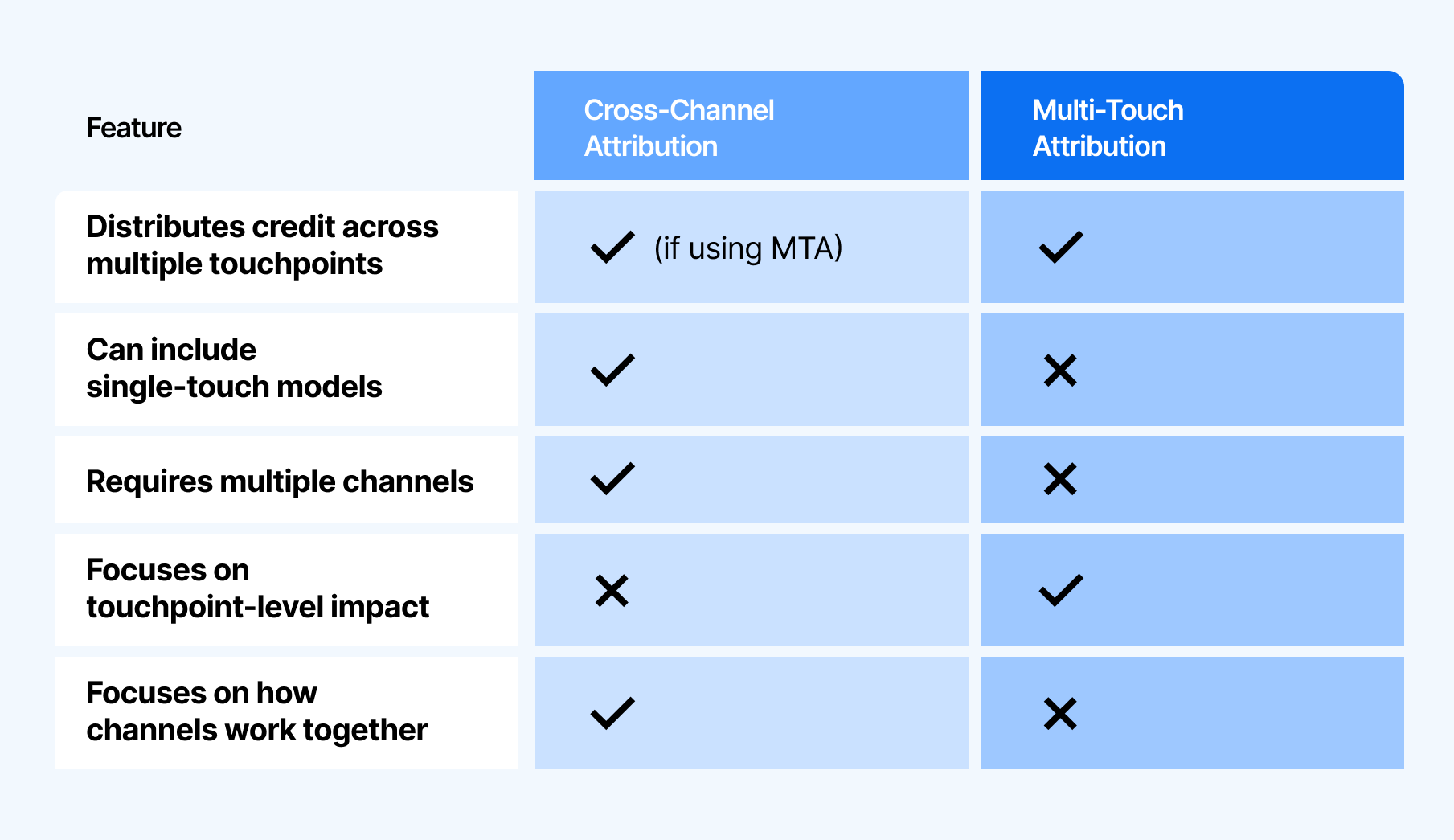
Cross-Channel vs Multi-Touch Attribution
Multi-touch attribution distributes credit across multiple touchpoints in a single customer journey, regardless of the channels used.
Cross-channel is an umbrella term that can include single-touch, multi-touch, and hybrid models.
Cross-channel requires the journey to span across multiple channels (go figure).
Multi-touch attribution doesn’t require multiple channels; it only requires multiple touchpoints. A customer who sees three Facebook ads before converting still has a multi-touch journey.
Cross-Channel vs Marketing Mix Modeling
Marketing mix modeling (MMM) is a statistical analysis technique that helps businesses evaluate and optimize the impact of their marketing tactics across different channels.
Many attribution models only focus on assigning value within digital channels, but MMM takes a holistic approach to consider both online and offline marketing activities, as well as external factors such as seasonality, competitor actions, and economic conditions.
When Cross-channel Attribution Is (and Isn’t) the Right Choice
Cross-channel attribution can be incredibly powerful — but it’s not a silver bullet. Knowing when to use it (and when not to) is just as important as choosing the right model.
When Cross-channel Attribution Is the Right Fit
Cross-channel attribution works best in businesses with multiple active channels and meaningful mid-funnel complexity. If customers regularly interact with several touchpoints before converting, then you’re on the right track here. Single-touch models, in such a case, will oversimplify what’s really driving performance.
It’s especially valuable when:
You’re allocating budget across multiple paid channels that influence each other.
Your funnel includes real consideration phases, not just impulse purchases.
You need to understand assist value, not just last-click conversions.
You’re optimizing creative, messaging, or sequencing across channels.
When MMM Is the Better Choice
MMM is often the better option when you need high-level, strategic guidance, especially in environments where user-level attribution breaks down.
MMM tends to work better when:
You invest heavily in upper-funnel or offline channels like TV, CTV, radio, or out-of-home.
Privacy limitations reduce your visibility into individual user journeys.
You’re focused on long-term budget allocation rather than day-to-day optimization.
Seasonality or macro trends play a large role in performance.
MMM trades granularity for stability, making it ideal for understanding broad channel impact over time rather than optimizing tactical levers.
In many modern setups, unified measurement— combining MMM, experimentation, and attribution — can outperform any single model alone. This approach allows teams to balance tactical insights with strategic truth, using each method where it’s strongest.
What Are the Challenges and Limitations of Cross-channel Attribution?
It’s not uncommon to often encounter several challenges in accurately attributing conversions to the right channels. Here are some of the most common challenges when it comes to channel attribution.
Data Quality Issues
Marketing data is often fragmented across siloed systems, making it difficult to create a unified view that everyone can get behind. This is very common, as integrating data from multiple channels is technically complex.
Solution: Implement a centralized data dashboard that unifies cross-channel tracking and standardizes all of your efforts across platforms.
Cross-Device Tracking and Identity Issues
Tracking interactions across devices becomes really complex. Without reliable cross-device identification, you’re left with gaps that can skew performance insights.
Solution: Use deterministic and probabilistic identity resolution powered by first-party data to connect cross-device interactions into a single, unified customer profile.
Privacy and Compliance Restraints
Privacy regulations such as GDPR and CCPA, along with platform-level restrictions, have reduced access to user-level data. In addition, strict requirements around how data is collected, used, and stored makes it difficult to track behavior across channels.
Solution: Implement a first-party and zero-party data that preserves signal, strengthens compliance, and restores attribution accuracy.
Attribution Bias and Overconfidence
When you rely too heavily on attribution alone, you may optimize away channels that play important roles. Attribution is there to help make informed decisions, not a replacement for human judgment.
Solution: Pair attribution insights with incrementality testing, broader performance metrics, and strategic context to ensure balanced, data-informed decisions.
How to Implement Cross-Channel Attribution
Implementing cross-channel attribution effectively requires meticulous planning and execution. Here’s how to get started.
1. Choose the Right Attribution Model
The first step in implementing cross-channel attribution is selecting an attribution model that aligns with your business goals. As previously noted, various models exist — such as last-touch, position-based, and linear attribution — each with its strengths and weaknesses.
Analyzing your marketing objectives and customer behavior patterns is critical in choosing the most suitable model.
2. Set Up Proper Tracking
Once the appropriate attribution model is selected, the next step involves setting up robust tracking mechanisms. This process typically includes implementing tags and pixels on your website and within advertising platforms to collect data on user interactions.
Leveraging tools like Google Analytics and specialized attribution software can facilitate seamless data collection and integration across channels.
3. Align Your Teams on Interpretation
An attribution model is only as useful as the decisions people make from it. If growth, marketing, and finance teams interpret attribution differently — or trust different dashboards — you’ll end up with misaligned priorities and wasted spend. For instance, you’ll want to decide which KPIs and ecommerce metrics to track.
4. Iterate as Channels Change
Your attribution strategy shouldn’t be static, because your channel mix isn’t. As you add new platforms, test new creatives, or shift budget toward emerging channels, your model needs to be re-evaluated to reflect how customers actually move across touchpoints. You may eventually find yourself adding MMM and incrementality testing to the mix.
Follow the Journey
Cross-channel attribution helps teams understand how multiple touchpoints work together to drive conversions. If you’re ready to move beyond siloed channel reporting, Triple Whale gives you a clearer, more unified view of performance.
With cross-channel attribution, blended measurement, and tools that connect spend to real business outcomes, you can make smarter budget decisions with confidence. Book a demo today.
Cross-Channel Attribution FAQs
What is an example of cross-channel marketing?
A customer discovers a brand through an Instagram ad, later searches on Google, receives an email, and converts through a retargeting ad. Cross-channel attribution measures how each of these touchpoints contributed to the conversion.
Is cross-channel attribution the same as multi-channel attribution (MTA)?
Nope. Cross-channel attribution looks at how channels work together, while multi-touch attribution is one method for distributing credit across multiple interactions.
What are the most common cross-channel attribution models?
Common models include linear, time decay, position-based, and data-driven attribution. You could also use marketing mix modeling (MMM) for aggregated, channel-level insights.
Can small or mid-sized businesses use cross-channel attribution?
Yes! SMBs can benefit from structured multi-touch or blended attribution approaches.
Do you need a dedicated attribution tool for cross-channel attribution?
Highly recommended. As your data complexity grows, using a unified attribution platform like Triple Whale becomes essential for maintaining accurate tracking, preserving first-party data, and feeling confident in your decisions.
Component Sales
5.32K
Benchmark your ecommerce brand against industry leaders
In a world where consumers bounce between Google searches, Reddit reviews, newsletters, and in-store visits before making a purchase, traditional marketing metrics are no longer enough.
Cross-channel attribution helps identify and assign value to the multiple marketing channels that influence a customer’s decision to buy.
This guide provides everything you need to know about how cross-channel attribution works — its benefits, pitfalls, use cases, and more.
Key Takeaways:
Cross-channel attribution tracks customer interactions across different channels and assigns value to each touchpoint.
Cross-channel attribution helps you understand how different interactions work together to drive conversions.
You need to choose an attribution model for how credit is assigned and ensure the underlying data is accurate and complete.
What Is Cross-channel Attribution?
Cross-channel attribution is a marketing measurement strategy. This model analyzes customer interactions across multiple marketing channels — such as website visits, email, and paid media — to determine how each touchpoint contributes to conversions such as sign-ups or purchases.
For example, a customer might:
Click on an Instagram ad
Visit your website but take no action
See an Instagram retargeting ad
Return through a Google search and make a purchase
Cross-channel attribution helps you assign value to every part of such a customer journey, so you can determine exactly which channel contributes (and by how much) to the final purchase.
Why Does Cross-channel Attribution Matter?
Getting a complete picture of cross-channel touchpoints has a waterfall effect on your business. Here are the main benefits of implementing this type of marketing attribution.
Reveals Assisted Conversions
Many channels influence conversions without being the final touchpoint. Cross-channel attribution highlights these assist interactions, ensuring upper- and mid-funnel efforts receive appropriate credit.
Supports Full-funnel Decision-making
Cross-channel models look at the multifaceted nature of the customer's path to purchase. Done right, it gives you a clearer picture of the full journey, helping you optimize your marketing efforts.
Improves Budget Allocation
With a more complete understanding of the customer journey, you can allocate spend more strategically, shifting investment toward the channels that drive incremental impact and improving overall ROI.
Reduces Channel Bias
Branded search often shows the highest ROAS in last-click reporting, leading marketers to over-invest in it while cutting upper-funnel channels. Cross-channel attribution reduces this bias by revealing how demand-creation channels contribute to conversions — not just the channels that close them.
How Does Cross-channel Attribution Work?
At a high level, cross-channel attribution works by collecting signals across the customer journey and connecting those signals to real people or sessions. Then, the system assigns credit to each touchpoint using a defined model. Let’s define this further.
Signal Collection
Everything starts with data. Cross-channel attribution relies on comprehensively gathering customer interaction signals across all marketing platforms (like Meta, Google, and TikTok), channels (like email and ads), touchpoints (like in-store visits, ad impressions, and website views) and devices (mobile, desktop).
In the example above, the Triple Whale Channel Overlap section shows the total number of orders with a touchpoint from any other channel.
Identity Resolution
Once signals are collected, the next step is determining which interactions belong to the same customer. Identity resolution attempts to stitch together all the events (i.e., devices, sessions, and channels) into a single, comprehensive path to conversion.
This is typically done using a combination of deterministic signals (like logged-in users or hashed emails) and identity resolution technology.
Credit Assignment
After journeys are stitched, attribution models assign credit to each touchpoint involved in a conversion. Depending on the model, credit might be distributed evenly, weighted toward certain interactions, or influenced by timing, position, or historical performance patterns.
At the end of this process, you end up seeing a unified attribution view that ties every channel to conversions. Inside Triple Whale, for example, this ties to revenue, and profit — highlighting assist value, channel roles across the funnel, and blended performance metrics like MER and blended ROAS, all in one place.
What Are Common Cross-channel Attribution Models?
As mentioned, how the value is assigned depends on the attribution model you choose to use. Below is a look at common cross-channel attribution models.
Single-touch
First-click and last-click attribution assign 100% of the credit to a single touchpoint—either the first interaction or the final one, respectively. These are cross-channel in scope, but not cross-channel in insight.
Linear Attribution
Linear attribution equally credits all touchpoints, recognizing the importance of the entire customer journey but may dilute the impact of key interactions.
Time Decay Attribution
The time decay model places more value on interactions closer to the conversion. This model effectively highlights the most influential touchpoints but may undervalue the significance of initial awareness-building efforts.
Position-Based Attribution
Position-based models assign different weights to specific touchpoints based on where they occur during the customer journey. These provide a more balanced approach but might not be as precise in pinpointing the most impactful interactions.
There are three kinds:
U-shaped: This is like how you might remember a book you read a while ago: The beginning and the end stand out, but the middle is a little fuzzy. This model gives the majority of the credit to the first and last touchpoints, while still recognizing the touchpoints in between.
W-shaped: This model gives the most credit to three milestone touchpoints (the tops of your W) and weights everything in between evenly.
Z-shaped: Each zag of your Z symbolizes one of four milestone touchpoints that get the most credit in this model. Everything in between is credited evenly.
Algorithmic Attribution
This method is all about utilizing statistical algorithms to assign values to different touchpoints. Like all algorithms, it gets “smarter” with the more data you feed it.
One common type of algorithmic attribution is incremental attribution, which strives to identify the conversions that wouldn’t have happened if it weren’t for specific touchpoints and credit those touchpoints accordingly.
What’s the Difference Between Cross-channel Attribution, Multi-touch Attribution (MTA), and Marketing Mix Modeling (MMM)?
While these terms are often used interchangeably, they solve different measurement problems and operate at different levels of the marketing stack. Understanding the distinction is key to choosing the right method for your business.
Cross-Channel vs Multi-Touch Attribution
Multi-touch attribution distributes credit across multiple touchpoints in a single customer journey, regardless of the channels used.
Cross-channel is an umbrella term that can include single-touch, multi-touch, and hybrid models.
Cross-channel requires the journey to span across multiple channels (go figure).
Multi-touch attribution doesn’t require multiple channels; it only requires multiple touchpoints. A customer who sees three Facebook ads before converting still has a multi-touch journey.
Cross-Channel vs Marketing Mix Modeling
Marketing mix modeling (MMM) is a statistical analysis technique that helps businesses evaluate and optimize the impact of their marketing tactics across different channels.
Many attribution models only focus on assigning value within digital channels, but MMM takes a holistic approach to consider both online and offline marketing activities, as well as external factors such as seasonality, competitor actions, and economic conditions.
When Cross-channel Attribution Is (and Isn’t) the Right Choice
Cross-channel attribution can be incredibly powerful — but it’s not a silver bullet. Knowing when to use it (and when not to) is just as important as choosing the right model.
When Cross-channel Attribution Is the Right Fit
Cross-channel attribution works best in businesses with multiple active channels and meaningful mid-funnel complexity. If customers regularly interact with several touchpoints before converting, then you’re on the right track here. Single-touch models, in such a case, will oversimplify what’s really driving performance.
It’s especially valuable when:
You’re allocating budget across multiple paid channels that influence each other.
Your funnel includes real consideration phases, not just impulse purchases.
You need to understand assist value, not just last-click conversions.
You’re optimizing creative, messaging, or sequencing across channels.
When MMM Is the Better Choice
MMM is often the better option when you need high-level, strategic guidance, especially in environments where user-level attribution breaks down.
MMM tends to work better when:
You invest heavily in upper-funnel or offline channels like TV, CTV, radio, or out-of-home.
Privacy limitations reduce your visibility into individual user journeys.
You’re focused on long-term budget allocation rather than day-to-day optimization.
Seasonality or macro trends play a large role in performance.
MMM trades granularity for stability, making it ideal for understanding broad channel impact over time rather than optimizing tactical levers.
In many modern setups, unified measurement— combining MMM, experimentation, and attribution — can outperform any single model alone. This approach allows teams to balance tactical insights with strategic truth, using each method where it’s strongest.
What Are the Challenges and Limitations of Cross-channel Attribution?
It’s not uncommon to often encounter several challenges in accurately attributing conversions to the right channels. Here are some of the most common challenges when it comes to channel attribution.
Data Quality Issues
Marketing data is often fragmented across siloed systems, making it difficult to create a unified view that everyone can get behind. This is very common, as integrating data from multiple channels is technically complex.
Solution: Implement a centralized data dashboard that unifies cross-channel tracking and standardizes all of your efforts across platforms.
Cross-Device Tracking and Identity Issues
Tracking interactions across devices becomes really complex. Without reliable cross-device identification, you’re left with gaps that can skew performance insights.
Solution: Use deterministic and probabilistic identity resolution powered by first-party data to connect cross-device interactions into a single, unified customer profile.
Privacy and Compliance Restraints
Privacy regulations such as GDPR and CCPA, along with platform-level restrictions, have reduced access to user-level data. In addition, strict requirements around how data is collected, used, and stored makes it difficult to track behavior across channels.
Solution: Implement a first-party and zero-party data that preserves signal, strengthens compliance, and restores attribution accuracy.
Attribution Bias and Overconfidence
When you rely too heavily on attribution alone, you may optimize away channels that play important roles. Attribution is there to help make informed decisions, not a replacement for human judgment.
Solution: Pair attribution insights with incrementality testing, broader performance metrics, and strategic context to ensure balanced, data-informed decisions.
How to Implement Cross-Channel Attribution
Implementing cross-channel attribution effectively requires meticulous planning and execution. Here’s how to get started.
1. Choose the Right Attribution Model
The first step in implementing cross-channel attribution is selecting an attribution model that aligns with your business goals. As previously noted, various models exist — such as last-touch, position-based, and linear attribution — each with its strengths and weaknesses.
Analyzing your marketing objectives and customer behavior patterns is critical in choosing the most suitable model.
2. Set Up Proper Tracking
Once the appropriate attribution model is selected, the next step involves setting up robust tracking mechanisms. This process typically includes implementing tags and pixels on your website and within advertising platforms to collect data on user interactions.
Leveraging tools like Google Analytics and specialized attribution software can facilitate seamless data collection and integration across channels.
3. Align Your Teams on Interpretation
An attribution model is only as useful as the decisions people make from it. If growth, marketing, and finance teams interpret attribution differently — or trust different dashboards — you’ll end up with misaligned priorities and wasted spend. For instance, you’ll want to decide which KPIs and ecommerce metrics to track.
4. Iterate as Channels Change
Your attribution strategy shouldn’t be static, because your channel mix isn’t. As you add new platforms, test new creatives, or shift budget toward emerging channels, your model needs to be re-evaluated to reflect how customers actually move across touchpoints. You may eventually find yourself adding MMM and incrementality testing to the mix.
Follow the Journey
Cross-channel attribution helps teams understand how multiple touchpoints work together to drive conversions. If you’re ready to move beyond siloed channel reporting, Triple Whale gives you a clearer, more unified view of performance.
With cross-channel attribution, blended measurement, and tools that connect spend to real business outcomes, you can make smarter budget decisions with confidence. Book a demo today.
Cross-Channel Attribution FAQs
What is an example of cross-channel marketing?
A customer discovers a brand through an Instagram ad, later searches on Google, receives an email, and converts through a retargeting ad. Cross-channel attribution measures how each of these touchpoints contributed to the conversion.
Is cross-channel attribution the same as multi-channel attribution (MTA)?
Nope. Cross-channel attribution looks at how channels work together, while multi-touch attribution is one method for distributing credit across multiple interactions.
What are the most common cross-channel attribution models?
Common models include linear, time decay, position-based, and data-driven attribution. You could also use marketing mix modeling (MMM) for aggregated, channel-level insights.
Can small or mid-sized businesses use cross-channel attribution?
Yes! SMBs can benefit from structured multi-touch or blended attribution approaches.
Do you need a dedicated attribution tool for cross-channel attribution?
Highly recommended. As your data complexity grows, using a unified attribution platform like Triple Whale becomes essential for maintaining accurate tracking, preserving first-party data, and feeling confident in your decisions.
Share
Kaleena Stroud
Kaleena Stroud is a copywriter for SaaS and DTC businesses.
Kaleena Stroud
Kaleena Stroud is a content writer at Triple Whale, bringing data stories to life. She spent many years running an online copywriting business, where she helped brands launch and revamp their Shopify stores. Her work has been featured in Practical Ecommerce, Convert, and Create & Cultivate.
Body Copy: The following benchmarks compare advertising metrics from April 1-17 to the previous period. Considering President Trump first unveiled his tariffs on April 2, the timing corresponds with potential changes in advertising behavior among ecommerce brands (though it isn’t necessarily correlated).


 Moby AIAsk questions, analyze performance, and work with your business context.
 ActionsTake governed action across the tools that run your business.
 AutomationsSchedule recurring analysis and work that runs on your terms.
 Landing PagesCreative conversion-focused ecommerce pages with Moby.
 Creative StudioGenerate and refine creative grounded in your brand.













.webp)

.webp)
