Imagine you’re on a road trip. You have a destination in mind, but the journey is just as important as the endpoint. You encounter different landscapes, weather, and roadblocks along the way, each adding positively or negatively to your experience.
Now imagine the many, many other people who have made that same road trip.
Your unique road trip experience is like a customer journey with an ecommerce business. The customer journey is all about the individual experiences and interactions a user has with your brand at each touchpoint or interaction.
The collective experience of everyone who has embarked on the same road trip is like the customer lifecycle. This big-picture look at a customer’s entire relationship with your brand encompasses various stages like awareness and loyalty, rather than focusing on specific interactions.
Clearly, there are some differences when you’re considering customer lifecycle vs. customer journey, but due to their similarities, the two terms are often used interchangeably.
Here, learn more about the differences between these two concepts and how both contribute to your bottom line.
What Is the Customer Lifecycle?
The customer lifecycle is a high-level understanding of how customers interact with a business over time, from the first moment they become aware of the brand to ongoing loyalty and retention. A common customer lifecycle definition is the start-to-finish experience customers have with a business, encompassing all stages of their relationship.
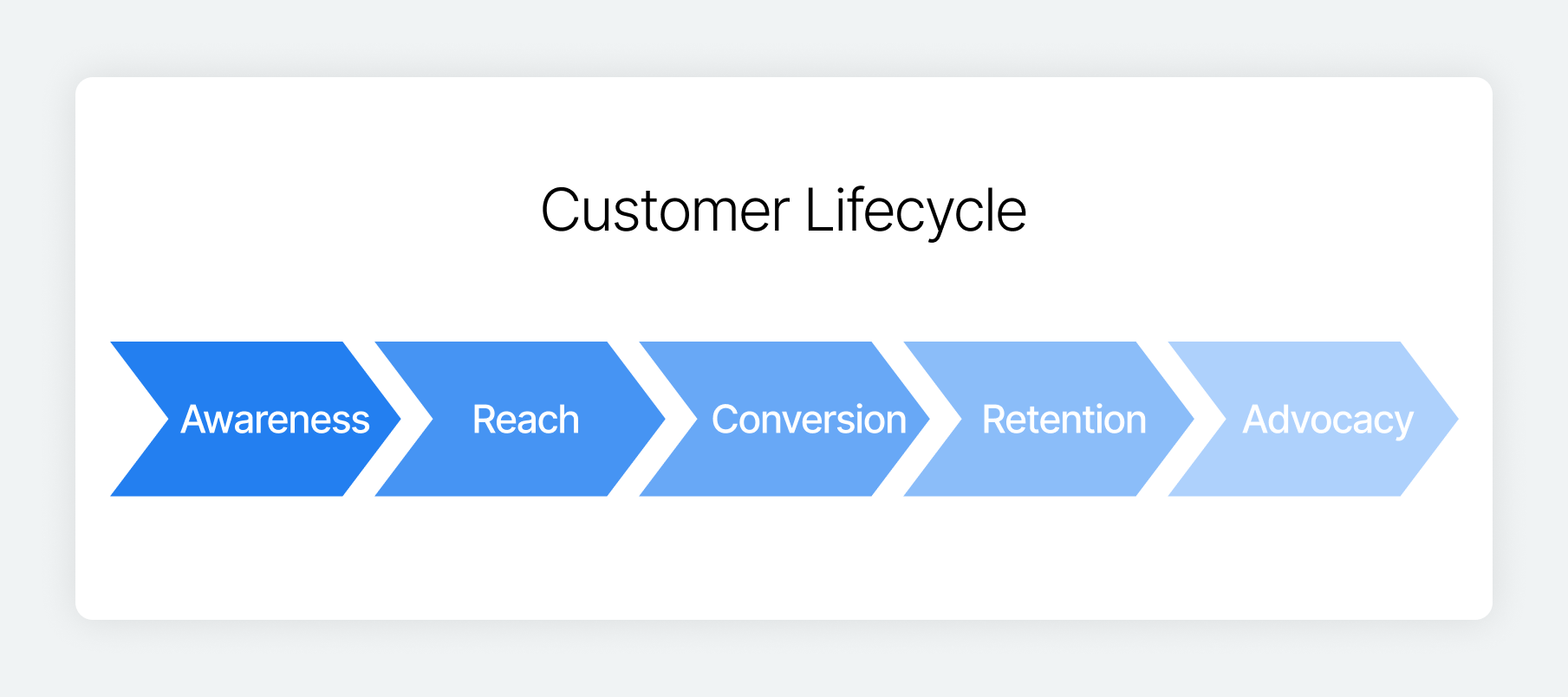
Most businesses break this relationship down into these five customer lifecycle stages, although the exact stages may vary depending on your brand.
Awareness: The customer becomes aware of your business, product, or service through various channels, such as ads, social media, or word of mouth. For example, maybe they saw your Instagram ad for your online clothing store.
Reach: The customer visits your website or social media page to learn more about your offerings. For example, they click on that IG ad and visit your online shop.
Conversion: The customer converts. They either make a purchase or take some other desired action, such as filling out a form or signing up for a newsletter. For example, they add one of your items to their cart and complete the checkout process.
Retention: The customer is satisfied with their purchase and continues to use it. Your customer retention strategies help keep them engaged and build loyalty. For example, maybe you offer exclusive discounts or early access to new collections to your most loyal customers.
Advocacy: The customer becomes a loyal fan of your business and promotes it through referrals or reviews. For example, they might share a picture of themselves wearing your clothing on social media and tag your store or leave a positive review on your website.
Customer lifecycle management helps you identify where to focus your efforts and resources to improve your marketing and sales funnel. By analyzing each stage of the customer lifecycle, you can determine where your business is succeeding and where you can better serve your customers.
For example, if you have a high customer acquisition cost but a low retention rate, you may need to focus on improving your customer retention processes. By doing so, you can ensure your existing customers have a positive experience and are more likely to continue supporting your brand.
The information you gather can help you at each stage of the customer lifecycle.
During the awareness and reach stages, you can focus on building brand awareness through targeted marketing and advertising efforts and engaging content.
To encourage conversion, you can make the buying process seamless and offer incentives such as discounts and free trials.
When you’re focused on retention, employ personalization and excellent customer service. You can reward loyal customers with special offers or exclusive content, and continually improve the product or service to keep them satisfied.
Then, you can support advocacy by encouraging satisfied customers to share their positive experiences through referrals or reviews. Respond promptly to any negative feedback to address any issues.
What Is the Customer Journey?
The customer journey, sometimes also referred to as the customer experience journey, is the individual end-to-end experience a customer has with a business. It encompasses all the touchpoints a customer has with your company, from pre-purchase research to post-purchase support.
Unlike the 10,000-foot view the customer lifecycle gives you, the customer journey gives you a narrower understanding of your customer experience. (That means this isn’t a question of customer journey vs. customer experience; rather, customer journey helps you analyze your customer experience.)
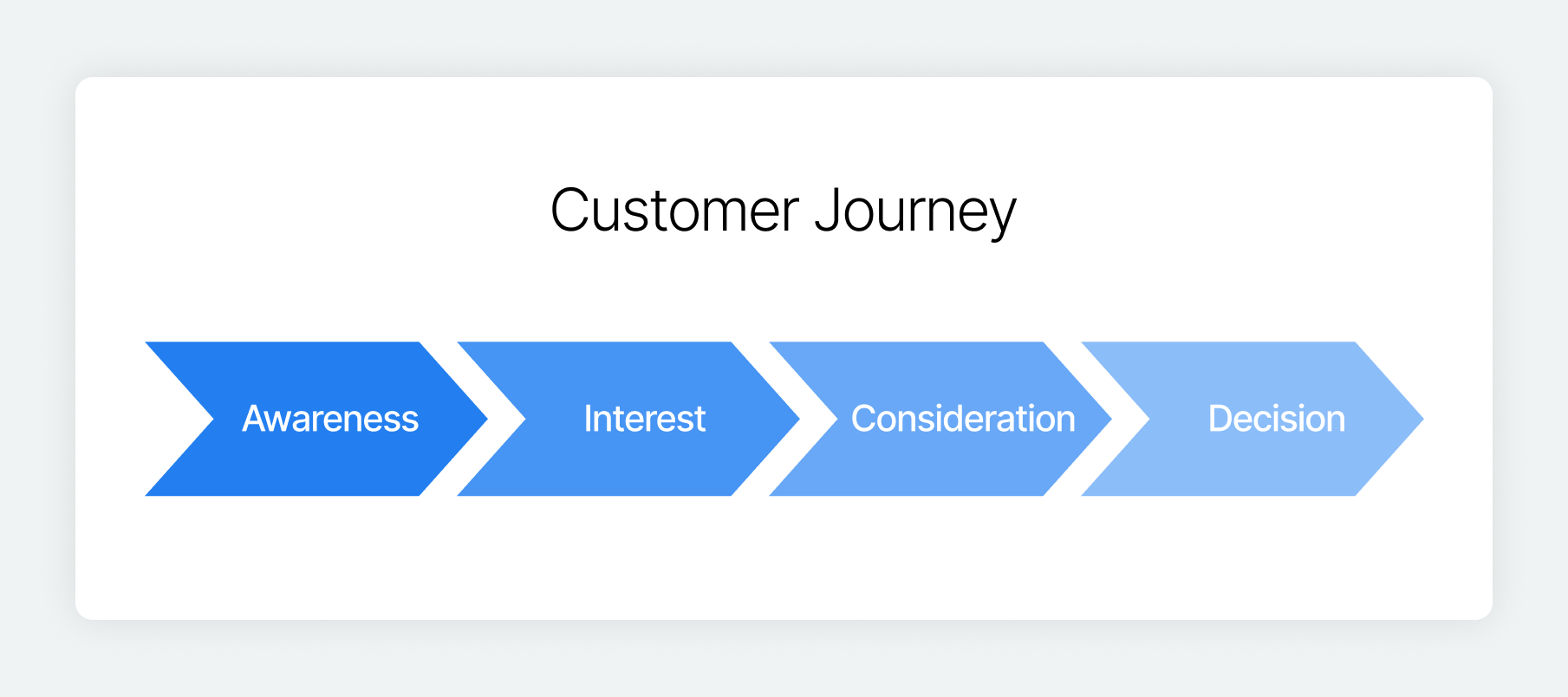
There are typically a number of customer journey touchpoints along the way. (And a quick note on language: We avoid describing these as “stages of the customer journey” to help limit confusion between these two concepts.) Some of the key touchpoints, according to Harvard Division of Continuing Education, include:
Awareness: The customer becomes aware of a problem or a need. They begin to research and gather information about possible solutions. For example, if they need affordable stainless steel jewelry, they may start looking for online businesses that offer it.
Interest: After a customer becomes aware of a product or service that can solve their problem, they begin to develop an interest in it. They may start to research and gather more information about the product, its features, and its benefits. For example, they may start researching different brands, reading reviews, and comparing features and pricing of companies that sell stainless steel jewelry.
Consideration: Once the customer has identified the best option (your business!), they begin to evaluate your products and jewelry designs. They may read reviews on your website, watch videos, or talk to friends and family to gather more information in consideration of making a purchase.
Decision: The customer is ready to convert or make a purchase and buy their first piece of jewelry from your brand. (A conversion may complete the buyer’s journey, or you may have additional touchpoints like post-purchase surveys or support.)
Customer journey analytics help you understand each touchpoint of the customer journey. In turn, you can identify areas of improvement and optimize your processes to provide a better experience.
There can also be effects from understanding your customer journey on retention. You can identify potential pain points or issues that may cause customers to churn and address them proactively. This can lead to increased customer satisfaction, loyalty, and advocacy, which are critical for long-term success.
This process is often called customer journey mapping. This is a tool used to visualize the customer journey and identify opportunities for improvement. Here are the steps involved in customer journey mapping:
Define the customer persona: Identify the customer's needs, goals, and pain points.
List the touchpoints: List all the touchpoints the customer has with your business, from pre-purchase research to post-purchase support.
Gather feedback: Collect feedback from customers through surveys, reviews, or customer service interactions.
Identify pain points: Analyze the feedback and determine the areas where customers are experiencing difficulty or frustration.
Prioritize improvements: Address those pain points based on the effect they have on the customer experience and your business’s resources.
Implement improvements: Develop and put in place solutions to address the pain points, such as improving website navigation, providing more comprehensive product information, or streamlining the checkout process.
Monitor and evaluate: Continuously assess the customer journey to identify any new pain points and make further improvements.
Customer Lifecycle vs. Customer Journey: What’s the Difference?
The customer lifecycle and customer journey are two different concepts, although they are often used interchangeably. Let’s take a closer look at customer lifecycle vs. customer journey.
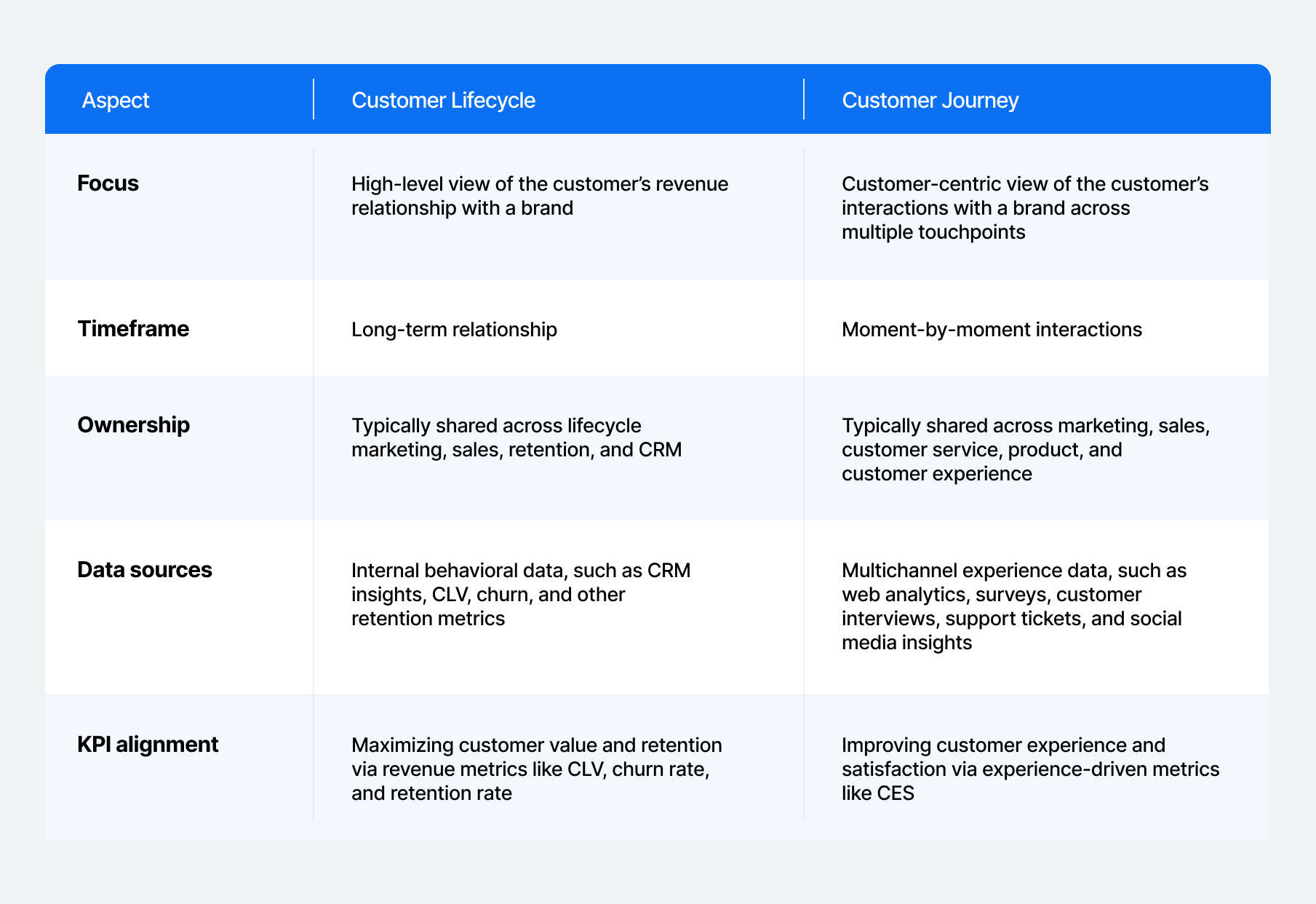
Focus: The customer lifecycle is focused on the different stages a customer goes through, from initial awareness to advocacy, from the perspective of the company. The customer journey focuses on the individual touchpoints and experiences a customer has with the business, from the perspective of the customer.
Timeframe: A customer lifecycle is a long-term approach, whereas the customer journey is more immediate and focused on the current experience.
Ownership: In both cases, ownership is shared across numerous teams and staffers. Lifecycle typically falls under the umbrella of marketing, sales, retention, and CRM teams, while journey is typically shared across marketing, sales, customer service, product, and customer experience teams.
Data sources: Lifecycle insights usually draw upon internal data about your customers’ behavior, such as your CLV, churn rate, retention rate, and other customer retention analytics. Consumer journey data is more experiential, such as feedback from surveys and interviews, support tickets, and social media.
KPI alignment: The customer lifecycle is aligned with maximizing customer value and retention, whereas the customer journey is focused on improving customer engagement, experience, and satisfaction.
In summary, the customer lifecycle is a high-level view of the customer relationship, while the customer journey is a more detailed view of the customer experience. Both concepts are important for businesses to understand, but they serve different purposes.
How to Choose the Most Relevant Approach for Your Business
When deciding to focus on the customer lifecycle or journey, consider several factors, including:
Business goals: The approach you take should align with your brand’s goals and objectives, such as increasing revenue, improving customer retention, or driving customer satisfaction.
Customer preferences: Tailor your approach to the preferences and needs of your target customer base, taking into account factors like age, location, and purchasing habits.
Resources: Make sure your approach is feasible given your available resources, including time, budget, and staff.
Stage of business: New businesses may choose to focus on customer acquisition (journey), while a more established business might focus on customer retention (lifecycle).
Industry and competition: Assess your competitive landscape and the specific challenges and opportunities within your industry, then decide which approach is more vital to you to monitor.
How to Integrate Customer Lifecycle and Customer Journey Approaches
Customer lifecycle and customer journey are distinct concepts, but they’re clearly related. Use both to your advantage and view them as complementary. By integrating these approaches, you can gain a more comprehensive understanding of the relationship your customers have with your brand. And when you dig deeper into both approaches, you can develop targeted strategies for improving experience, retention, and loyalty.
“Good teams build lifecycle plans. Good teams build journey maps,” Bryant Garvin, Operator in Residence at Triple Whale, says. “Great teams, and smart operators, connect the two.”
“This is why your CRM, paid, CX, product, and UGC programs should feel like one system, not separate departments fighting for the same customer. Each has a particular set of skills that, when layered together, drive revenue growth and positive consumer sentiment.”
One way to integrate both approaches is to map the customer journey within the context of the customer lifecycle. This involves identifying the touchpoints within each stage of the customer lifecycle and analyzing the customer experience at each. Another way to integrate these approaches is to use customer feedback to inform both the customer lifecycle and the customer journey.
These integration strategies give you a deeper understanding of the customer experience and help you identify areas for improvement at every possible touchpoint.
Common Challenges and How to Avoid Them
When you’re first starting out analyzing your customer lifecycle and journey, you may encounter a few bumps in the road. Here are a few frequent issues to be aware of.
Challenges in Managing the Customer Lifecycle
Lack of integration: Let’s say your marketing and sales teams focus on customer acquisition, while your customer support and customer success teams focus on customer engagement. This lack of alignment can result in a disjointed customer lifecycle.
Identifying key metrics to track: Measuring the effectiveness of each stage of the customer lifecycle can be tricky. It may take some time and effort to pinpoint the ecommerce metrics you’ll focus on, go through the appropriate customer segmentation, and accurately and thoughtfully interpret the data.
Challenges in Managing the Customer Journey
Lack of customer insight: If you don’t already have a clear understanding of your customers’ needs and preferences, you might struggle to deliver a seamless customer journey.
Siloed departments: Different departments within your business may have different goals and priorities, which can lead to a disjointed customer journey.
Limited resources: If you don’t have the resources to invest in improving the customer journey, you may not be able to address all the pain points you uncover at this time.
Changing customer expectations: As customer expectations evolve, you’ll have to adapt to provide a personalized, seamless customer journey, and it isn’t always easy to pivot.
Lack of integration: Different systems and technologies may not integrate seamlessly, which can lead to a fragmented customer journey.
Customer Lifecycle and Customer Journey Case Studies
Let’s take a look at a couple examples that can help you understand how businesses put these two concepts to work.
Example of Successful Customer Lifecycle Management
The marketing agency ATTN was faced with a challenge from its ecommerce business client Bones Coffee Company: They were navigating unreliable in-platform performance marketing reporting, leading to decreased performance and client frustration.
To solve this, ATTN implemented Triple Whale’s Pixel for client brands, providing attribution clarity and real-time insights for clients. They also used a post-purchase survey integration to further validate attribution data with customer survey responses.
As a result, they were able to scale Bones Coffee's YouTube daily ad spend by +960% within 45 days, leading to a +701% growth in net profit and an 84% decrease in blended CPA year over year.
Example of Successful Customer Journey Management
Ecommerce supplement business Obvi was struggling with unreliable in-platform data on Facebook and TikTok, which resulted in a significant drop in returns and marketing budget.
Implementing Triple Whale's data solutions, such as the Triple Pixel, provided them with accurate data and insights into their customer journey, allowing them to optimize and scale marketing with confidence.
As a result, Obvi saw significant performance growth, with a 117% increase in marketing and a 44% decrease in CPA. Additionally, they identified more than 2,080 hours of time savings per year due to the elimination of tedious manual reporting.
Final Thoughts
Both customer lifecycle and customer journey are essential concepts for businesses looking to improve their customer experience and drive growth. While the two approaches are different, they’re closely related and should be viewed as complementary.
By understanding customer lifecycle vs. customer journey, you can develop targeted strategies for improving your customer experience and maximizing customer retention.
Learn more about how Triple Whale can help you make the most of both your customer lifecycle and your customer journey data. Book a demo today!
Customer Lifecycle vs. Customer Journey FAQs
What’s the difference between the customer lifecycle and customer journey?
The customer lifecycle is a high-level view of the customer relationship, from the perspective of the business. The customer journey is a more detailed view of the customer experience from the perspective of the customer.
What are the main stages of the customer lifecycle?
The primary customer lifecycle stages are:
Awareness, when the customer first becomes aware of your brand
Reach, when they first interact with your brand online
Conversion, when they complete a desired action like making a purchase or filling out a form
Retention, when they engage and build loyalty with your brand
Advocacy, when the customer is such a fan of your business, they promote it to their network
How can aligning both approaches improve retention and customer experience?
Used together, customer lifecycle and customer journey can help you do more of what’s working and tweak what’s not as successful at precisely the touchpoints that matter for both retention and experience.
Component Sales
5.32K
Benchmark your ecommerce brand against industry leaders
Imagine you’re on a road trip. You have a destination in mind, but the journey is just as important as the endpoint. You encounter different landscapes, weather, and roadblocks along the way, each adding positively or negatively to your experience.
Now imagine the many, many other people who have made that same road trip.
Your unique road trip experience is like a customer journey with an ecommerce business. The customer journey is all about the individual experiences and interactions a user has with your brand at each touchpoint or interaction.
The collective experience of everyone who has embarked on the same road trip is like the customer lifecycle. This big-picture look at a customer’s entire relationship with your brand encompasses various stages like awareness and loyalty, rather than focusing on specific interactions.
Clearly, there are some differences when you’re considering customer lifecycle vs. customer journey, but due to their similarities, the two terms are often used interchangeably.
Here, learn more about the differences between these two concepts and how both contribute to your bottom line.
What Is the Customer Lifecycle?
The customer lifecycle is a high-level understanding of how customers interact with a business over time, from the first moment they become aware of the brand to ongoing loyalty and retention. A common customer lifecycle definition is the start-to-finish experience customers have with a business, encompassing all stages of their relationship.
Most businesses break this relationship down into these five customer lifecycle stages, although the exact stages may vary depending on your brand.
Awareness: The customer becomes aware of your business, product, or service through various channels, such as ads, social media, or word of mouth. For example, maybe they saw your Instagram ad for your online clothing store.
Reach: The customer visits your website or social media page to learn more about your offerings. For example, they click on that IG ad and visit your online shop.
Conversion: The customer converts. They either make a purchase or take some other desired action, such as filling out a form or signing up for a newsletter. For example, they add one of your items to their cart and complete the checkout process.
Retention: The customer is satisfied with their purchase and continues to use it. Your customer retention strategies help keep them engaged and build loyalty. For example, maybe you offer exclusive discounts or early access to new collections to your most loyal customers.
Advocacy: The customer becomes a loyal fan of your business and promotes it through referrals or reviews. For example, they might share a picture of themselves wearing your clothing on social media and tag your store or leave a positive review on your website.
Customer lifecycle management helps you identify where to focus your efforts and resources to improve your marketing and sales funnel. By analyzing each stage of the customer lifecycle, you can determine where your business is succeeding and where you can better serve your customers.
For example, if you have a high customer acquisition cost but a low retention rate, you may need to focus on improving your customer retention processes. By doing so, you can ensure your existing customers have a positive experience and are more likely to continue supporting your brand.
The information you gather can help you at each stage of the customer lifecycle.
During the awareness and reach stages, you can focus on building brand awareness through targeted marketing and advertising efforts and engaging content.
To encourage conversion, you can make the buying process seamless and offer incentives such as discounts and free trials.
When you’re focused on retention, employ personalization and excellent customer service. You can reward loyal customers with special offers or exclusive content, and continually improve the product or service to keep them satisfied.
Then, you can support advocacy by encouraging satisfied customers to share their positive experiences through referrals or reviews. Respond promptly to any negative feedback to address any issues.
What Is the Customer Journey?
The customer journey, sometimes also referred to as the customer experience journey, is the individual end-to-end experience a customer has with a business. It encompasses all the touchpoints a customer has with your company, from pre-purchase research to post-purchase support.
Unlike the 10,000-foot view the customer lifecycle gives you, the customer journey gives you a narrower understanding of your customer experience. (That means this isn’t a question of customer journey vs. customer experience; rather, customer journey helps you analyze your customer experience.)
There are typically a number of customer journey touchpoints along the way. (And a quick note on language: We avoid describing these as “stages of the customer journey” to help limit confusion between these two concepts.) Some of the key touchpoints, according to Harvard Division of Continuing Education, include:
Awareness: The customer becomes aware of a problem or a need. They begin to research and gather information about possible solutions. For example, if they need affordable stainless steel jewelry, they may start looking for online businesses that offer it.
Interest: After a customer becomes aware of a product or service that can solve their problem, they begin to develop an interest in it. They may start to research and gather more information about the product, its features, and its benefits. For example, they may start researching different brands, reading reviews, and comparing features and pricing of companies that sell stainless steel jewelry.
Consideration: Once the customer has identified the best option (your business!), they begin to evaluate your products and jewelry designs. They may read reviews on your website, watch videos, or talk to friends and family to gather more information in consideration of making a purchase.
Decision: The customer is ready to convert or make a purchase and buy their first piece of jewelry from your brand. (A conversion may complete the buyer’s journey, or you may have additional touchpoints like post-purchase surveys or support.)
Customer journey analytics help you understand each touchpoint of the customer journey. In turn, you can identify areas of improvement and optimize your processes to provide a better experience.
There can also be effects from understanding your customer journey on retention. You can identify potential pain points or issues that may cause customers to churn and address them proactively. This can lead to increased customer satisfaction, loyalty, and advocacy, which are critical for long-term success.
This process is often called customer journey mapping. This is a tool used to visualize the customer journey and identify opportunities for improvement. Here are the steps involved in customer journey mapping:
Define the customer persona: Identify the customer's needs, goals, and pain points.
List the touchpoints: List all the touchpoints the customer has with your business, from pre-purchase research to post-purchase support.
Gather feedback: Collect feedback from customers through surveys, reviews, or customer service interactions.
Identify pain points: Analyze the feedback and determine the areas where customers are experiencing difficulty or frustration.
Prioritize improvements: Address those pain points based on the effect they have on the customer experience and your business’s resources.
Implement improvements: Develop and put in place solutions to address the pain points, such as improving website navigation, providing more comprehensive product information, or streamlining the checkout process.
Monitor and evaluate: Continuously assess the customer journey to identify any new pain points and make further improvements.
Customer Lifecycle vs. Customer Journey: What’s the Difference?
The customer lifecycle and customer journey are two different concepts, although they are often used interchangeably. Let’s take a closer look at customer lifecycle vs. customer journey.
Focus: The customer lifecycle is focused on the different stages a customer goes through, from initial awareness to advocacy, from the perspective of the company. The customer journey focuses on the individual touchpoints and experiences a customer has with the business, from the perspective of the customer.
Timeframe: A customer lifecycle is a long-term approach, whereas the customer journey is more immediate and focused on the current experience.
Ownership: In both cases, ownership is shared across numerous teams and staffers. Lifecycle typically falls under the umbrella of marketing, sales, retention, and CRM teams, while journey is typically shared across marketing, sales, customer service, product, and customer experience teams.
Data sources: Lifecycle insights usually draw upon internal data about your customers’ behavior, such as your CLV, churn rate, retention rate, and other customer retention analytics. Consumer journey data is more experiential, such as feedback from surveys and interviews, support tickets, and social media.
KPI alignment: The customer lifecycle is aligned with maximizing customer value and retention, whereas the customer journey is focused on improving customer engagement, experience, and satisfaction.
In summary, the customer lifecycle is a high-level view of the customer relationship, while the customer journey is a more detailed view of the customer experience. Both concepts are important for businesses to understand, but they serve different purposes.
How to Choose the Most Relevant Approach for Your Business
When deciding to focus on the customer lifecycle or journey, consider several factors, including:
Business goals: The approach you take should align with your brand’s goals and objectives, such as increasing revenue, improving customer retention, or driving customer satisfaction.
Customer preferences: Tailor your approach to the preferences and needs of your target customer base, taking into account factors like age, location, and purchasing habits.
Resources: Make sure your approach is feasible given your available resources, including time, budget, and staff.
Stage of business: New businesses may choose to focus on customer acquisition (journey), while a more established business might focus on customer retention (lifecycle).
Industry and competition: Assess your competitive landscape and the specific challenges and opportunities within your industry, then decide which approach is more vital to you to monitor.
How to Integrate Customer Lifecycle and Customer Journey Approaches
Customer lifecycle and customer journey are distinct concepts, but they’re clearly related. Use both to your advantage and view them as complementary. By integrating these approaches, you can gain a more comprehensive understanding of the relationship your customers have with your brand. And when you dig deeper into both approaches, you can develop targeted strategies for improving experience, retention, and loyalty.
“Good teams build lifecycle plans. Good teams build journey maps,” Bryant Garvin, Operator in Residence at Triple Whale, says. “Great teams, and smart operators, connect the two.”
“This is why your CRM, paid, CX, product, and UGC programs should feel like one system, not separate departments fighting for the same customer. Each has a particular set of skills that, when layered together, drive revenue growth and positive consumer sentiment.”
One way to integrate both approaches is to map the customer journey within the context of the customer lifecycle. This involves identifying the touchpoints within each stage of the customer lifecycle and analyzing the customer experience at each. Another way to integrate these approaches is to use customer feedback to inform both the customer lifecycle and the customer journey.
These integration strategies give you a deeper understanding of the customer experience and help you identify areas for improvement at every possible touchpoint.
Common Challenges and How to Avoid Them
When you’re first starting out analyzing your customer lifecycle and journey, you may encounter a few bumps in the road. Here are a few frequent issues to be aware of.
Challenges in Managing the Customer Lifecycle
Lack of integration: Let’s say your marketing and sales teams focus on customer acquisition, while your customer support and customer success teams focus on customer engagement. This lack of alignment can result in a disjointed customer lifecycle.
Identifying key metrics to track: Measuring the effectiveness of each stage of the customer lifecycle can be tricky. It may take some time and effort to pinpoint the ecommerce metrics you’ll focus on, go through the appropriate customer segmentation, and accurately and thoughtfully interpret the data.
Challenges in Managing the Customer Journey
Lack of customer insight: If you don’t already have a clear understanding of your customers’ needs and preferences, you might struggle to deliver a seamless customer journey.
Siloed departments: Different departments within your business may have different goals and priorities, which can lead to a disjointed customer journey.
Limited resources: If you don’t have the resources to invest in improving the customer journey, you may not be able to address all the pain points you uncover at this time.
Changing customer expectations: As customer expectations evolve, you’ll have to adapt to provide a personalized, seamless customer journey, and it isn’t always easy to pivot.
Lack of integration: Different systems and technologies may not integrate seamlessly, which can lead to a fragmented customer journey.
Customer Lifecycle and Customer Journey Case Studies
Let’s take a look at a couple examples that can help you understand how businesses put these two concepts to work.
Example of Successful Customer Lifecycle Management
The marketing agency ATTN was faced with a challenge from its ecommerce business client Bones Coffee Company: They were navigating unreliable in-platform performance marketing reporting, leading to decreased performance and client frustration.
To solve this, ATTN implemented Triple Whale’s Pixel for client brands, providing attribution clarity and real-time insights for clients. They also used a post-purchase survey integration to further validate attribution data with customer survey responses.
As a result, they were able to scale Bones Coffee's YouTube daily ad spend by +960% within 45 days, leading to a +701% growth in net profit and an 84% decrease in blended CPA year over year.
Example of Successful Customer Journey Management
Ecommerce supplement business Obvi was struggling with unreliable in-platform data on Facebook and TikTok, which resulted in a significant drop in returns and marketing budget.
Implementing Triple Whale's data solutions, such as the Triple Pixel, provided them with accurate data and insights into their customer journey, allowing them to optimize and scale marketing with confidence.
As a result, Obvi saw significant performance growth, with a 117% increase in marketing and a 44% decrease in CPA. Additionally, they identified more than 2,080 hours of time savings per year due to the elimination of tedious manual reporting.
Final Thoughts
Both customer lifecycle and customer journey are essential concepts for businesses looking to improve their customer experience and drive growth. While the two approaches are different, they’re closely related and should be viewed as complementary.
By understanding customer lifecycle vs. customer journey, you can develop targeted strategies for improving your customer experience and maximizing customer retention.
Learn more about how Triple Whale can help you make the most of both your customer lifecycle and your customer journey data. Book a demo today!
Customer Lifecycle vs. Customer Journey FAQs
What’s the difference between the customer lifecycle and customer journey?
The customer lifecycle is a high-level view of the customer relationship, from the perspective of the business. The customer journey is a more detailed view of the customer experience from the perspective of the customer.
What are the main stages of the customer lifecycle?
The primary customer lifecycle stages are:
Awareness, when the customer first becomes aware of your brand
Reach, when they first interact with your brand online
Conversion, when they complete a desired action like making a purchase or filling out a form
Retention, when they engage and build loyalty with your brand
Advocacy, when the customer is such a fan of your business, they promote it to their network
How can aligning both approaches improve retention and customer experience?
Used together, customer lifecycle and customer journey can help you do more of what’s working and tweak what’s not as successful at precisely the touchpoints that matter for both retention and experience.
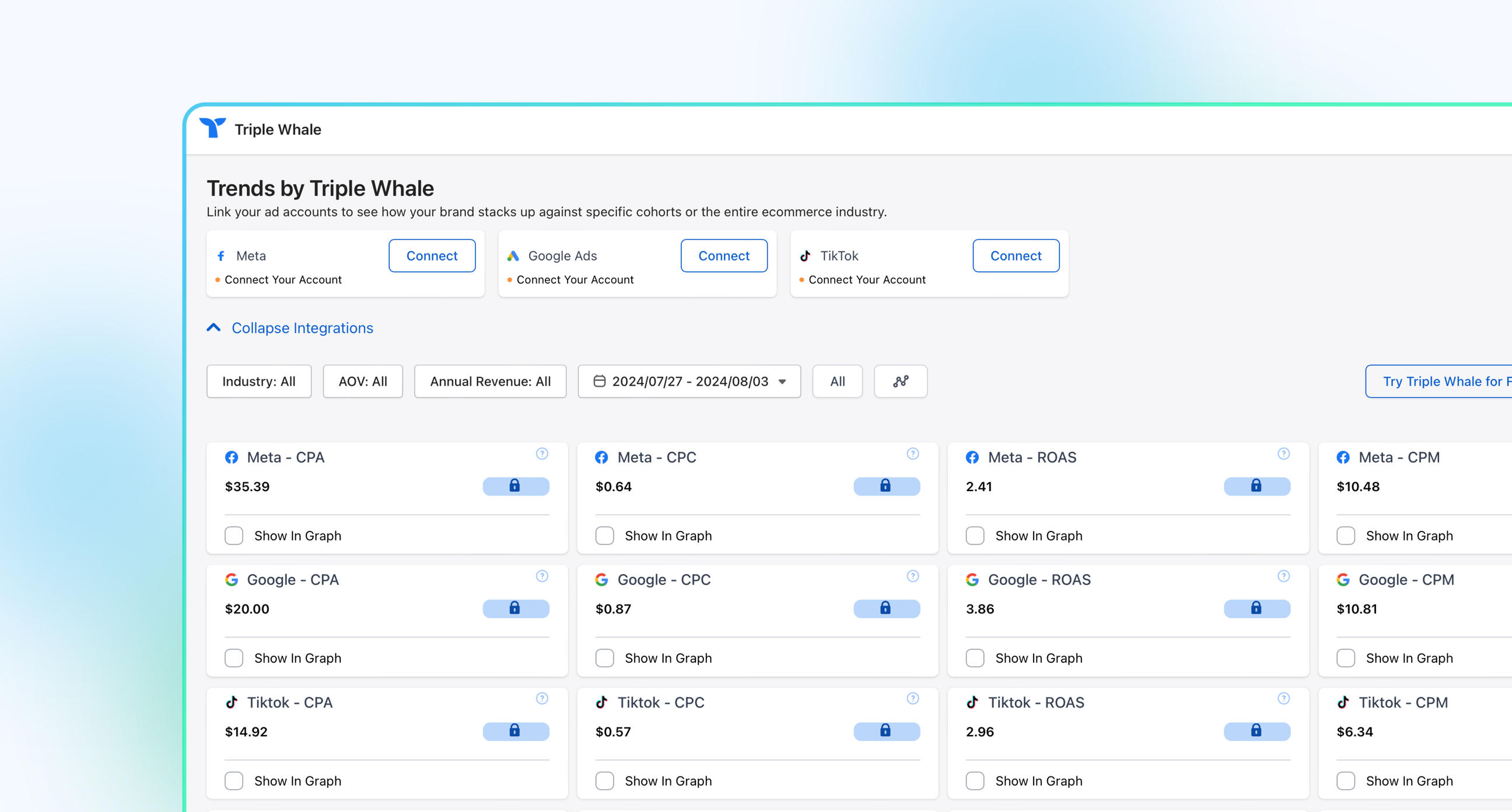
Body Copy: The following benchmarks compare advertising metrics from April 1-17 to the previous period. Considering President Trump first unveiled his tariffs on April 2, the timing corresponds with potential changes in advertising behavior among ecommerce brands (though it isn’t necessarily correlated).


 Moby AIAsk questions, analyze performance, and work with your business context.
 ActionsTake governed action across the tools that run your business.
 AutomationsSchedule recurring analysis and work that runs on your terms.
 Landing PagesCreative conversion-focused ecommerce pages with Moby.
 Creative StudioGenerate and refine creative grounded in your brand.




.webp)



.webp)

.webp)
