Measuring what truly drives incremental growth is harder than ever. Customer journeys jump across 20+ touchpoints, privacy changes break tracking, and every ad platform claims credit for the same conversions.
Incrementality testing cuts through that noise, revealing which channels, campaigns, and tactics actually cause lift.
In this guide, we break down the best incrementality testing tools of 2026, compare features, and help you determine which platform is right for your business.
What Is Incrementality Testing?
Incrementality measures the causal impact, or the true impact, of your marketing. In other words, incrementality testing methods help you understand what would have happened anyway, without your ads.
Unlike traditional marketing attribution, which tells you where clicks came from, incrementality isolates the additional revenue, conversions, or acquisitions generated because of your marketing. While it shares some similarities with A/B testing, it's far more complex than that. Learn more about incrementality vs A/B testing here.
It gives marketers confidence in scaled decisions, even when signal loss and cross-device behavior make attribution murky, especially those dealing with:
Cross-device behavior
Loss of tracking signals
Upper-funnel investments
Offline and online channel mixes
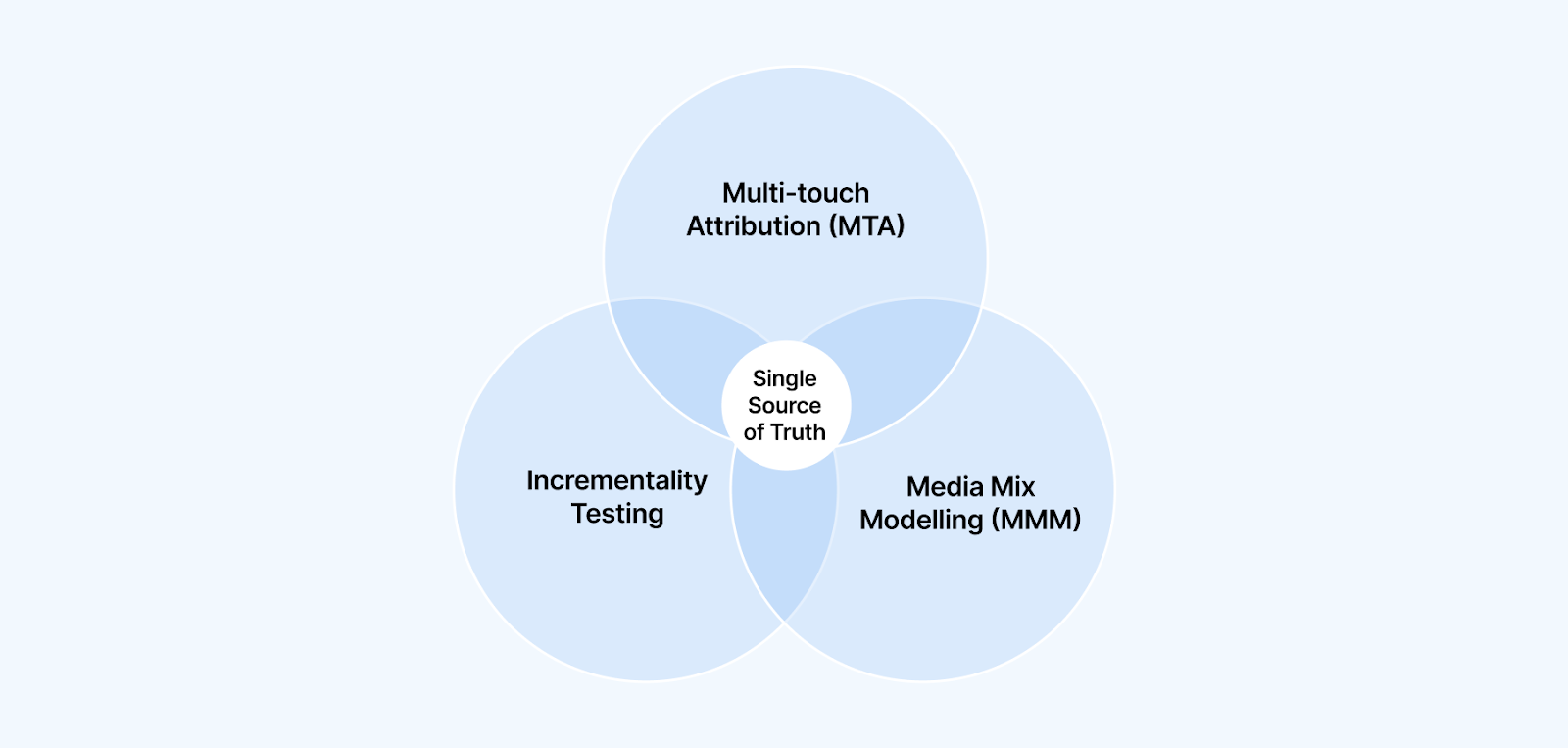
Incrementality becomes even more powerful when paired with marketing mix modeling (MMM) and multi-touch attribution (MTA):
MMM: Identifies long-term revenue correlations across channels
MTA: Surfaces which touchpoints influence conversions
Incrementality testing: Proves causal lift
Together, these tools triangulate reality with far greater accuracy.
What to Look for in Incrementality Testing Platforms
Choosing the right incrementality testing platform is about more than simply having the ability to run single, or multiple experiments. The best tools help you design statistically valid tests, automate complex workflows, integrate cleanly with your data, and turn results into actionable next steps.
Below are the core capabilities to evaluate as you compare solutions.
Scientific Rigor & Methodology
A strong platform must be grounded in proven scientific methods, such as:
Randomized control trials (RCTs)
Geo-experiments
Audience-level holdouts
Robust statistical modeling
Tools that rely on simplistic heuristics or opaque black boxes risk misleading results. The platform should transparently explain how lift is calculated and how noise, variance, and bias are handled.
Triple Whale’s marketing data science team, for example, helps brands design and interpret experiments for accuracy and business relevance.
Synthetic Controls Over Matched Markets
Many older incrementality tools use matched markets — pairing two similar geographic regions (e.g., Detroit vs. Milwaukee) and comparing performance across them. But matched markets rarely behave identically, and small differences can skew results.
Synthetic control modeling creates a composite holdout group from multiple regions to more accurately mirror the treated market. This dramatically improves reliability and reduces false positives.
Privacy-Durable, First-Party Data Integration
Your incrementality solution should be built for a world without third-party cookies. That means:
Native integrations with your data warehouse
Reliance on durable first-party metrics (orders, revenue, installs, subscriptions)
Minimal dependence on pixel-based signals
Privacy-proofing ensures your experiments remain valid as policies evolve.
Fast, Flexible Experiment Setup
Incrementality testing should not require weeks of data science work. Modern tools compress complex experiment design into minutes, enabling:
Geo experiments
Audience holdouts
Channel-level tests
Creative or tactic lift studies
Multi-market testing at scale
If setup requires manual CSV uploads or engineering resources, the tool will slow your optimization cycles.
Clear, Actionable Analytics
Incrementality results are only useful if your team can understand them and act on them. The best platforms provide clean, intuitive reporting with metrics such as:
Incremental ROAS (iROAS)
Cost per incremental acquisition (CPIA)
Revenue lift
Confidence intervals
Directional insights
Even more valuable is the ability to connect these findings back to everyday media decisions — reallocating budget, adjusting bids, optimizing creative, or planning spend.
Integration into Broader Measurement
Incrementality testing is not an island. It’s most valuable when paired with MMM and MTA.
Standalone tools often create fragmentation — conflicting results, duplicated work, and slower decisions.
The Best Incrementality Testing Tools in 2026
Below is our comparison of the top tools marketers are using this year — what they do well, where they fall short, and who each tool is best for.
Compass by Triple Whale (MTA + MMM + Incrementality + AI Agents)
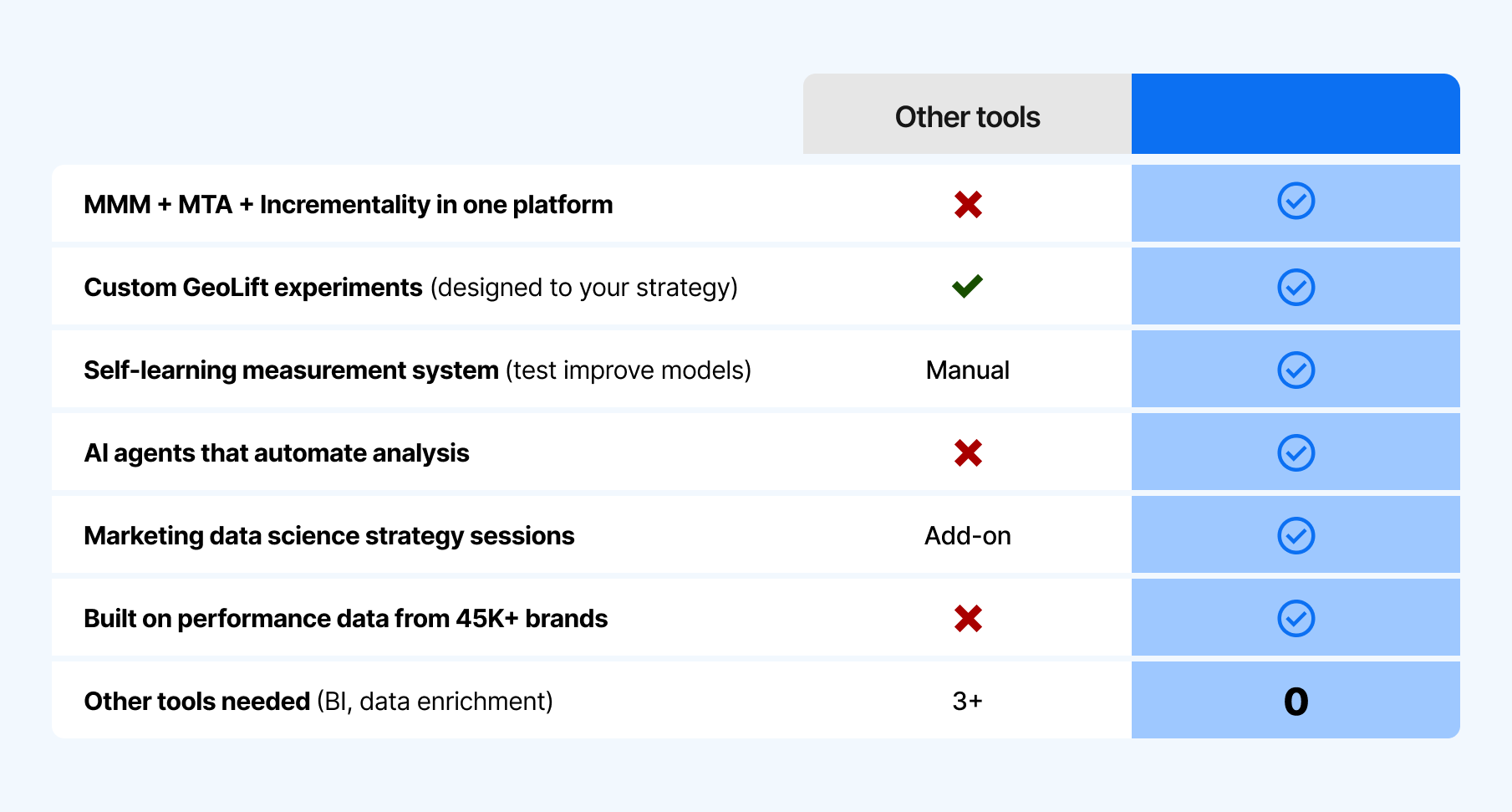
While most tools only show marketing performance through a single lens, Compass by Triple Whale brings all three methodologies (incrementality or MMM or MTA) into a single decision-ready view.
This model is powered by AI agents that get smarter with every test, combined with expert guidance from marketing data scientists, so your insights are fully unified and tailored to your business.
Key Features:
Unified MTA, MMM, and incrementality in one platform
MMM with scenario planning and flexible MTA for real-time optimization
Built-in incrementality tests launched and applied directly in the platform
Always-on agents purpose-built for marketing measurement and decision-making
Embedded marketing science support for experiment design & strategic guidance
Best for: Scaling, multi-channel ecommerce brands with complex funnels that want a complete, integrated measurement system; with heavy view-through activity
Pricing: Paid add-on to existing Triple Whale plans; inclusive of MMM, incrementality testing, AI agents, and marketing science support
Pros: Only unified measurement system with MTA + MMM + Incrementality + AI agents powered by your business’s data; One seamless view in your Triple Whale dashboard for simplified decision-making
Cons: Best suited for scaling teams with complex measurement needs; Not ideal for early-stage brands that primarily rely on attribution only
Google (Incrementality)
Google offers native incrementality options including Conversion Lift and Geo Experiments.
Key Features:
Channel-level lift measurement
Geo experiments for search, shopping, and YouTube
Audience-based conversion lift
Best for: Performance marketers optimizing Google Ads
Pricing: Included with Google Ads for eligible spend levels.
Pros: Easy setup for Google campaigns; No additional software required
Cons: Limited to Google’s ecosystem; No cross-channel lifts; Requires large spend and traffic to run meaningful tests
TikTok Conversion Lift (Incrementality)
TikTok’s native conversion lift product helps quantify the causal effect of TikTok ads.
Key Features:
Audience-level lift tests
Full-funnel lift
Native integration with TikTok’s ad manager
Best for:Brands doing heavy TikTok investment, especially TOF.
Pricing:Included for qualifying campaigns.
Pros: Easy to activate; Clear lift reporting
Cons:TikTok-only; Requires significant spend for statistical power
Haus (Incrementality + MMM)
Haus focuses exclusively on incrementality experiments and automation.
Key Features:
Geo-experimentation
Lift modeling
Market-level experimentation tools
MMM informed by experiments
Best for: Smaller brands that want a standalone incrementality platform.
Pricing: Custom
Pros: Strong experimentation tooling
Cons: Requires reconciling results manually, siloed from other measurement tools, lack of cross-channel visibility; Only measures what you test, leaving measurement gaps across the full mix
Measured (Incrementality + Attribution)
Measured combines incrementality with attribution modeling and analytics dashboards.
Key Features:
Incrementality measurement
Media planning tools
Attribution overlap analysis
Best for: Brands with large budgets and multi-agency collaboration.
Pricing:Enterprise pricing
Pros: Strong analytics
Cons: No unified MMM + MTA integration; Longer implementation cycles and setup can be complex
INCRMNTAL (Always-On Incrementality)
INCRMNTAL uses automated modeling to estimate incremental impact without running explicit holdouts.
Key Features:
Always-on incrementality estimation
Predictive models
Creative + campaign lift insights
Best for: Teams wanting a lightweight, continuous incrementality read.
Pricing: Custom
Pros: Continuous modeling
Cons: Not as scientifically rigorous as holdout-based experiments; Requires interpretation for actionability
How to Choose the Right Incrementality Tools (and When You Need More Than Just Testing)
Incrementality testing is essential — but it’s only one part of the measurement puzzle. The right tool for your business depends on your stage of growth, your channel mix, and how sophisticated your decision-making needs to be.
By Growth Stage
Here’s a simple way to think about where your brand fits:
Simple incrementality-only platforms or platform-native lift.
Good for isolated channel tests
Still requires manual reconciliation across tools
Scaling brands ($20M–$250M+, $500k+/month spend)
Unified Measurement by Triple Whale.
MMM + MTA + Incrementality under one roof
Ideal for brands with multi-channel complexity
Why Scaling Brands Graduate to Unified Measurement
Most tools solve one part of the measurement problem — MMM, MTA, or Incrementality. But more tools don’t mean better decisions. In fact, they often disagree, slow teams down, and add operational drag.
Compass solves this by bringing all three models together and letting them talk to each other. Tests refine MMM. MMM calibrates MTA. AI agents detect conflicts. Data scientists translate insights into actions.
The Unified Measurement System That Does It All
Compass by Triple Whale is the only platform where MMM, MTA, and Incrementality Testing actively inform each other, creating one cohesive decision engine.
If your customer journeys have outgrown what clicks can show, Compass gives you clarity, confidence, and causal truth. Book a demo today.
Incrementality Testing Tools FAQs
Can you run incrementality tests without a tool?
Yes, but only in a limited way. Running true incrementality tests manually (e.g., building holdouts, synthetic controls, or geo splits yourself) is extremely labor-intensive and requires data science expertise.
If you're an early-stage brand, you can start with platform-native lift tests from Meta, Google, or TikTok. These are easier to activate and don’t require a dedicated tool.
But as soon as you’re running multi-channel campaigns or need cross-platform causal truth, you’ll quickly outgrow platform tests and need a more robust incrementality platform.
How often should you run incrementality tests?
As often as your business questions demand. Many tools (including Triple Whale) allow unlimited tests and models.
How accurate are incrementality tools?
Accuracy depends on methodology. Holdout-based tests and synthetic controls are the gold standard.
Component Sales
5.32K
Benchmark your ecommerce brand against industry leaders
Measuring what truly drives incremental growth is harder than ever. Customer journeys jump across 20+ touchpoints, privacy changes break tracking, and every ad platform claims credit for the same conversions.
Incrementality testing cuts through that noise, revealing which channels, campaigns, and tactics actually cause lift.
In this guide, we break down the best incrementality testing tools of 2026, compare features, and help you determine which platform is right for your business.
What Is Incrementality Testing?
Incrementality measures the causal impact, or the true impact, of your marketing. In other words, incrementality testing methods help you understand what would have happened anyway, without your ads.
Unlike traditional marketing attribution, which tells you where clicks came from, incrementality isolates the additional revenue, conversions, or acquisitions generated because of your marketing. While it shares some similarities with A/B testing, it's far more complex than that. Learn more about incrementality vs A/B testing here.
It gives marketers confidence in scaled decisions, even when signal loss and cross-device behavior make attribution murky, especially those dealing with:
Cross-device behavior
Loss of tracking signals
Upper-funnel investments
Offline and online channel mixes
Incrementality becomes even more powerful when paired with marketing mix modeling (MMM) and multi-touch attribution (MTA):
MMM: Identifies long-term revenue correlations across channels
MTA: Surfaces which touchpoints influence conversions
Incrementality testing: Proves causal lift
Together, these tools triangulate reality with far greater accuracy.
What to Look for in Incrementality Testing Platforms
Choosing the right incrementality testing platform is about more than simply having the ability to run single, or multiple experiments. The best tools help you design statistically valid tests, automate complex workflows, integrate cleanly with your data, and turn results into actionable next steps.
Below are the core capabilities to evaluate as you compare solutions.
Scientific Rigor & Methodology
A strong platform must be grounded in proven scientific methods, such as:
Randomized control trials (RCTs)
Geo-experiments
Audience-level holdouts
Robust statistical modeling
Tools that rely on simplistic heuristics or opaque black boxes risk misleading results. The platform should transparently explain how lift is calculated and how noise, variance, and bias are handled.
Triple Whale’s marketing data science team, for example, helps brands design and interpret experiments for accuracy and business relevance.
Synthetic Controls Over Matched Markets
Many older incrementality tools use matched markets — pairing two similar geographic regions (e.g., Detroit vs. Milwaukee) and comparing performance across them. But matched markets rarely behave identically, and small differences can skew results.
Synthetic control modeling creates a composite holdout group from multiple regions to more accurately mirror the treated market. This dramatically improves reliability and reduces false positives.
Privacy-Durable, First-Party Data Integration
Your incrementality solution should be built for a world without third-party cookies. That means:
Native integrations with your data warehouse
Reliance on durable first-party metrics (orders, revenue, installs, subscriptions)
Minimal dependence on pixel-based signals
Privacy-proofing ensures your experiments remain valid as policies evolve.
Fast, Flexible Experiment Setup
Incrementality testing should not require weeks of data science work. Modern tools compress complex experiment design into minutes, enabling:
Geo experiments
Audience holdouts
Channel-level tests
Creative or tactic lift studies
Multi-market testing at scale
If setup requires manual CSV uploads or engineering resources, the tool will slow your optimization cycles.
Clear, Actionable Analytics
Incrementality results are only useful if your team can understand them and act on them. The best platforms provide clean, intuitive reporting with metrics such as:
Incremental ROAS (iROAS)
Cost per incremental acquisition (CPIA)
Revenue lift
Confidence intervals
Directional insights
Even more valuable is the ability to connect these findings back to everyday media decisions — reallocating budget, adjusting bids, optimizing creative, or planning spend.
Integration into Broader Measurement
Incrementality testing is not an island. It’s most valuable when paired with MMM and MTA.
Standalone tools often create fragmentation — conflicting results, duplicated work, and slower decisions.
The Best Incrementality Testing Tools in 2026
Below is our comparison of the top tools marketers are using this year — what they do well, where they fall short, and who each tool is best for.
Compass by Triple Whale (MTA + MMM + Incrementality + AI Agents)
While most tools only show marketing performance through a single lens, Compass by Triple Whale brings all three methodologies (incrementality or MMM or MTA) into a single decision-ready view.
This model is powered by AI agents that get smarter with every test, combined with expert guidance from marketing data scientists, so your insights are fully unified and tailored to your business.
Key Features:
Unified MTA, MMM, and incrementality in one platform
MMM with scenario planning and flexible MTA for real-time optimization
Built-in incrementality tests launched and applied directly in the platform
Always-on agents purpose-built for marketing measurement and decision-making
Embedded marketing science support for experiment design & strategic guidance
Best for: Scaling, multi-channel ecommerce brands with complex funnels that want a complete, integrated measurement system; with heavy view-through activity
Pricing: Paid add-on to existing Triple Whale plans; inclusive of MMM, incrementality testing, AI agents, and marketing science support
Pros: Only unified measurement system with MTA + MMM + Incrementality + AI agents powered by your business’s data; One seamless view in your Triple Whale dashboard for simplified decision-making
Cons: Best suited for scaling teams with complex measurement needs; Not ideal for early-stage brands that primarily rely on attribution only
Google (Incrementality)
Google offers native incrementality options including Conversion Lift and Geo Experiments.
Key Features:
Channel-level lift measurement
Geo experiments for search, shopping, and YouTube
Audience-based conversion lift
Best for: Performance marketers optimizing Google Ads
Pricing: Included with Google Ads for eligible spend levels.
Pros: Easy setup for Google campaigns; No additional software required
Cons: Limited to Google’s ecosystem; No cross-channel lifts; Requires large spend and traffic to run meaningful tests
TikTok Conversion Lift (Incrementality)
TikTok’s native conversion lift product helps quantify the causal effect of TikTok ads.
Key Features:
Audience-level lift tests
Full-funnel lift
Native integration with TikTok’s ad manager
Best for:Brands doing heavy TikTok investment, especially TOF.
Pricing:Included for qualifying campaigns.
Pros: Easy to activate; Clear lift reporting
Cons:TikTok-only; Requires significant spend for statistical power
Haus (Incrementality + MMM)
Haus focuses exclusively on incrementality experiments and automation.
Key Features:
Geo-experimentation
Lift modeling
Market-level experimentation tools
MMM informed by experiments
Best for: Smaller brands that want a standalone incrementality platform.
Pricing: Custom
Pros: Strong experimentation tooling
Cons: Requires reconciling results manually, siloed from other measurement tools, lack of cross-channel visibility; Only measures what you test, leaving measurement gaps across the full mix
Measured (Incrementality + Attribution)
Measured combines incrementality with attribution modeling and analytics dashboards.
Key Features:
Incrementality measurement
Media planning tools
Attribution overlap analysis
Best for: Brands with large budgets and multi-agency collaboration.
Pricing:Enterprise pricing
Pros: Strong analytics
Cons: No unified MMM + MTA integration; Longer implementation cycles and setup can be complex
INCRMNTAL (Always-On Incrementality)
INCRMNTAL uses automated modeling to estimate incremental impact without running explicit holdouts.
Key Features:
Always-on incrementality estimation
Predictive models
Creative + campaign lift insights
Best for: Teams wanting a lightweight, continuous incrementality read.
Pricing: Custom
Pros: Continuous modeling
Cons: Not as scientifically rigorous as holdout-based experiments; Requires interpretation for actionability
How to Choose the Right Incrementality Tools (and When You Need More Than Just Testing)
Incrementality testing is essential — but it’s only one part of the measurement puzzle. The right tool for your business depends on your stage of growth, your channel mix, and how sophisticated your decision-making needs to be.
By Growth Stage
Here’s a simple way to think about where your brand fits:
Simple incrementality-only platforms or platform-native lift.
Good for isolated channel tests
Still requires manual reconciliation across tools
Scaling brands ($20M–$250M+, $500k+/month spend)
Unified Measurement by Triple Whale.
MMM + MTA + Incrementality under one roof
Ideal for brands with multi-channel complexity
Why Scaling Brands Graduate to Unified Measurement
Most tools solve one part of the measurement problem — MMM, MTA, or Incrementality. But more tools don’t mean better decisions. In fact, they often disagree, slow teams down, and add operational drag.
Compass solves this by bringing all three models together and letting them talk to each other. Tests refine MMM. MMM calibrates MTA. AI agents detect conflicts. Data scientists translate insights into actions.
The Unified Measurement System That Does It All
Compass by Triple Whale is the only platform where MMM, MTA, and Incrementality Testing actively inform each other, creating one cohesive decision engine.
If your customer journeys have outgrown what clicks can show, Compass gives you clarity, confidence, and causal truth. Book a demo today.
Incrementality Testing Tools FAQs
Can you run incrementality tests without a tool?
Yes, but only in a limited way. Running true incrementality tests manually (e.g., building holdouts, synthetic controls, or geo splits yourself) is extremely labor-intensive and requires data science expertise.
If you're an early-stage brand, you can start with platform-native lift tests from Meta, Google, or TikTok. These are easier to activate and don’t require a dedicated tool.
But as soon as you’re running multi-channel campaigns or need cross-platform causal truth, you’ll quickly outgrow platform tests and need a more robust incrementality platform.
How often should you run incrementality tests?
As often as your business questions demand. Many tools (including Triple Whale) allow unlimited tests and models.
How accurate are incrementality tools?
Accuracy depends on methodology. Holdout-based tests and synthetic controls are the gold standard.
Share
Kaleena Stroud
Kaleena Stroud is a copywriter for SaaS and DTC businesses.
Kaleena Stroud
Kaleena Stroud is a content writer at Triple Whale, bringing data stories to life. She spent many years running an online copywriting business, where she helped brands launch and revamp their Shopify stores. Her work has been featured in Practical Ecommerce, Convert, and Create & Cultivate.
Body Copy: The following benchmarks compare advertising metrics from April 1-17 to the previous period. Considering President Trump first unveiled his tariffs on April 2, the timing corresponds with potential changes in advertising behavior among ecommerce brands (though it isn’t necessarily correlated).


 Moby AIAsk questions, analyze performance, and work with your business context.
 ActionsTake governed action across the tools that run your business.
 AutomationsSchedule recurring analysis and work that runs on your terms.
 Landing PagesCreative conversion-focused ecommerce pages with Moby.
 Creative StudioGenerate and refine creative grounded in your brand.













.webp)

.webp)
