If you’re like most advertisers, seeing an Event Match Quality (EMQ) score around 6 or 7 in Meta or TikTok’s Event Manager might send you into a panic. You’ll ask yourself, “Is this good, or bad? Should I panic? Will this tank my ROAS?”
Here’s what you need to know right upfront: EMQ is a minimum viable signal metric, not a performance lever you need to obsess over.
Meta introduced EMQ to help advertisers understand how well their conversion tracking connects website events to actual Facebook and Instagram users. TikTok introduced EMQ in late 2024 to improve ad tracking and attribution.
In this era of continual iOS privacy updates and ad blocker proliferation, this matching process has become even more critical and challenging than ever.
However, chasing a perfect 10/10 EMQ score is often a waste of time. Meta’s own internal benchmark sits around 6 out of 10, and the returns above that diminish quickly.
This guide will help you understand what EMQ actually measures, when to care about it, and when to ignore it to focus on what really matters: capturing complete, consistent conversion data across your entire funnel.
What is Event Match Quality (EMQ)?
Event Match Quality (EMQ) is how advertising platforms measure the quality of your conversion tracking data's connection between website events and actual users on their platforms. It’s like a confidence score: When someone purchases on your site, can the platform definitively link that purchase to a specific user profile?
Both Meta (for Facebook and Instagram) and TikTok use EMQ scoring to evaluate the effectiveness of your tracking. Better event matching leads to better attribution, targeting, and ad optimization. Since platforms can’t rely on third-party tracking any longer, they need high-quality first-party data from advertisers to make their ad delivery systems work effectively.
This is where EMQ comes in. Without reliable event matching, platforms can’t tell which ads are driving conversions, or which audiences are converting best. EMQ tells you how successfully your tracking setup is providing the data these platforms need to optimize your campaigns and ultimately improve your return on ad spend.
How EMQ works
Event Match Quality scoring systems rate your conversion-tracking data on a scale of 0 to 10. The score reflects how successfully the advertising platform can match the events you send — purchases, add-to-carts, page views — to specific user profiles in its database.
Platforms calculate EMQ based on two primary factors:
Customer information parameters. These are the data points you send with each event, such as email addresses, phone numbers, IP addresses, browser IDs, and click IDs. Platforms categorize these parameters by priority, and email and click IDs typically carry the most weight, while parameters like city or state provide less matching power.
Match rate percentage. This measures what percentage of your event instances successfully connect to a user account on the platform. If you send 1,000 purchase events and 850 match to identifiable users, that contributes to a stronger EMQ score.
Event Match Quality: Meta Definition
Meta’s EMQ score is calculated from the last 48 hours of data, so it can fluctuate based on recent traffic patterns and data quality. EMQ applies to both Pixel events (browser-side tracking) and Conversions API (CAPI, server-side tracking) for website activity.
Meta provides visibility into your EMQ scores in Events Manager, where you can see scores for each event type. They also offer detailed breakdowns showing which parameters you’re capturing and how frequently.
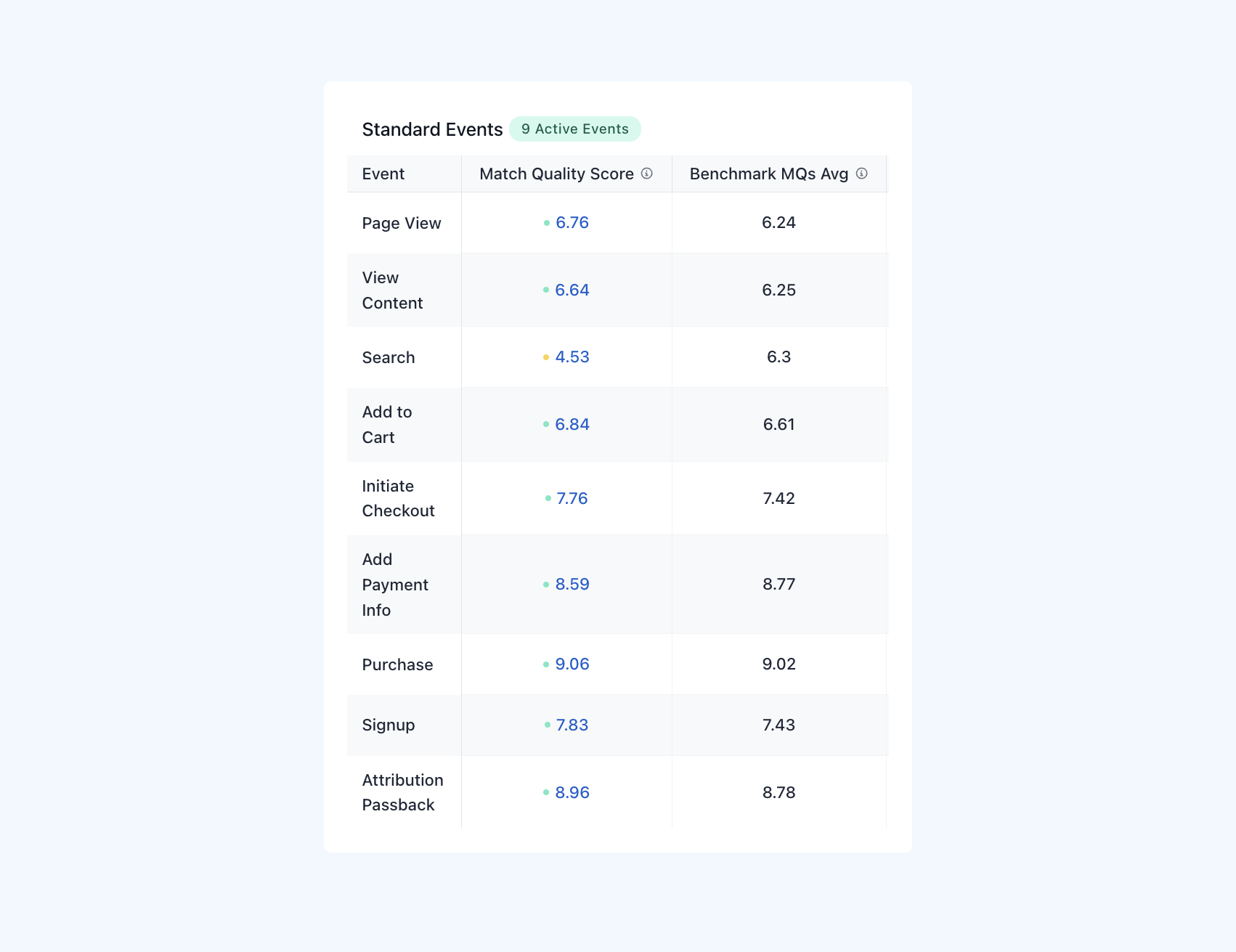
You can also find your EMQ score in Triple Whale’s Sonar Optimize Dashboard, where you can also benchmark your scores against peers in your industry. Benchmarks help you understand where you stand, where you’re underperforming, and where you can improve signal quality. It will also help assuage your fears when you see a score you expect to be higher (more on that later).
How TikTok Calculates EMQ
TikTok also uses an EMQ scoring system that calculates EMQ using a weighted average of all your match key coverages. TikTok evaluates match quality based on similar identifiers to Meta:
Click IDs from TikTok ad clicks
Hashed emails and phone numbers
External IDs (customer IDs, membership IDs)
IP addresses and user agents
Browser cookies
You can view TikTok’s EMQ scores in TikTok Events Manager under the diagnostics and monitoring tools, where scores are calculated using a weighted average of all match key coverages.
Event Type Hierarchy
Different event types naturally produce different EMQ scores across all platforms. A purchase event typically scores higher because customers provide identifying information during checkout: like email, phone, and billing address. A page event scores lower because someone just landed on your homepage and hasn’t shared personal details (that can be tracked) yet.
This hierarchy is perfectly normal and doesn’t indicate a problem with your tracking setup.
What is a “Good” EMQ Score?
Meta suggests a score of 6 out of 10 is considered healthy and sufficient for ad optimization. This is counterintuitive for overachievers, but there’s a good reason why 6/10 is absolutely enough. TikTok operates on similar principles, though they’re less explicit about their internal benchmarks.
Let’s break down realistic expectations by event type:
Top-of-funnel events (Page View, View Content): An EMQ of 4.5 to 7 is typical. These events capture users early in their journey when limited identifying data is available.
Mid-funnel events (Add-to-Cart, Initiate Checkout): Target an EMQ of 6 to 8. These events indicate higher intent and often occur when users are logged in or have interacted more with your site.
Bottom-of-funnel events (Purchase, Complete Registration): Aim for 7.5 to 9.3. These events typically include email, phone, and other customer details, making high match rates achievable.
The critical reframing here is that an EMQ score of 8 to 10 rarely produces meaningfully better campaign performance than a score of 6 to 7 across platforms. Once you cross the threshold where platforms can reliably match events to users and understand who’s converting, additional improvements to the score deliver diminishing returns.
You can think of EMQ like internet speed. If you have 50 Mbps, upgrading to 100 Mbps makes a noticeable difference for streaming and downloads. But upgrading from 500 Mbps to 1000 Mbps probably won’t be noticeably faster during daily use. EMQ works similarly.
What Platforms Don’t Tell You About EMQ
Here’s the secret that rarely makes it into platform documentation or help center articles: advertising platforms never tell brands to “optimize EMQ” as a primary objective.
Why? Because ad platforms’ optimization systems care more about total conversion volume and signal consistency than about squeezing every last point out of your match quality score.
Meta would rather see 1,010 conversions at a 6 EMQ versus 1,000 conversions at a 9 EMQ. More events mean more training data for the algorithm. The system is then able to learn faster, optimize better, and deliver stronger results when it has a higher volume of conversions to analyze, even if each individual conversion has slightly less matching data attached to it. This principle applies across Meta, TikTok, and other advertising platforms.
Ad platforms actually prioritize:
Conversion volume: Sending all your conversions, even if some have lower match quality.
Signal consistency: Reliably tracking events over time without gaps or drops.
Full event coverage: Capturing the complete customer journey, not just high-intent actions.
This is a fundamentally different mindset than treating EMQ as a KPI to maximize. It means that if you’re facing a tradeoff between capturing an additional 50 conversions per day with EMQ scores around 6, versus maintaining your current volume at EMQ scores of 8.5, you should choose the higher volume.
The Real EMQ Problem: Missing Signal
A high EMQ score can actually be misleading. It might make you feel good when you check Events Manager, but it can mask serious problems in your conversion tracking pipeline.
If your EMQ is 9 out of 10 but you’re only capturing 92% of your actual conversions, you have a bigger problem than someone with a 6 EMQ who’s capturing 99% of conversions.
Common issues that a high EMQ can hide:
Missing server-side events: Many brands implement Pixel tracking (browser-side) but never properly set up Conversions API (server-side). This means ad blockers, browser restrictions, and iOS privacy settings are silently dropping a portion of their conversions. The events that do get through might have great match quality, but the missing volume is hurting campaign performance.
Partial funnel coverage: Some brands only track purchase events with great data quality, but they’re missing add-to-cart, initiate checkout, or other mid-funnel signals. Meta’s algorithm can’t optimize effectively when it only sees the final step.
Silent drops across channels: If your tracking is missing conversions from certain traffic sources (like organic social, email, or referral traffic), you might have a high EMQ for paid traffic but an incomplete picture of customer behavior.
Missing 3 to 5% of your conversions is worse than having a slightly lower EMQ. The missing volume actively harms your return on ad spend because Meta can’t optimize toward conversions it doesn’t see.
This is where tools like Triple Whale’s Sonar Optimize become valuable. By using data from Shopify and enriched first-party data from Triple Whale’s Pixel, Sonar Optimize ensures you’re sending high-quality data that captures the full customer journey, even when browser-based tracking misses things.
Why Cross-Platform EMQ Strategy Matters
If you’re running ads on multiple platforms, your tracking infrastructure needs to support all of them with the same level of completeness and consistency. You can’t optimize for Meta in isolation and ignore TikTok, or vice versa.
This creates an interesting challenge for multi-platform advertisers: you need a unified approach to data quality and signal health. The conversation shifts from tactical, platform-specific implementation to strategic infrastructure that works everywhere.
Brands that succeed on multiple platforms typically:
Centralize first-party data collection: They gather customer data in one system (like Shopify or a CDP) and distribute it consistently to all ad platforms.
Use enriched server-side tracking: They don’t rely solely on browser pixels. They send data directly from their servers to Meta, TikTok, Google, and other platforms, bypassing browser limitations. Triple Whale’s Sonar Optimize collects data from Shopify web hooks as well, which is then passed downstream for a more complete picture.
Monitor signal health holistically: They track metrics like event match quality across platforms, not just in isolation on one channel.
The future of advertising measurement isn’t about perfect tracking on one platform. It’s about reliable, consistent signals across every channel where you spend ad dollars.
How to Improve EMQ (Without Missing the Point)
Don’t sacrifice conversion volume to get a higher score. EMQ shouldn’t be treated as the North star KPI. It’s far more valuable to optimize for signal reliability and completeness, not maximum EMQ. But if you want to know how to optimize EMQ, here are a few methods to improve it across platforms:
1. Implement server-side tracking
The single most impactful step is setting up server-side tracking through platforms’ conversion APIs:
Meta’s Conversions API (CAPI) for Facebook and Instagram
TikTok Events API for TikTok
Browser-based tracking is increasingly limited by iOS restrictions, ad blockers, and privacy features. Server-side tracking sends events directly from your server to ad platforms, bypassing these limitations entirely. Set this up with Sonar Optimize and create enriched events that get sent back to Meta, Google, and TikTok. More platforms are coming to Sonar Optimize soon, including Pinterest, Snapchat, Microsoft, and X/Twitter.
2. Enable advanced matching
Advanced matching allows platforms to automatically capture additional user information from form fields on your website and send it with tracking events.
For Meta: Turn on advanced matching in Events Manager setting and ensure it’s enabled in your Pixel implementation.
For TikTok: Enable advanced matching through TikTok Events Manager to send hashed email and phone numbers with your events.
3. Collect zero- and first-party data earlier in the journey
The earlier you can identify users, the better your EMQ scores across all event types. Consider implementing:
Exit-intent popups that offer a discount in exchange for an email
Account creating incentives that encourage users to log in before purchasing
Lead generation forms that capture contact information early in the funnel
Even simple tactics like exit popups that collect emails can significantly improve EMQ for
early-funnel events like page views and content views. Sonar Optimize can capture these events and pass it along with subsequent events to all connected platforms, increasing match quality throughout the journey.
4. Ensure checkout requires key identifiers
Make email and phone number required fields at checkout. These are the highest-priority identifiers for EMQ across all platforms. Without them, even perfectly implemented server-side tracking will struggle to match purchase events effectively.
5. Maintain event consistency
Send events regularly and reliably. EMQ scores are calculated using recent data (Meta uses 48 hours), so gaps or irregularities in your event stream can artificially lower your score. Consistent tracking also helps algorithms to learn and optimize faster.
6. Monitor and maintain data quality
Implement data validation to ensure the information you’re capturing is accurate and properly formatted:
Hashed emails need to follow each platform’s specific hashing requirements
Phone numbers should include country codes
IP addresses should be formatted correctly
Click IDs should be captured and passed with conversion events
The important caveat is that these improvements should be implemented in service of better signal capture, not in pursuit of a specific EMQ number. If forcing phone numbers at checkout increases your EMQ from 7 to 8.5 but it reduces your conversion rate by 15%, that would be a bad trade.
How to Respond When Your EMQ Drops
You check your Events Manager and notice your Purchase EMQ dropped from 8.1 to 6.4 overnight. Should you panic?
Probably not. Here’s what to actually do:
Check if it’s real or noise. EMQ is calculated using recent data (Meta uses the last 48 hours). Short-term fluctuations are normal, especially if you’ve had unusually high low traffic, a different audience segment converted (like B2B vs B2C customers), or you ran a promotion that attracted different user behavior. Give it two or three days and if the score recovers on its own, it was just normal variance.
What Usually Doesn’t Matter
Don’t immediately overhaul your entire tracking setup if:
Your score dropped by 0.5 to 1 point
Only one event type shows a decrease
Your conversion volume is still normal
Your ROAS and CPA metrics haven’t changed
When to Actually Investigate
Do investigate if:
Your EMQ drops by 2+ points across multiple event types
The drop coincides with decreased conversion volume
You recently made changes to your website, checkout, or tracking implementation
You see warnings or errors in your platform’s Events Manager
Website changes that removed data collection points
Changes to your checkout flow that made fields optional instead of required
New privacy tools or browser updates affecting tracking
The Five-Minute Health Check
When something seems off, run this quick diagnostic:
Test events. Use the platform’s test events feature (available in both Meta and TikTok Events Managers) to verify that events are firing correctly with the expected parameters.
Check Events Manager. Look for diagnostic warnings or deduplication issues.
Review recent changes. Did you or your developer change anything on the site in the last 72 hours?
Compare metrics. Look at your actual conversion numbers in Shopify or your ecommerce platform — does the volume match what the ad platforms are seeing?
Verify server-side tracking. If you’re using server-side APIs, check that your events are still transmitting correctly to all platforms.
Make sure your Pixel matches. If you’re using Sonar Optimize, make sure the pixel selected aligns with the pixel on Events Manager.
FAQs
What is Event Match Quality?
Event Match Quality is a 0-10 scoring system used by advertising platforms like Meta and TikTok that measures how accurately your tracked events can be matched to specific user profiles. The score reflects both the quantity and quality of customer data parameters you send with each event.
What is a good EMQ score?
A good EMQ score depends on the event type. For top-funnel events like page views, 4.5-7 is typical. For mid-funnel events like add-to-cart, aim for 6-8. For purchase events, 7.5-9 is ideal. Meta’s internal benchmark is around 6 out of 10, and TikTok operates on similar principles. Above these thresholds, returns diminish quickly.
Does EMQ affect ROAS?
EMQ can influence ROAS indirectly by improving attribution accuracy and optimization speed, but it’s not a direct performance lever. Platforms would rather see more total conversions with perfect EMQ. Focus on capturing complete conversion data rather than maximizing your EMQ score.
Why did my EMQ drop?
Short-term EMQ drops are often normal variance due to traffic fluctuations, different audience segments, or promotional campaigns. Investigate if the drop is 2+ points across multiple events, coincides with decreased volume, or shows errors in Events Manager. Otherwise, give it 2-3 days to stabilize.
Is higher EMQ always better?
No. While higher EMQ can improve matching, the returns diminish quickly above the ~6 benchmark that platforms use internally. Obsessing over achieving 9-10 EMQ often means sacrificing conversion volume or making user experience compromises (like forcing excessive data collection) that hurt your business more than the EMQ improvement helps.
Should I worry if EMQ changes?
Only if it’s accompanied by actual performance problems. Small fluctuations (0.5-1 point) are normal noise. If your campaigns are performing well with good ROAS and acceptable CPA, temporary EMQ variations are irrelevant. Platform algorithms are resilient as long as you’re above the ~6 threshold.
See Your Signal Health Holistically
Event Match Quality is one indicator of tracking health, but it’s only part of the picture. The platforms want you to focus on their individual metrics, but your business needs to see signal quality across Meta, TikTok, Google, and every other channel where you invest ad spend.
Sonar Optimize captures the missed touchpoints and enhances your first-party data to send stronger, cleaner signals — improving Event Match Quality and ad efficiency. The goal is to build a reliable, consistent signal infrastructure that supports all your advertising channels so you can make confident optimization decisions based on that data.
Ready to enhance your ad platform data and improve EMQ? Brands that implemented Sonar Optimize have reported a 17% increase in ROAS in as little as 30 days. Let’s improve your ROAS next.
Component Sales
5.32K
Benchmark your ecommerce brand against industry leaders
If you’re like most advertisers, seeing an Event Match Quality (EMQ) score around 6 or 7 in Meta or TikTok’s Event Manager might send you into a panic. You’ll ask yourself, “Is this good, or bad? Should I panic? Will this tank my ROAS?”
Here’s what you need to know right upfront: EMQ is a minimum viable signal metric, not a performance lever you need to obsess over.
Meta introduced EMQ to help advertisers understand how well their conversion tracking connects website events to actual Facebook and Instagram users. TikTok introduced EMQ in late 2024 to improve ad tracking and attribution.
In this era of continual iOS privacy updates and ad blocker proliferation, this matching process has become even more critical and challenging than ever.
However, chasing a perfect 10/10 EMQ score is often a waste of time. Meta’s own internal benchmark sits around 6 out of 10, and the returns above that diminish quickly.
This guide will help you understand what EMQ actually measures, when to care about it, and when to ignore it to focus on what really matters: capturing complete, consistent conversion data across your entire funnel.
What is Event Match Quality (EMQ)?
Event Match Quality (EMQ) is how advertising platforms measure the quality of your conversion tracking data's connection between website events and actual users on their platforms. It’s like a confidence score: When someone purchases on your site, can the platform definitively link that purchase to a specific user profile?
Both Meta (for Facebook and Instagram) and TikTok use EMQ scoring to evaluate the effectiveness of your tracking. Better event matching leads to better attribution, targeting, and ad optimization. Since platforms can’t rely on third-party tracking any longer, they need high-quality first-party data from advertisers to make their ad delivery systems work effectively.
This is where EMQ comes in. Without reliable event matching, platforms can’t tell which ads are driving conversions, or which audiences are converting best. EMQ tells you how successfully your tracking setup is providing the data these platforms need to optimize your campaigns and ultimately improve your return on ad spend.
How EMQ works
Event Match Quality scoring systems rate your conversion-tracking data on a scale of 0 to 10. The score reflects how successfully the advertising platform can match the events you send — purchases, add-to-carts, page views — to specific user profiles in its database.
Platforms calculate EMQ based on two primary factors:
Customer information parameters. These are the data points you send with each event, such as email addresses, phone numbers, IP addresses, browser IDs, and click IDs. Platforms categorize these parameters by priority, and email and click IDs typically carry the most weight, while parameters like city or state provide less matching power.
Match rate percentage. This measures what percentage of your event instances successfully connect to a user account on the platform. If you send 1,000 purchase events and 850 match to identifiable users, that contributes to a stronger EMQ score.
Event Match Quality: Meta Definition
Meta’s EMQ score is calculated from the last 48 hours of data, so it can fluctuate based on recent traffic patterns and data quality. EMQ applies to both Pixel events (browser-side tracking) and Conversions API (CAPI, server-side tracking) for website activity.
Meta provides visibility into your EMQ scores in Events Manager, where you can see scores for each event type. They also offer detailed breakdowns showing which parameters you’re capturing and how frequently.
You can also find your EMQ score in Triple Whale’s Sonar Optimize Dashboard, where you can also benchmark your scores against peers in your industry. Benchmarks help you understand where you stand, where you’re underperforming, and where you can improve signal quality. It will also help assuage your fears when you see a score you expect to be higher (more on that later).
How TikTok Calculates EMQ
TikTok also uses an EMQ scoring system that calculates EMQ using a weighted average of all your match key coverages. TikTok evaluates match quality based on similar identifiers to Meta:
Click IDs from TikTok ad clicks
Hashed emails and phone numbers
External IDs (customer IDs, membership IDs)
IP addresses and user agents
Browser cookies
You can view TikTok’s EMQ scores in TikTok Events Manager under the diagnostics and monitoring tools, where scores are calculated using a weighted average of all match key coverages.
Event Type Hierarchy
Different event types naturally produce different EMQ scores across all platforms. A purchase event typically scores higher because customers provide identifying information during checkout: like email, phone, and billing address. A page event scores lower because someone just landed on your homepage and hasn’t shared personal details (that can be tracked) yet.
This hierarchy is perfectly normal and doesn’t indicate a problem with your tracking setup.
What is a “Good” EMQ Score?
Meta suggests a score of 6 out of 10 is considered healthy and sufficient for ad optimization. This is counterintuitive for overachievers, but there’s a good reason why 6/10 is absolutely enough. TikTok operates on similar principles, though they’re less explicit about their internal benchmarks.
Let’s break down realistic expectations by event type:
Top-of-funnel events (Page View, View Content): An EMQ of 4.5 to 7 is typical. These events capture users early in their journey when limited identifying data is available.
Mid-funnel events (Add-to-Cart, Initiate Checkout): Target an EMQ of 6 to 8. These events indicate higher intent and often occur when users are logged in or have interacted more with your site.
Bottom-of-funnel events (Purchase, Complete Registration): Aim for 7.5 to 9.3. These events typically include email, phone, and other customer details, making high match rates achievable.
The critical reframing here is that an EMQ score of 8 to 10 rarely produces meaningfully better campaign performance than a score of 6 to 7 across platforms. Once you cross the threshold where platforms can reliably match events to users and understand who’s converting, additional improvements to the score deliver diminishing returns.
You can think of EMQ like internet speed. If you have 50 Mbps, upgrading to 100 Mbps makes a noticeable difference for streaming and downloads. But upgrading from 500 Mbps to 1000 Mbps probably won’t be noticeably faster during daily use. EMQ works similarly.
What Platforms Don’t Tell You About EMQ
Here’s the secret that rarely makes it into platform documentation or help center articles: advertising platforms never tell brands to “optimize EMQ” as a primary objective.
Why? Because ad platforms’ optimization systems care more about total conversion volume and signal consistency than about squeezing every last point out of your match quality score.
Meta would rather see 1,010 conversions at a 6 EMQ versus 1,000 conversions at a 9 EMQ. More events mean more training data for the algorithm. The system is then able to learn faster, optimize better, and deliver stronger results when it has a higher volume of conversions to analyze, even if each individual conversion has slightly less matching data attached to it. This principle applies across Meta, TikTok, and other advertising platforms.
Ad platforms actually prioritize:
Conversion volume: Sending all your conversions, even if some have lower match quality.
Signal consistency: Reliably tracking events over time without gaps or drops.
Full event coverage: Capturing the complete customer journey, not just high-intent actions.
This is a fundamentally different mindset than treating EMQ as a KPI to maximize. It means that if you’re facing a tradeoff between capturing an additional 50 conversions per day with EMQ scores around 6, versus maintaining your current volume at EMQ scores of 8.5, you should choose the higher volume.
The Real EMQ Problem: Missing Signal
A high EMQ score can actually be misleading. It might make you feel good when you check Events Manager, but it can mask serious problems in your conversion tracking pipeline.
If your EMQ is 9 out of 10 but you’re only capturing 92% of your actual conversions, you have a bigger problem than someone with a 6 EMQ who’s capturing 99% of conversions.
Common issues that a high EMQ can hide:
Missing server-side events: Many brands implement Pixel tracking (browser-side) but never properly set up Conversions API (server-side). This means ad blockers, browser restrictions, and iOS privacy settings are silently dropping a portion of their conversions. The events that do get through might have great match quality, but the missing volume is hurting campaign performance.
Partial funnel coverage: Some brands only track purchase events with great data quality, but they’re missing add-to-cart, initiate checkout, or other mid-funnel signals. Meta’s algorithm can’t optimize effectively when it only sees the final step.
Silent drops across channels: If your tracking is missing conversions from certain traffic sources (like organic social, email, or referral traffic), you might have a high EMQ for paid traffic but an incomplete picture of customer behavior.
Missing 3 to 5% of your conversions is worse than having a slightly lower EMQ. The missing volume actively harms your return on ad spend because Meta can’t optimize toward conversions it doesn’t see.
This is where tools like Triple Whale’s Sonar Optimize become valuable. By using data from Shopify and enriched first-party data from Triple Whale’s Pixel, Sonar Optimize ensures you’re sending high-quality data that captures the full customer journey, even when browser-based tracking misses things.
Why Cross-Platform EMQ Strategy Matters
If you’re running ads on multiple platforms, your tracking infrastructure needs to support all of them with the same level of completeness and consistency. You can’t optimize for Meta in isolation and ignore TikTok, or vice versa.
This creates an interesting challenge for multi-platform advertisers: you need a unified approach to data quality and signal health. The conversation shifts from tactical, platform-specific implementation to strategic infrastructure that works everywhere.
Brands that succeed on multiple platforms typically:
Centralize first-party data collection: They gather customer data in one system (like Shopify or a CDP) and distribute it consistently to all ad platforms.
Use enriched server-side tracking: They don’t rely solely on browser pixels. They send data directly from their servers to Meta, TikTok, Google, and other platforms, bypassing browser limitations. Triple Whale’s Sonar Optimize collects data from Shopify web hooks as well, which is then passed downstream for a more complete picture.
Monitor signal health holistically: They track metrics like event match quality across platforms, not just in isolation on one channel.
The future of advertising measurement isn’t about perfect tracking on one platform. It’s about reliable, consistent signals across every channel where you spend ad dollars.
How to Improve EMQ (Without Missing the Point)
Don’t sacrifice conversion volume to get a higher score. EMQ shouldn’t be treated as the North star KPI. It’s far more valuable to optimize for signal reliability and completeness, not maximum EMQ. But if you want to know how to optimize EMQ, here are a few methods to improve it across platforms:
1. Implement server-side tracking
The single most impactful step is setting up server-side tracking through platforms’ conversion APIs:
Meta’s Conversions API (CAPI) for Facebook and Instagram
TikTok Events API for TikTok
Browser-based tracking is increasingly limited by iOS restrictions, ad blockers, and privacy features. Server-side tracking sends events directly from your server to ad platforms, bypassing these limitations entirely. Set this up with Sonar Optimize and create enriched events that get sent back to Meta, Google, and TikTok. More platforms are coming to Sonar Optimize soon, including Pinterest, Snapchat, Microsoft, and X/Twitter.
2. Enable advanced matching
Advanced matching allows platforms to automatically capture additional user information from form fields on your website and send it with tracking events.
For Meta: Turn on advanced matching in Events Manager setting and ensure it’s enabled in your Pixel implementation.
For TikTok: Enable advanced matching through TikTok Events Manager to send hashed email and phone numbers with your events.
3. Collect zero- and first-party data earlier in the journey
The earlier you can identify users, the better your EMQ scores across all event types. Consider implementing:
Exit-intent popups that offer a discount in exchange for an email
Account creating incentives that encourage users to log in before purchasing
Lead generation forms that capture contact information early in the funnel
Even simple tactics like exit popups that collect emails can significantly improve EMQ for
early-funnel events like page views and content views. Sonar Optimize can capture these events and pass it along with subsequent events to all connected platforms, increasing match quality throughout the journey.
4. Ensure checkout requires key identifiers
Make email and phone number required fields at checkout. These are the highest-priority identifiers for EMQ across all platforms. Without them, even perfectly implemented server-side tracking will struggle to match purchase events effectively.
5. Maintain event consistency
Send events regularly and reliably. EMQ scores are calculated using recent data (Meta uses 48 hours), so gaps or irregularities in your event stream can artificially lower your score. Consistent tracking also helps algorithms to learn and optimize faster.
6. Monitor and maintain data quality
Implement data validation to ensure the information you’re capturing is accurate and properly formatted:
Hashed emails need to follow each platform’s specific hashing requirements
Phone numbers should include country codes
IP addresses should be formatted correctly
Click IDs should be captured and passed with conversion events
The important caveat is that these improvements should be implemented in service of better signal capture, not in pursuit of a specific EMQ number. If forcing phone numbers at checkout increases your EMQ from 7 to 8.5 but it reduces your conversion rate by 15%, that would be a bad trade.
How to Respond When Your EMQ Drops
You check your Events Manager and notice your Purchase EMQ dropped from 8.1 to 6.4 overnight. Should you panic?
Probably not. Here’s what to actually do:
Check if it’s real or noise. EMQ is calculated using recent data (Meta uses the last 48 hours). Short-term fluctuations are normal, especially if you’ve had unusually high low traffic, a different audience segment converted (like B2B vs B2C customers), or you ran a promotion that attracted different user behavior. Give it two or three days and if the score recovers on its own, it was just normal variance.
What Usually Doesn’t Matter
Don’t immediately overhaul your entire tracking setup if:
Your score dropped by 0.5 to 1 point
Only one event type shows a decrease
Your conversion volume is still normal
Your ROAS and CPA metrics haven’t changed
When to Actually Investigate
Do investigate if:
Your EMQ drops by 2+ points across multiple event types
The drop coincides with decreased conversion volume
You recently made changes to your website, checkout, or tracking implementation
You see warnings or errors in your platform’s Events Manager
Website changes that removed data collection points
Changes to your checkout flow that made fields optional instead of required
New privacy tools or browser updates affecting tracking
The Five-Minute Health Check
When something seems off, run this quick diagnostic:
Test events. Use the platform’s test events feature (available in both Meta and TikTok Events Managers) to verify that events are firing correctly with the expected parameters.
Check Events Manager. Look for diagnostic warnings or deduplication issues.
Review recent changes. Did you or your developer change anything on the site in the last 72 hours?
Compare metrics. Look at your actual conversion numbers in Shopify or your ecommerce platform — does the volume match what the ad platforms are seeing?
Verify server-side tracking. If you’re using server-side APIs, check that your events are still transmitting correctly to all platforms.
Make sure your Pixel matches. If you’re using Sonar Optimize, make sure the pixel selected aligns with the pixel on Events Manager.
FAQs
What is Event Match Quality?
Event Match Quality is a 0-10 scoring system used by advertising platforms like Meta and TikTok that measures how accurately your tracked events can be matched to specific user profiles. The score reflects both the quantity and quality of customer data parameters you send with each event.
What is a good EMQ score?
A good EMQ score depends on the event type. For top-funnel events like page views, 4.5-7 is typical. For mid-funnel events like add-to-cart, aim for 6-8. For purchase events, 7.5-9 is ideal. Meta’s internal benchmark is around 6 out of 10, and TikTok operates on similar principles. Above these thresholds, returns diminish quickly.
Does EMQ affect ROAS?
EMQ can influence ROAS indirectly by improving attribution accuracy and optimization speed, but it’s not a direct performance lever. Platforms would rather see more total conversions with perfect EMQ. Focus on capturing complete conversion data rather than maximizing your EMQ score.
Why did my EMQ drop?
Short-term EMQ drops are often normal variance due to traffic fluctuations, different audience segments, or promotional campaigns. Investigate if the drop is 2+ points across multiple events, coincides with decreased volume, or shows errors in Events Manager. Otherwise, give it 2-3 days to stabilize.
Is higher EMQ always better?
No. While higher EMQ can improve matching, the returns diminish quickly above the ~6 benchmark that platforms use internally. Obsessing over achieving 9-10 EMQ often means sacrificing conversion volume or making user experience compromises (like forcing excessive data collection) that hurt your business more than the EMQ improvement helps.
Should I worry if EMQ changes?
Only if it’s accompanied by actual performance problems. Small fluctuations (0.5-1 point) are normal noise. If your campaigns are performing well with good ROAS and acceptable CPA, temporary EMQ variations are irrelevant. Platform algorithms are resilient as long as you’re above the ~6 threshold.
See Your Signal Health Holistically
Event Match Quality is one indicator of tracking health, but it’s only part of the picture. The platforms want you to focus on their individual metrics, but your business needs to see signal quality across Meta, TikTok, Google, and every other channel where you invest ad spend.
Sonar Optimize captures the missed touchpoints and enhances your first-party data to send stronger, cleaner signals — improving Event Match Quality and ad efficiency. The goal is to build a reliable, consistent signal infrastructure that supports all your advertising channels so you can make confident optimization decisions based on that data.
Ready to enhance your ad platform data and improve EMQ? Brands that implemented Sonar Optimize have reported a 17% increase in ROAS in as little as 30 days. Let’s improve your ROAS next.
Share
Allie Mistakidis
Allie Mistakidis is a Content Writer at Triple Whale, silversmith at Aloraflora Jewelry, and retail store co-owner at Whiskeyjack Boutique in Windsor, ON, Canada. She has a Masters degree in plumage evolution in birds, and spent several years doing technical support, including at Shopify. You can connect with her on LinkedIn.
Body Copy: The following benchmarks compare advertising metrics from April 1-17 to the previous period. Considering President Trump first unveiled his tariffs on April 2, the timing corresponds with potential changes in advertising behavior among ecommerce brands (though it isn’t necessarily correlated).


 Moby AIAsk questions, analyze performance, and work with your business context.
 ActionsTake governed action across the tools that run your business.
 AutomationsSchedule recurring analysis and work that runs on your terms.
 Landing PagesCreative conversion-focused ecommerce pages with Moby.
 Creative StudioGenerate and refine creative grounded in your brand.












.webp)

.webp)
