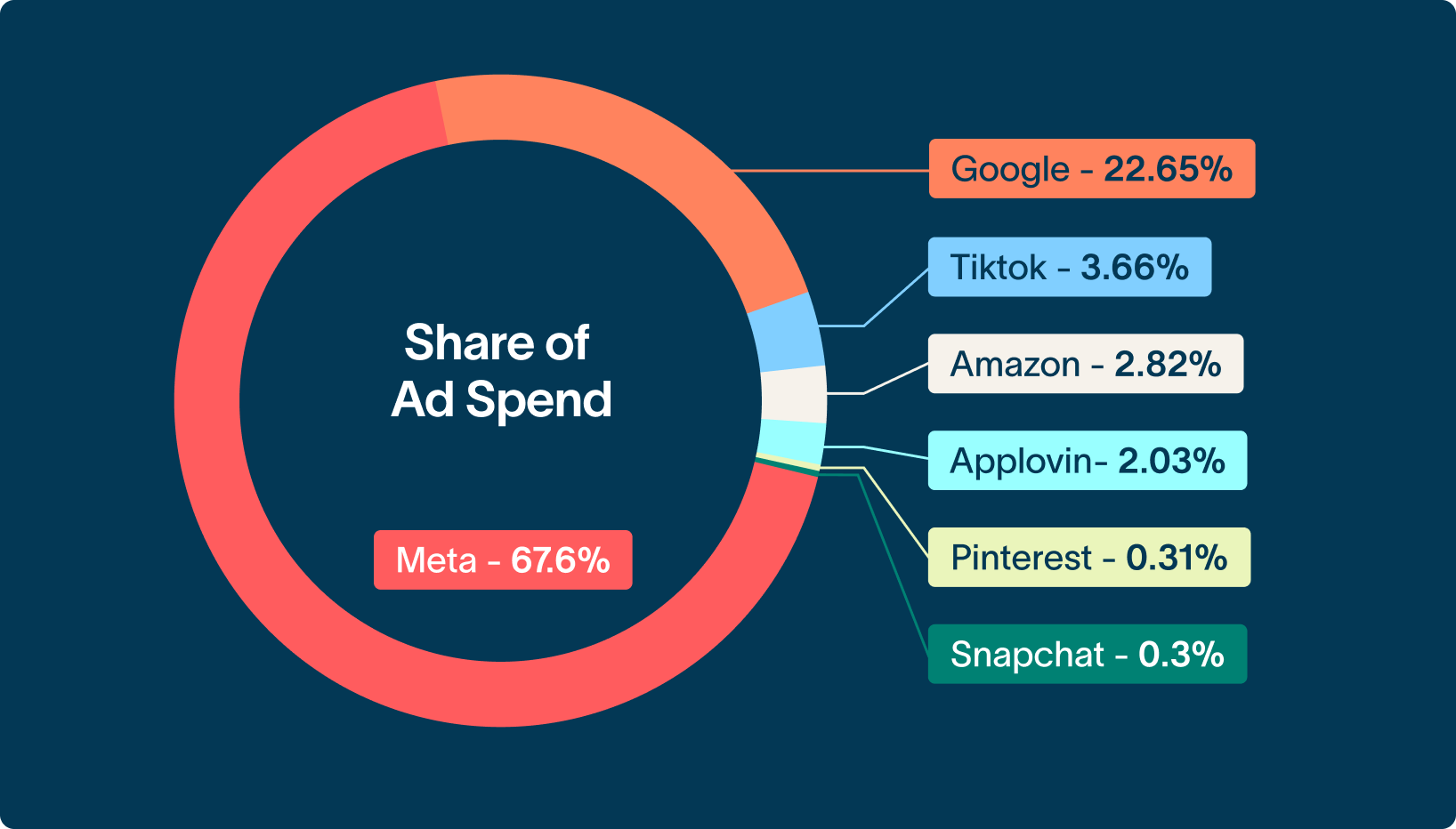
Brands using Triple Whale generated $2.88 billion in revenue from $606 million in ad spend during BFCM 2025. Meta drove the largest share of that tracked media investment, accounting for 67.6% of ad spend and delivering a 2.26x ROAS even as advertising costs climbed.
This shows, more than ever, that Facebook is still a main player in BFCM strategies because it combines broad reach, advanced targeting, and placements across Facebook and Instagram.
This guide breaks down the Meta ad benchmarks behind these results and shows how Triple Whale and Moby AI can help you apply those insights to your Black Friday Facebook ads in 2026.
Benefits of advertising on Facebook during Black Friday
The number one reason for advertising on Facebook: it’s where the people are.
With more than 3 billion monthly active users, Facebook and Instagram give advertisers access to one of the world's largest audiences across multiple placements.
Combined with advanced targeting, diverse ad formats, and an audience that's already comfortable shopping online, Meta remains one of the most effective platforms for reaching and converting customers.
Here are some reasons why Facebook ads are particularly effective for BFCM campaigns:
Advanced targeting and retargeting: Facebook’s advanced targeting abilities help brands reach high-intent shoppers based on demographics, interests, and behaviors. In a BFCM campaign, it would be effective to retarget past customers, create lookalike audiences, or serve ads to customers who have interacted with your brand during previous holiday seasons.
Dynamic ad formats: With a diverse range of ad formats, including carousel, video, and collection ads, Facebook allows brands to showcase their products in a variety of ways, which can boost conversions during BFCM by encouraging bundles or pairing complementary items.
Data-driven insights: Facebook has robust analytics available to help brands track campaign performance in real-time, which can enable brands to adjust and optimize campaigns based on what’s working for specific audiences.
Triple Whale BFCM 2025 benchmark data
In our BFCM 2025 Retrospective Report, we evaluated the ad performance data for over 33,000 shops. The dataset included $2.88 billion in revenue, $606.6 million in ad spend, and 26 million orders. There are some key statistics from the report that indicate Facebook/Meta remains a hot place to advertise for BFCM:
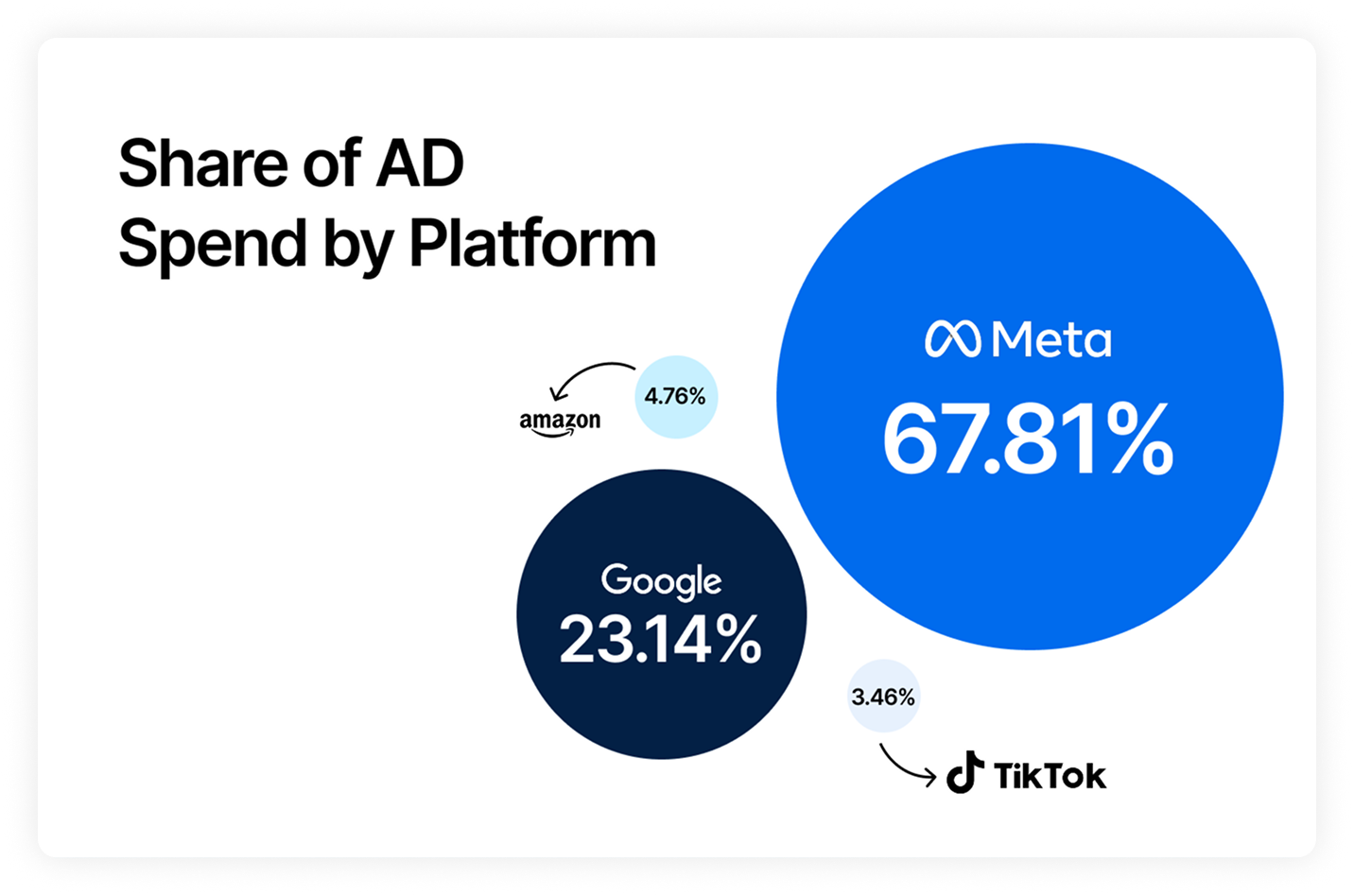
Meta comprised 67.6% of tracked ad spend, making it the largest paid channel in the report
Meta’s ROAS reached 2.26, an increase of 3.18% over BFCM 2024
Meta’s AOV saw a 4.44% increase year over year, reaching a median of $77.79
The less positive news:
Meta’s CPA of $34.06 was 2.19% higher than in BFCM 2025
CPM increased approximately 7.8% to $22.26, showing it’s getting more expensive to reach audiences
Meta’s share of tracked ad spend was essentially flat but slightly lower than its 67.81% share in BFCM 2024
The takeaway is mixed: Meta generated a modestly stronger ROAS and higher AOV, but brands paid more for impressions and acquisitions. To win BFCM in 2026, brands need to look back at their 2025 performance to make confident, data-backed decisions that take their performance to the next level.
Meta strategies for BFCM 2026
Meta is a dominant platform, and the tried-and-true methods like carousel ads and Advantage+ campaigns are still in play, but to maximize ROI for BFCM 2026, here are some more strategies to consider:
Prepare to spend: Expect higher advertising costs during BFCM 2026. Use peak-period CPM and CPA estimates — not average-week costs — when setting budgets and performance targets.
Start before Black Friday: Pre-BFCM ad spend hit $396.6 million from November 24, 2025, through November 27, 2025 — 65% of the amount spent during the four-day BFCM weekend. Plan audience warming, offer testing, and creative learning early on.Create sophisticated segments: Use Recency-Frequency-Monetary (RFM) segments to advertise with specific and relevant ads for each audience.
Champions. Recent, frequent, high-value customers get Loyalty/VIP campaigns
Loyal customers. High frequency, good value → Cross-sell campaigns
Big spenders. High monetary, low frequency → Win-back campaigns
New customers. Recent, low frequency → Onboarding sequences
Competitive intelligence: Review the Meta Ad Library for real-time competitive creative analysis, and adjust your own ads to win.
Maximize creative: Increase creative production by 3-4x to combat ad fatigue.
Dynamic bidding strategies: Identify peak traffic periods and adjust bidding accordingly.
Simplify campaign structure: Trust Facebook’s machine learning to find your buyers and invest more time in ad creative strategy.
Use Advantage+ to your advantage: With Advantage+ Shopping Campaigns, you can dynamically target relevant audiences and test multiple creatives against each other to optimize ads.
Unify the cross-channel experience: Customers expect seamless experiences across all touchpoints, so ensure you sync Meta ads with email/SMS campaigns. Coordinate the timing across all marketing channels for maximum impact.
Run your BFCM Meta program with Moby AI
Moby AI helps ecommerce teams analyze performance, prepare supported actions, and turn recurring work into Automations.
Use creative performance data
Creative performance can shift dramatically by placement during BFCM. Triple Whale’s 2025 data shows where Meta delivered the most scale and where lower-cost placements created opportunities for greater efficiency, giving brands a practical starting point for planning their own creative tests.
Facebook Feed drove scale: $154 million in spend, $500 million in conversion value, and 2.51 ROAS
Instagram Stories combined scale and efficiency: $202 million in conversion value and 2.51 ROAS
Facebook and Instagram Reels generated $184 million in combined conversion value with CPMs 30-40% lower than Feed placements
Reels Overlay and Marketplace were efficient at low scale: 8.68 and 4.70 ROAS on $2 million in spend each
Test carousel, video, and static inside your own account using the same offer, audience stage, attribution model, and window before naming a format winner
Automate parts of your media buying
Moby AI helps teams move from insight to action without giving up control. By combining performance data with your rules, thresholds, permissions, and approval settings, it can help your team make and review supported changes faster:
Adjust Meta budgets using a defined metric, lookback window, threshold, and maximum change
Pause or activate eligible entities across Meta campaigns, ad sets, and ads when the team’s rules are met
Launch approved ads by creating campaigns, ad sets, creatives, and ads, then publishing approved work
Schedule campaign workflows for recurring performance checks, pacing reviews, threshold monitoring, and supported action proposals
Queue proposed changes for review with the target, current state, proposed state, supporting data, and rationale visible before execution
Turn analyses into Automations that run on a defined cadence and preserve the account’s approval settings
Strengthen Meta signals with Sonar Optimize
Meta’s optimization is only as strong as the conversion signals it receives. Sonar Optimize enriches the first-party customer and conversion data sent from Triple Whale to Meta, giving the platform more complete information for reporting, audience building, targeting, and campaign optimization.
Sends enriched first-party customer and conversion events to Meta server-side through the Meta Conversions API
Supports standard funnel events and specialized outcomes such as New Customer Purchase and Returning Customer Purchase
Gives Meta more complete information for reporting, audience creation, targeting, bidding, and delivery optimization
Provides deduplication keys when the Meta Web Pixel and Sonar report the same event
Lets teams monitor event delivery in Triple Whale and confirm receipt in Meta Events Manager
Send Triple Whale attribution back to Meta
Meta Attribution Passback connects measurement with optimization by sending Triple Whale-attributed purchase data back to Meta. This gives eligible advertisers a way to optimize campaign delivery.
Meta Attribution Passback sends Triple Whale-attributed purchase data back to Meta as an UpdatePurchase event
Teams select the attribution model, window, performance goal, and purchase exclusions used for passback
The integration powers Meta Custom Attribution for eligible advertisers with access to Sonar Optimize
Test against a business-as-usual campaign and evaluate both cells in Triple Whale on the same attribution basis
Turn benchmarks into action this BFCM
With advanced targeting and retargeting options, dynamic ad formats, and robust data-driven insights, Facebook is an indispensable tool for brands aiming to maximize their reach and conversions during this peak shopping period.
Brands should take note of the ad performance trends outlined in this article to benchmark their BFCM 2025 data and prepare for 2026, in addition to using AI-powered tools to optimize performance in real-time. Combine these tactics with cross-channel coordination, and you’ll be positioned to capitalize on the biggest shopping period of the year.
Ready to crush BFCM 2026? Book a demo to see how Triple Whale can help your team put them into action.
Frequently Asked Questions
When should I start running Black Friday Facebook ads?
Start at least 2–4 weeks before Black Friday (typically early to mid-November). Use the early window to build warm audiences through engagement and traffic campaigns, then shift to conversion-focused campaigns in the final 7–10 days.
How much should I budget for Black Friday Facebook ads?
There's no universal number, but a common approach is to spend 2–5x your normal daily budget during the BFCM window. CPMs spike significantly during this period, so account for that when planning bids and budgets.
Why do CPMs increase so much during Black Friday?
Every advertiser — across every industry — is competing for the same ad inventory at the same time. Higher demand with fixed supply drives auction prices up. Planning your creative and audiences in advance helps avoid wasted spend on poor-performing ads at elevated CPMs.
What ad formats work best for Black Friday Facebook campaigns?
Video ads (especially short-form, 15–30 seconds) and carousel ads showcasing multiple products tend to perform well. Static image ads with clear, bold discount messaging also convert reliably. Test multiple formats in advance and scale what's already working before Black Friday hits.
Component Sales
5.32K
Benchmark your ecommerce brand against industry leaders
Brands using Triple Whale generated $2.88 billion in revenue from $606 million in ad spend during BFCM 2025. Meta drove the largest share of that tracked media investment, accounting for 67.6% of ad spend and delivering a 2.26x ROAS even as advertising costs climbed.
This shows, more than ever, that Facebook is still a main player in BFCM strategies because it combines broad reach, advanced targeting, and placements across Facebook and Instagram.
This guide breaks down the Meta ad benchmarks behind these results and shows how Triple Whale and Moby AI can help you apply those insights to your Black Friday Facebook ads in 2026.
Benefits of advertising on Facebook during Black Friday
The number one reason for advertising on Facebook: it’s where the people are.
With more than 3 billion monthly active users, Facebook and Instagram give advertisers access to one of the world's largest audiences across multiple placements.
Combined with advanced targeting, diverse ad formats, and an audience that's already comfortable shopping online, Meta remains one of the most effective platforms for reaching and converting customers.
Here are some reasons why Facebook ads are particularly effective for BFCM campaigns:
Advanced targeting and retargeting: Facebook’s advanced targeting abilities help brands reach high-intent shoppers based on demographics, interests, and behaviors. In a BFCM campaign, it would be effective to retarget past customers, create lookalike audiences, or serve ads to customers who have interacted with your brand during previous holiday seasons.
Dynamic ad formats: With a diverse range of ad formats, including carousel, video, and collection ads, Facebook allows brands to showcase their products in a variety of ways, which can boost conversions during BFCM by encouraging bundles or pairing complementary items.
Data-driven insights: Facebook has robust analytics available to help brands track campaign performance in real-time, which can enable brands to adjust and optimize campaigns based on what’s working for specific audiences.
Triple Whale BFCM 2025 benchmark data
In our BFCM 2025 Retrospective Report, we evaluated the ad performance data for over 33,000 shops. The dataset included $2.88 billion in revenue, $606.6 million in ad spend, and 26 million orders. There are some key statistics from the report that indicate Facebook/Meta remains a hot place to advertise for BFCM:
Meta comprised 67.6% of tracked ad spend, making it the largest paid channel in the report
Meta’s ROAS reached 2.26, an increase of 3.18% over BFCM 2024
Meta’s AOV saw a 4.44% increase year over year, reaching a median of $77.79
The less positive news:
Meta’s CPA of $34.06 was 2.19% higher than in BFCM 2025
CPM increased approximately 7.8% to $22.26, showing it’s getting more expensive to reach audiences
Meta’s share of tracked ad spend was essentially flat but slightly lower than its 67.81% share in BFCM 2024
The takeaway is mixed: Meta generated a modestly stronger ROAS and higher AOV, but brands paid more for impressions and acquisitions. To win BFCM in 2026, brands need to look back at their 2025 performance to make confident, data-backed decisions that take their performance to the next level.
Meta strategies for BFCM 2026
Meta is a dominant platform, and the tried-and-true methods like carousel ads and Advantage+ campaigns are still in play, but to maximize ROI for BFCM 2026, here are some more strategies to consider:
Prepare to spend: Expect higher advertising costs during BFCM 2026. Use peak-period CPM and CPA estimates — not average-week costs — when setting budgets and performance targets.
Start before Black Friday: Pre-BFCM ad spend hit $396.6 million from November 24, 2025, through November 27, 2025 — 65% of the amount spent during the four-day BFCM weekend. Plan audience warming, offer testing, and creative learning early on.Create sophisticated segments: Use Recency-Frequency-Monetary (RFM) segments to advertise with specific and relevant ads for each audience.
Champions. Recent, frequent, high-value customers get Loyalty/VIP campaigns
Loyal customers. High frequency, good value → Cross-sell campaigns
Big spenders. High monetary, low frequency → Win-back campaigns
New customers. Recent, low frequency → Onboarding sequences
Competitive intelligence: Review the Meta Ad Library for real-time competitive creative analysis, and adjust your own ads to win.
Maximize creative: Increase creative production by 3-4x to combat ad fatigue.
Dynamic bidding strategies: Identify peak traffic periods and adjust bidding accordingly.
Simplify campaign structure: Trust Facebook’s machine learning to find your buyers and invest more time in ad creative strategy.
Use Advantage+ to your advantage: With Advantage+ Shopping Campaigns, you can dynamically target relevant audiences and test multiple creatives against each other to optimize ads.
Unify the cross-channel experience: Customers expect seamless experiences across all touchpoints, so ensure you sync Meta ads with email/SMS campaigns. Coordinate the timing across all marketing channels for maximum impact.
Run your BFCM Meta program with Moby AI
Moby AI helps ecommerce teams analyze performance, prepare supported actions, and turn recurring work into Automations.
Use creative performance data
Creative performance can shift dramatically by placement during BFCM. Triple Whale’s 2025 data shows where Meta delivered the most scale and where lower-cost placements created opportunities for greater efficiency, giving brands a practical starting point for planning their own creative tests.
Facebook Feed drove scale: $154 million in spend, $500 million in conversion value, and 2.51 ROAS
Instagram Stories combined scale and efficiency: $202 million in conversion value and 2.51 ROAS
Facebook and Instagram Reels generated $184 million in combined conversion value with CPMs 30-40% lower than Feed placements
Reels Overlay and Marketplace were efficient at low scale: 8.68 and 4.70 ROAS on $2 million in spend each
Test carousel, video, and static inside your own account using the same offer, audience stage, attribution model, and window before naming a format winner
Automate parts of your media buying
Moby AI helps teams move from insight to action without giving up control. By combining performance data with your rules, thresholds, permissions, and approval settings, it can help your team make and review supported changes faster:
Adjust Meta budgets using a defined metric, lookback window, threshold, and maximum change
Pause or activate eligible entities across Meta campaigns, ad sets, and ads when the team’s rules are met
Launch approved ads by creating campaigns, ad sets, creatives, and ads, then publishing approved work
Schedule campaign workflows for recurring performance checks, pacing reviews, threshold monitoring, and supported action proposals
Queue proposed changes for review with the target, current state, proposed state, supporting data, and rationale visible before execution
Turn analyses into Automations that run on a defined cadence and preserve the account’s approval settings
Strengthen Meta signals with Sonar Optimize
Meta’s optimization is only as strong as the conversion signals it receives. Sonar Optimize enriches the first-party customer and conversion data sent from Triple Whale to Meta, giving the platform more complete information for reporting, audience building, targeting, and campaign optimization.
Sends enriched first-party customer and conversion events to Meta server-side through the Meta Conversions API
Supports standard funnel events and specialized outcomes such as New Customer Purchase and Returning Customer Purchase
Gives Meta more complete information for reporting, audience creation, targeting, bidding, and delivery optimization
Provides deduplication keys when the Meta Web Pixel and Sonar report the same event
Lets teams monitor event delivery in Triple Whale and confirm receipt in Meta Events Manager
Send Triple Whale attribution back to Meta
Meta Attribution Passback connects measurement with optimization by sending Triple Whale-attributed purchase data back to Meta. This gives eligible advertisers a way to optimize campaign delivery.
Meta Attribution Passback sends Triple Whale-attributed purchase data back to Meta as an UpdatePurchase event
Teams select the attribution model, window, performance goal, and purchase exclusions used for passback
The integration powers Meta Custom Attribution for eligible advertisers with access to Sonar Optimize
Test against a business-as-usual campaign and evaluate both cells in Triple Whale on the same attribution basis
Turn benchmarks into action this BFCM
With advanced targeting and retargeting options, dynamic ad formats, and robust data-driven insights, Facebook is an indispensable tool for brands aiming to maximize their reach and conversions during this peak shopping period.
Brands should take note of the ad performance trends outlined in this article to benchmark their BFCM 2025 data and prepare for 2026, in addition to using AI-powered tools to optimize performance in real-time. Combine these tactics with cross-channel coordination, and you’ll be positioned to capitalize on the biggest shopping period of the year.
Ready to crush BFCM 2026? Book a demo to see how Triple Whale can help your team put them into action.
Frequently Asked Questions
When should I start running Black Friday Facebook ads?
Start at least 2–4 weeks before Black Friday (typically early to mid-November). Use the early window to build warm audiences through engagement and traffic campaigns, then shift to conversion-focused campaigns in the final 7–10 days.
How much should I budget for Black Friday Facebook ads?
There's no universal number, but a common approach is to spend 2–5x your normal daily budget during the BFCM window. CPMs spike significantly during this period, so account for that when planning bids and budgets.
Why do CPMs increase so much during Black Friday?
Every advertiser — across every industry — is competing for the same ad inventory at the same time. Higher demand with fixed supply drives auction prices up. Planning your creative and audiences in advance helps avoid wasted spend on poor-performing ads at elevated CPMs.
What ad formats work best for Black Friday Facebook campaigns?
Video ads (especially short-form, 15–30 seconds) and carousel ads showcasing multiple products tend to perform well. Static image ads with clear, bold discount messaging also convert reliably. Test multiple formats in advance and scale what's already working before Black Friday hits.
Share
Emily Kordys
Emily Kordys
Emily is a Content Writer at Triple Whale, where she creates data-driven content for ecommerce marketers. She has spent nearly a decade in content marketing across the B2B SaaS and ecommerce industries, helping brands turn complex topics into engaging, actionable content.
Body Copy: The following benchmarks compare advertising metrics from April 1-17 to the previous period. Considering President Trump first unveiled his tariffs on April 2, the timing corresponds with potential changes in advertising behavior among ecommerce brands (though it isn’t necessarily correlated).


 Moby AIAsk questions, analyze performance, and work with your business context.
 ActionsTake governed action across the tools that run your business.
 AutomationsSchedule recurring analysis and work that runs on your terms.
 Landing PagesCreative conversion-focused ecommerce pages with Moby.
 Creative StudioGenerate and refine creative grounded in your brand.








.webp)

.webp)
