Our benchmarks report will review common ad performance metrics for Google Ads across brands using Triple Whale to monitor and maximize their performance. This analysis includes over 21,000 brands for the period of August 1, 2025 to July 31, 2026.
READ MORE | A Guide to Ecommerce Metrics
Additionally, we’ll break down the vertical-specific trends with data from the following industries:
- Apparel & Accessories
- Beauty
- Home & Garden
- Food & Beverage
- Sports & Outdoors
- Health & Wellness
- Electronics
- Toys, Art & Collectibles
- Pets & Animals
- Automotive
- Baby
- Lifestyle & Boutique
- Travel Accessories
- Books & Music
- Business Supplies & Equipment
Overall Google Ads Benchmarks
| Metric |
Aug 2025 to July 2026 |
Aug 2024 to July 2025 |
% Change YoY |
| CPA |
$28.14 |
$25.59 |
+9.96% |
| CPM |
$15.35 |
$13.54 |
+13.34% |
| CVR |
3.11% |
3.34% |
-7.02% |
| ROAS |
3.27 |
3.39 |
-3.54% |
| AOV |
$87.65 |
$84.03 |
+4.31% |
| CTR |
1.65% |
1.45% |
+13.78% |
| MER |
0.28 |
0.27 |
+3.73% |
The overall ad performance data for Google Ads from August 2025 to July 2026 indicates a challenging ad platform marked by increased costs and declining efficiency. Marketing efficiency ratio (MER) improved by +3.73%, even as return on ad spend (ROAS) and conversion rate (CVR) experienced drops (-3.54% and -7.02%, respectively).
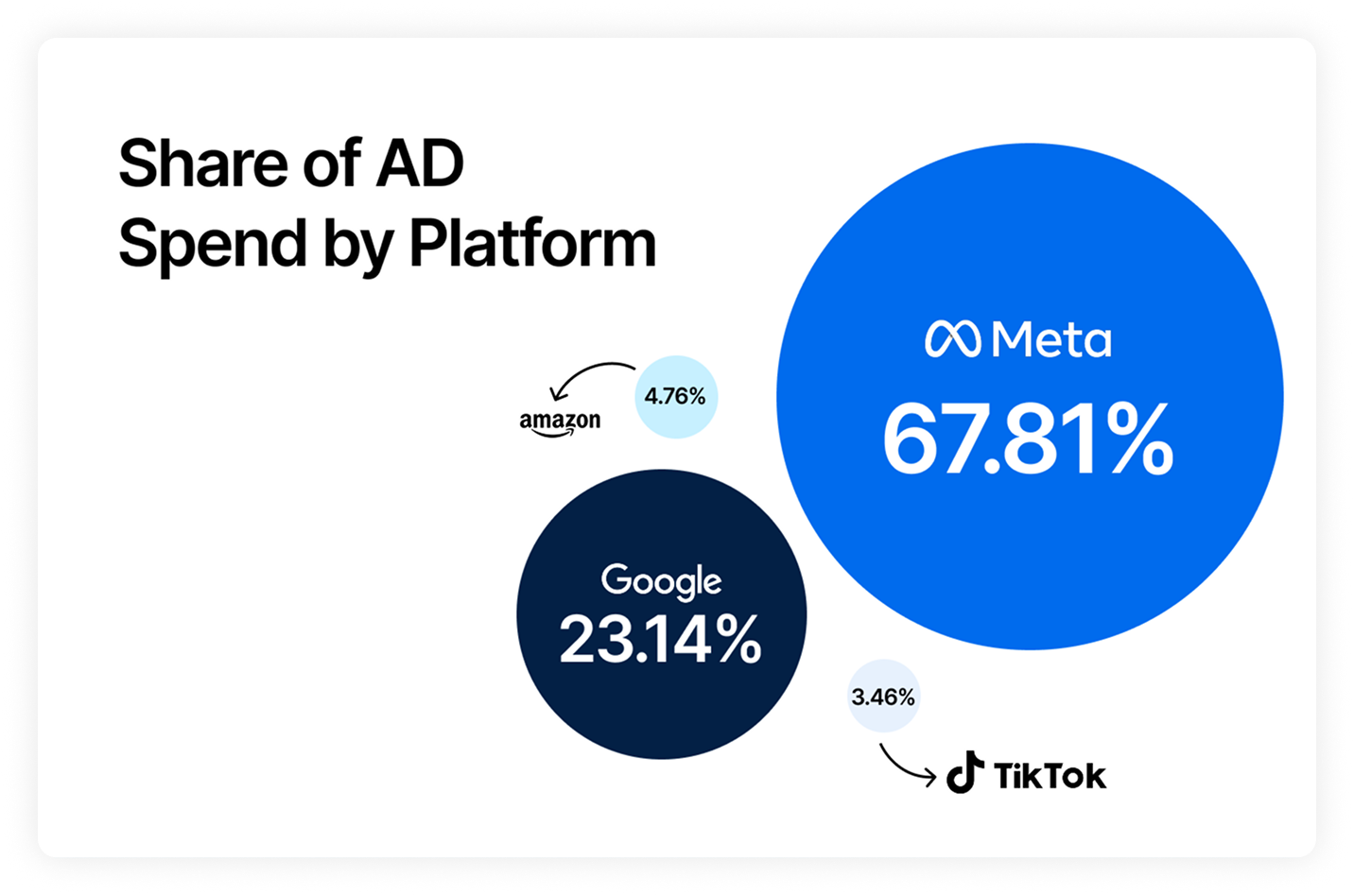
Triple Whale brands invested 22.50% of ad spend on Google Ads during this period, second only to Meta (66.88%). While they’re the next big competitor to the Meta behemoth, the share of spend for Google Ads still dropped by 2.63%.
Declines in ROAS and CVR show that higher engagement didn’t translate into stronger conversion efficiency. The median cost per acquisition (CPA) rose by +9.96% to $28.14, and median CPM also jumped by +13.34% to $15.35.
ROAS dropped by -3.54% to 3.27, and average order value (AOV) increased +4.31% to $87.65. Although click-through rate (CTR) increased (+13.78%), CVR dipped by -7.02%, meaning that customers were clicking on more ads, but converting less. This competitive environment means brands must optimize aggressively in order to maintain profitability.
Google Ads performance benchmarks: by industry
Industry-level benchmarks show how Google Ads costs, engagement, and returns vary across categories. The sections below compare CPA, CPM, CVR, CTR, ROAS, AOV, and MER across the 15 industries in this report, giving brands a clearer baseline for evaluating their own performance.
Cost per acquisition (CPA) by industry
| Industry |
Median CPA |
% Change YoY |
| Apparel & Accessories |
$25.40 |
+10.93% |
| Beauty |
$25.39 |
+9.18% |
| Home & Garden |
$38.94 |
+6.88% |
| Food & Beverage |
$23.65 |
+14.45% |
| Sports & Outdoors |
$30.42 |
+0.31% |
| Health & Wellness |
$34.76 |
+13.36% |
| Electronics |
$39.72 |
+17.49% |
| Toys, Art, & Collectibles |
$25.12 |
+6.07% |
| Pets & Animals |
$25.05 |
-3.78% |
| Automotive |
$38.14 |
+14.44% |
| Baby |
$24.14 |
+9.38% |
| Lifestyle & Boutique |
$24.07 |
+0.76% |
| Travel Accessories |
$31.78 |
+24.13% |
| Books & Music |
$20.97 |
+1.65% |
| Business Supplies & Equipment |
$38.39 |
+19.79% |
CPA shows how much it costs to acquire a customer. From August 2025 to July 2026, 14 of 15 industries showed increases in year-over-year growth. The sole exception was Pets & Animals, which achieved a -3.78% reduction in CPA to $25.05. Pets & Animals likely benefits from superior targeting optimization or stronger product-market fit compared to other verticals.
The most dramatic increases occurred in Travel Accessories (+24.13% to $31.78) and Business Supplies & Equipment (+19.79% to $38.39). While not as staggering, the remaining industries are all experiencing an increase in CPA points to increased competition driving up costs to acquire customers.
Cost per mille (CPM) by industry
| Industry |
Median CPM |
% Change YoY |
| Apparel & Accessories |
$12.13 |
+13.38% |
| Beauty |
$18.38 |
+10.99% |
| Home & Garden |
$15.76 |
+10.90% |
| Food & Beverage |
$15.94 |
+4.45% |
| Sports & Outdoors |
$14.53 |
+11.11% |
| Health & Wellness |
$22.40 |
+28.60% |
| Electronics |
$15.04 |
+19.08% |
| Toys, Art, & Collectibles |
$12.64 |
+10.30% |
| Pets & Animals |
$20.40 |
+7.62% |
| Automotive |
$15.06 |
+23.45% |
| Baby |
$14.30 |
+5.85% |
| Lifestyle & Boutique |
$12.77 |
+9.62% |
| Travel Accessories |
$14.61 |
+13.05% |
| Books & Music |
$14.34 |
+18.29% |
| Business Supplies & Equipment |
$19.95 |
+11.06% |
CPM increased universally across all industries in our dataset, with year-over-year growth ranging from +4.45% to +28.60%.
Health & Wellness experienced the steepest CPM inflation at +28.60% to $22.40, followed by Automotive (+23.45% to $15.06). Even the smallest increase for Food & Beverage (+4.45%) still represents the growing cost to reach audiences on Google Ads.
Even though Apparel had the lowest overall CPM ($12.13), the +13.38% increase indicates even industries with relatively cheap CPMs are experiencing higher costs than years prior.
Conversion rate (CVR) by industry
| Industry |
Median CVR |
% Change YoY |
| Apparel & Accessories |
2.78% |
-7.48% |
| Beauty |
4.33% |
-6.24% |
| Home & Garden |
2.30% |
-4.65% |
| Food & Beverage |
4.26% |
-12.80% |
| Sports & Outdoors |
2.63% |
-2.42% |
| Health & Wellness |
3.41% |
-2.44% |
| Electronics |
2.08% |
-14.98% |
| Toys, Art, & Collectibles |
3.01% |
-6.53% |
| Pets & Animals |
4.40% |
+1.59% |
| Automotive |
1.90% |
-8.39% |
| Baby |
3.12% |
-8.60% |
| Lifestyle & Boutique |
3.28% |
-1.38% |
| Travel Accessories |
2.39% |
-19.27% |
| Books & Music |
4.30% |
-2.81% |
| Business Supplies & Equipment |
2.58% |
-13.70% |
There was a decline in conversion rate for 14 of 15 industries in our dataset from August 2025 to July 2026, representing a widespread erosion in customers actually converting on the ads they clicked.
Only one industry improved their conversion rate, and it was Pets & Animals improving by +1.59% to 4.40%. The biggest declines in conversion rate were in Travel Accessories (-19.27% to 2.39%) and Business Supplies & Equipment (-13.70% to 2.58%).
Click-through rate (CTR) by industry
| Industry |
Median CTR |
% Change YoY |
| Apparel & Accessories |
1.67% |
+14.38% |
| Beauty |
1.61% |
+6.98% |
| Home & Garden |
1.54% |
+14.90% |
| Food & Beverage |
1.63% |
+11.54% |
| Sports & Outdoors |
1.67% |
+15.96% |
| Health & Wellness |
1.73% |
+26.75% |
| Electronics |
1.59% |
+19.25% |
| Toys, Art, & Collectibles |
1.62% |
+15.21% |
| Pets & Animals |
1.78% |
+16.49% |
| Automotive |
1.89% |
+19.72% |
| Baby |
1.63% |
+7.80% |
| Lifestyle & Boutique |
1.58% |
+13.04% |
| Travel Accessories |
1.73% |
+16.18% |
| Books & Music |
1.72% |
+8.27% |
| Business Supplies & Equipment |
1.53% |
+6.50% |
In contrast to other metrics, CTR improved across all 15 industries in the latest period, with growth ranging from +6.50% to +26.75%.
Health & Wellness led with +26.75% growth to 1.73% CTR, followed by Automotive (+19.72% to 1.89%) and Electronics (+19.25% to 1.59%).
A universal increase in CTR suggests these industries' advertising on Google Ads has better ad creative quality and targeting precision across the board. However, rising CTR combined with falling CVR suggests a growing gap between ad promise and landing page delivery.
Return on ad spend (ROAS) by industry
| Industry |
Median ROAS |
% Change YoY |
| Apparel & Accessories |
3.99 |
-0.47% |
| Beauty |
2.81 |
-2.13% |
| Home & Garden |
3.48 |
-2.55% |
| Food & Beverage |
3.18 |
-5.04% |
| Sports & Outdoors |
4.35 |
+6.49% |
| Health & Wellness |
2.06 |
-8.73% |
| Electronics |
2.91 |
-9.73% |
| Toys, Art, & Collectibles |
3.22 |
-0.75% |
| Pets & Animals |
2.88 |
+2.54% |
| Automotive |
4.07 |
-2.06% |
| Baby |
3.71 |
-4.90% |
| Lifestyle & Boutique |
3.10 |
+10.13% |
| Travel Accessories |
4.07 |
-13.10% |
| Books & Music |
2.79 |
+1.07% |
| Business Supplies & Equipment |
3.15 |
-2.45% |
ROAS declined across 11 of 15 industries from August 2025 to July 2026, mirroring the CVR pattern and confirming widespread efficiency deterioration.
Sports & Outdoors (+6.49%), Pets & Animals (+2.54%), Lifestyle & Boutique (+10.13%), and Books & Music (+1.07%) improved ROAS. The largest ROAS declines were in Travel Accessories (-13.10% to 4.07), Electronics (-9.73% to 2.91), and Health & Wellness (-8.73% to 2.06).
Average order value (AOV) by industry
| Industry |
Median AOV |
% Change YoY |
| Apparel & Accessories |
$99.39 |
+6.78% |
| Beauty |
$70.24 |
+5.39% |
| Home & Garden |
$129.92 |
+3.66% |
| Food & Beverage |
$71.39 |
+6.16% |
| Sports & Outdoors |
$131.92 |
+3.37% |
| Health & Wellness |
$72.34 |
+4.69% |
| Electronics |
$127.02 |
+13.80% |
| Toys, Art, & Collectibles |
$80.04 |
+6.19% |
| Pets & Animals |
$69.08 |
+5.47% |
| Automotive |
$150.42 |
+8.82% |
| Baby |
$88.07 |
+3.25% |
| Lifestyle & Boutique |
$76.44 |
+11.82% |
| Travel Accessories |
$145.16 |
+9.96% |
| Books & Music |
$57.99 |
-5.41% |
| Business Supplies & Equipment |
$120.69 |
+19.60% |
AOV trends increased across 14 of 15 industries, showing broad transaction-value growth rather than a mixed category pattern. Books & Music was the only industry to decline.
Business Supplies & Equipment led with a dramatic +19.60% increase to $120.69, while Consumer Electronics grew +13.80% to $127.02. Books & Music posted the only decline, falling -5.41% to $57.99.
Marketing efficiency ratio (MER) by industry
| Industry |
Median MER |
% Change YoY |
| Apparel & Accessories |
0.23 |
+0.92% |
| Beauty |
0.33 |
+2.91% |
| Home & Garden |
0.26 |
+3.67% |
| Food & Beverage |
0.29 |
+7.28% |
| Sports & Outdoors |
0.20 |
-4.06% |
| Health & Wellness |
0.42 |
+8.88% |
| Electronics |
0.31 |
+7.86% |
| Toys, Art, & Collectibles |
0.29 |
+0.13% |
| Pets & Animals |
0.33 |
-0.73% |
| Automotive |
0.22 |
+3.83% |
| Baby |
0.26 |
+5.95% |
| Lifestyle & Boutique |
0.29 |
-10.09% |
| Travel Accessories |
0.23 |
+17.03% |
| Books & Music |
0.34 |
+1.97% |
| Business Supplies & Equipment |
0.28 |
+1.94% |
MER increased across 12 of 15 industries from August 2025 to July 2026, indicating stronger blended efficiency for most categories.
The three exceptions were Sports & Outdoors (-4.06% to 0.20), Pets & Animals (-0.73% to 0.33), and Lifestyle & Boutique (-10.09% to 0.29). The largest MER increases occurred in Travel Accessories (+17.03% to 0.23) and Health & Wellness (+8.88% to 0.42).
Conclusion
Google Ads performance from August 2025 to July 2026 reflected higher costs and mixed efficiency across industries. CPA and CPM increased while ROAS and CVR declined, even as CTR, AOV, and MER improved.
These Google benchmarks provide a crucial reference for brands to optimize their ad strategies and maximize returns during the next planning cycle.
Want to get started? Triple Whale gives you full-funnel visibility into your marketing performance so you can shift spend, allocate budget, and get benchmarks at your fingertips. Get started for free today.


 Moby AIAsk questions, analyze performance, and work with your business context.
 ActionsTake governed action across the tools that run your business.
 AutomationsSchedule recurring analysis and work that runs on your terms.
 Landing PagesCreative conversion-focused ecommerce pages with Moby.
 Creative StudioGenerate and refine creative grounded in your brand.













.webp)

.webp)
