If you’re doing it right, your relationship with your customer won’t end the second they make a purchase from your ecommerce brand.
Instead, you’ll start focusing on engaging them in long-term retention and loyalty as soon as they first become aware you exist. This is called the customer lifecycle — the start-to-finish experience customers have with your business at all stages.
Customer lifecycle marketing is valuable in ecommerce: Retaining existing customers is generally more profitable than acquiring new ones.
Keep reading to learn more about the various stages of the customer lifecycle, how to identify where your customers are in that journey, and marketing strategies for each stage.
Key takeaways
Customer lifecycle marketing is the practice of tailoring your marketing efforts based on where customers are in the customer lifecycle, or their entire experience with your business, from awareness to advocacy.
Building a solid strategy for marketing across the five stages of the customer lifecycle takes time, money, and effort, but it can improve conversion rates, customer retention, and customer lifetime value, thereby increasing profits.
Start by establishing specific goals, the metrics you’ll use to track your progress toward them, and the right channels and tactics for marketing to your audience at every stage.
The Five Stages of the Customer Lifecycle
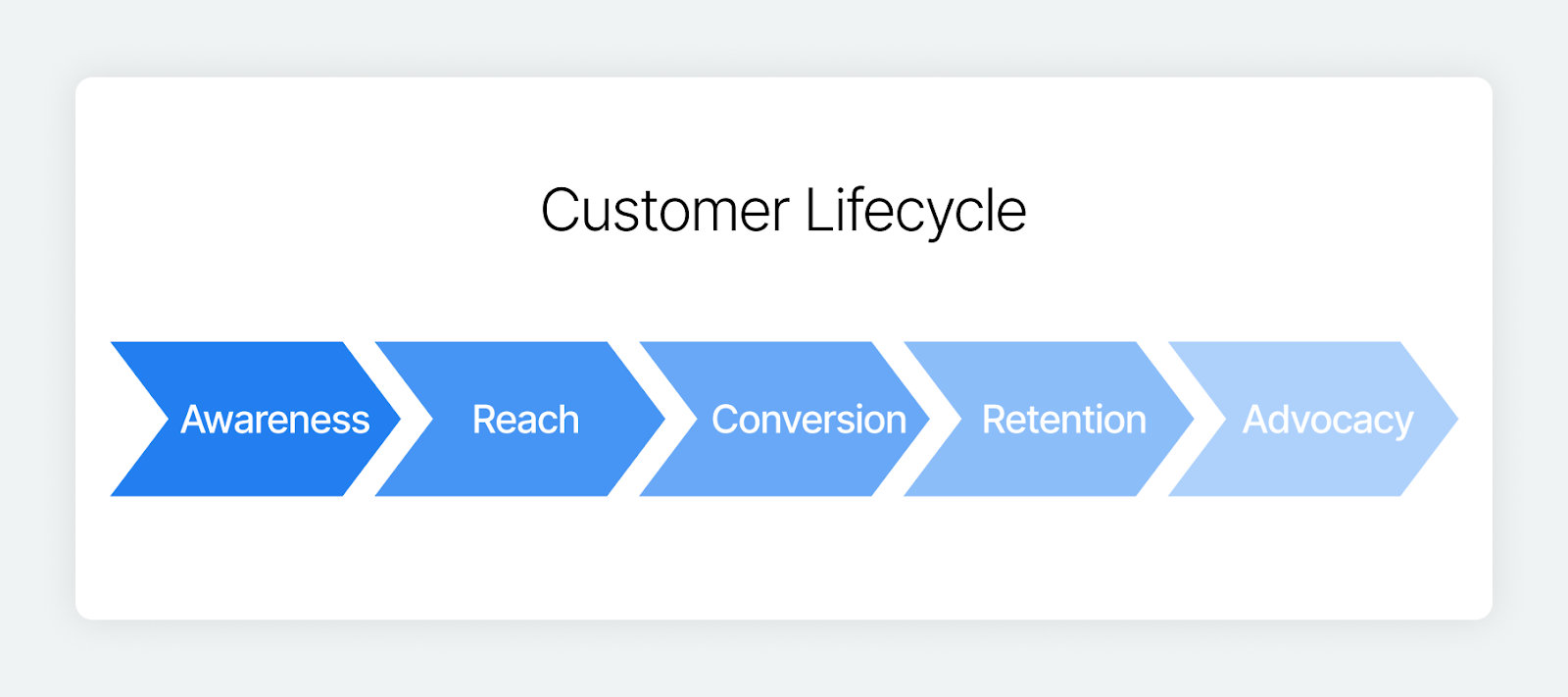
The customer lifecycle consists of five stages: awareness, reach, conversion, retention, and advocacy.
Each of the lifecycle marketing stages has its unique challenges and opportunities, and it's essential to understand where your customers are in this cycle so you can tailor your marketing efforts accordingly. Learn more about each stage below, including lifecycle marketing examples per stage.
Awareness
Definition/objective: Discovery. Introduce your brand and your offerings to potential customers
Behavioral signals: Visiting your site for the first time, visiting your social media pages
The awareness stage is the first step in the customer journey. This is the discovery stage, where potential customers become aware of your brand and what you have to offer. At this stage, your goal is to make a great first impression and create brand recognition. You can do this through various channels, such as social media, paid advertising, SEO content marketing, and influencer partnerships.
Examples:
Run paid social media ads based on demographics, interests, and behaviors
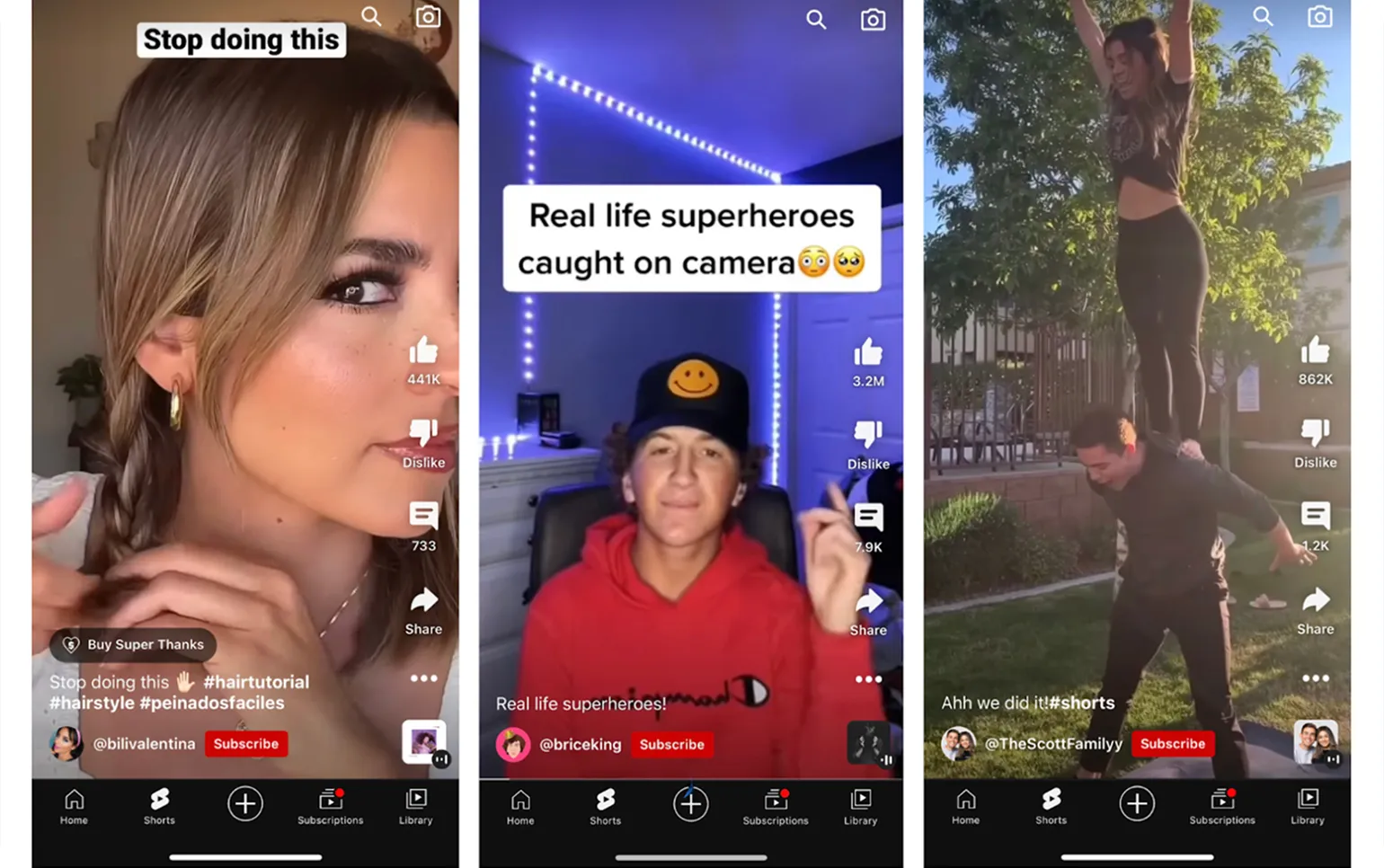
Partner with a TikTok influencer
Build and execute on an SEO content marketing strategy to drive education around your product, specialty, or expertise
Reach
Definition/objective: Acquisition. Begin to build trust and nurture leads with potential customers
Behavioral signals: Following your social media accounts, signing up for your newsletter
Core metrics: Email opt-in rate, returning visitors, engagement rate (such as social media likes, follows, and shares)
Common channels: Email marketing, paid social, SEO, content marketing, referral programs
Once someone is aware of your brand, the next stage is reach, which is sometimes also called acquisition or engagement. This is where you start to build a relationship with your potential customer by encouraging them to take action, such as signing up for a newsletter or following you on social media.
There’s more of a focus on customer acquisition, nurturing leads, and building trust with potential customers than during the awareness stage, which is where you’re primarily focused on making sure potential customers know your brand exists.
At this stage, the channels you use to market to your audience shift toward your owned assets, like your website, email list, and social media accounts. This reduces your reliance on paid media and cuts down on costs.
Examples:
Interact with followers on social media
Provide customer support across several channels
Send personalized email messages on certain milestones or special occasions
Distribute relevant blog posts or other information from your website
Offer incentives, such as discounts or freebies, to encourage sign-ups and subscriptions
Use retargeting ads to reach people who have engaged with your brand but haven't yet converted
Conversion
Definition/objective: Completed desired actions. A customer makes a purchase, signs up for your free trial, downloads your ebook, or converts in some other way you’re tracking
Behavioral signals: Making a purchase, downloading a digital product, signing up for a free trial
Core metrics: Conversion rate, average order value, customer acquisition cost
The conversion stage is where the actual transaction takes place. Whether it's making a purchase, signing up for a subscription, or booking a service, this stage is where the potential customer takes action and becomes an actual paying customer.
Your goal at this stage is to make the transaction as easy and seamless as possible. This means reducing friction to nudge shoppers toward conversions. Make sure your product pages are optimized with testimonials, reviews, and social proof that encourage a browser to add to their cart. Your checkout experience should be smooth, too, so they don’t abandon their cart before completing the purchase.
Examples:
Add social proof, such as customer reviews or testimonials, to your product pages
Simplify your checkout experience with one-click checkout options
Add flexible payment, such as installment plans or “buy now, pay later”, to reduce purchase friction
Offer free shipping
Create a sense of urgency with limited-time offers or low-stock warnings
Retention
Definition/objective: Relationship-building. Now that your customer has converted, you want to retain them and encourage repeat purchases
Behavioral signals: Opening post-purchase emails, completing a post-purchase survey
Once a customer has made a purchase, retention begins. This is where you focus on building a long-term relationship with your customers to ensure they have a positive experience with your brand. That can look like providing excellent customer service, personalized communication, and rewards or loyalty programs to incentivize repeat purchases.
It may also look like offering a subscription service to keep loyal customers automatically engaged, or finessing your lifecycle email marketing.
Your goal at this stage is to have a high repeat purchase rate, or the percentage of your shoppers who have made at least two purchases with you. You also want a low churn rate, or the percentage of your customers who have left your business over a certain period of time.
Examples:
Offer perks and discounts through a loyalty program or subscription model
Make it easy and fast for shoppers to contact customer support on your website and provide excellent service
Create personalized experiences on your website based on customer behavior and preferences
Use customer lifecycle email marketing to keep customers engaged and informed about new products, promotions, and updates
Advocacy
Definition/objective: Ambassadorship. Existing customers build awareness of your brand throughout their own networks
Behavioral signals: Leaving a review, tagging your account on social media, recommending your product to family and friends offline
Core metrics: Net promoter score, referral rate, customer lifetime value
Common channels: Loyalty programs, social media (user-generated content and reviews), referral programs
The final stage of the customer lifecycle is advocacy. This is where existing customers become growth multipliers, actively promoting your brand to others. The goal at this stage is to turn satisfied existing customers into loyal fans who will recommend your brand to their friends and family. For example, they might write a positive review on your website or post a picture of themselves using your product and tag you on social media.
This ultimately lowers your customer acquisition costs because you get the benefit of word-of-mouth marketing, which is entirely free.
Examples:
Offer exclusive early access to loyalty program members
Provide discounts to frequent shoppers to reward their loyalty
Send personalized thank-you notes
Encourage customers to leave reviews and ratings on your website and other review platforms
Implement a referral program to incentivize customers to tell their friends and family about your business
Share user-generated content on social media to showcase how customers are using and enjoying your products or services
Engage with customers on social media and respond to their comments and feedback
Stage
Primary Goal
Core Metrics
Revenue Impact
Awareness
Introduce your brand to high-quality potential customers
How to Create a Customer Lifecycle Marketing Strategy
To build a successful customer lifecycle marketing strategy, you’ll need to know your audience, clearly define the action you want them to take, and understand how best to motivate them to do so. But this shouldn’t be a one-off brainstorming session; rather, you should aim to create a practical, repeatable system that you can iterate on and continue to apply in the future.
Here’s a step-by-step guide to creating a strategy that sticks.
Step 1: Define Your Own Lifecycle Stages
While the five stages of the customer lifecycle above are generally agreed upon across industries, they may vary a bit depending on your business model. For example, a newer business likely needs to heavily prioritize awareness and reach stages and may not focus much strategy at all on advocacy in the early days.
You can define the stages however they work best for your brand. The best place to start is by getting clear on your goals and metrics for success. This will help you stay focused on your return on investment. Then, make sure you have alignment on your goals and your lifecycle stages from members of other teams.
Think about the best channels for your self-defined lifecycle stages, too. You need to choose the ones that align with your goals and resonate with your target audience. For example, social media might be effective for building brand awareness, but email marketing might be better for retention.
Step 2: Map Behaviors to Each Stage
Behavioral signals (also sometimes called behavioral triggers) are actions your customers (or potential customers) take that suggest they intend to make a purchase, or at least intend to further engage with your brand.
For example, website clicks are behavioral signals that users are interested in learning more about your offerings.
Tracking page views, cart abandonment, email engagement, and other similar behaviors sets you up for the next step, where you’ll group your users into segments that allow you to optimize your marketing efforts, called customer segmentation.
Step 3: Segment Your Customers
Customer segmentation allows you to create cohorts of shoppers based on their revenue potential and then optimize your budget by spending most efficiently on the segments or cohorts most likely to convert.
One common way of doing this is by grouping customers based on three vectors of past purchase behavior: recency, frequency, and monetary value. This technique is called RFM segmentation, and it allows you to sort your shoppers into high-value and low-value segments. High-value customers are more engaged and more likely to purchase again. Low-value customers are the least engaged and less likely to shop with you again, so your customer engagement efforts are typically best directed elsewhere.
Another effective approach is cohort analysis, which can be successfully used for lifecycle marketing when you group customers by purchase date. This cohort will, in theory, move through your customer lifecycle together. Of course, this doesn’t take into account individual differences in shopping intent and preferences, but it can be a helpful starting point.
Step 4: Assign a Metric to Each Stage
As any marketer knows, it’s easy to get bogged down by data. But you need to have clarity and focus in your customer lifecycle marketing strategy to be successful. The best way to do this is to focus on one primary metric per customer lifecycle stage. You can decide on which metric to measure based on your business goals.
Then, you can establish key performance indicators (KPIs) for each metric. These are benchmarks or outcomes you hope to achieve for each metric. For example, you may decide to track site traffic as your primary metric for your awareness stage. Your KPI may be to see a 35% increase in website traffic over the next 6 months.
Step 5: Activate Campaigns that Match Your Goals
Once you prioritize a metric for each stage of your customer lifecycle, you can target your segments appropriately with campaigns that drive results in those areas. Campaigns will always differ by lifecycle stage: How you attempt to drive awareness is very different from how you attempt to drive retention, for example.
Automation can help. Let’s say you set up an automation to send a specific, personalized reengagement email to anyone who abandons a cart. This helps you deliver personalized attention to improve loyalty and engagement with less of a lift on you and your team. It can also help prevent certain interactions from falling through the cracks that busy humans may miss.
Step 6: Measure Incremental Revenue Growth
As always, you’ll need to measure how your efforts are working. To determine the effectiveness of your customer lifecycle marketing strategy, it helps to look at incremental revenue growth. This is the extra income you make from a specific activity, like increasing your marketing efforts due to this new strategy you’ve created.
It’s calculated by subtracting your historic revenue over a specific time frame from your new revenue.
Keep in mind that market conditions, pricing changes, and changes in your offerings can also affect incremental revenue, so it doesn’t give you a perfect snapshot of the efficacy of your marketing efforts alone, but it’s a helpful estimate.
Because you segmented your customers per step 3 above, you can also look at your revenue by cohort, which can give you some insight into how your efforts are paying off by lifecycle stage.
Your CAC versus LTV ratio can also be helpful. This gives you a dollar number for how much value a customer delivers to your brand over their whole relationship with you, per Harvard Business School.
Remember too that it’s natural for retention to wane over time, which is often visualized by the retention curve: You want your curve to level off at some point rather than approach zero so you know some percentage of users have stuck with you over time. You can analyze your curve in the context of your cohorts or segments to see if you can identify any changes in retention based on the patterns, preferences, or other factors unique to these groups.
However you choose to measure your customer lifecycle marketing efforts, you need to track and analyze your results regularly. This will help you identify what's working and what's not and make data-driven decisions. You can use a tool like Triple Whale’s Triple Pixel for zero-party data attribution.
Common Challenges When Building a Lifecycle Marketing Strategy
Don’t let your lifecycle marketing strategy underperform or leave opportunities on the table. Try to avoid these common mistakes and challenges to guarantee success:
Treating the lifecycle as linear
The customer lifecycle is a generalization of a common trajectory for shoppers, but in reality, the path to conversion for most people — especially online shoppers — isn’t quite so simple. There is no straight line from awareness to advocacy. All customers are unique, which is why it’s important to understand the difference between customer lifecycle and customer journey.
Over-investing in acquisition
Yes, you want to expand your customer base, but focusing too much on early stages of the customer lifecycle can mean you’re ignoring the post-purchase experience, which is when you really build retention and loyalty.
Ignoring contribution margin
Your contribution margin is how much you profit from a sale after subtracting your costs. If you’re not keeping a careful eye on how much money you’re spending on your customer lifecycle marketing strategy, the incremental revenue growth may not be enough to move your bottom line.
Measuring vanity metrics
More data isn’t always better. Improving vanity metrics, which might include impressions or list size, doesn’t necessarily drive profitability. Make sure you’re measuring the metrics that matter most for your business and goals.
Relying too heavily on automation
Automation can be helpful, but your automated campaigns still need to be monitored and tweaked regularly. Copy, images, and offers can quickly become outdated if you don’t devote ongoing attention here.
Relying too heavily on historical data
Similarly, it’s important to keep in mind that your data surrounding your audience’s behaviors and preferences is all from the past. Predictive analytics and real-time data can help you evolve as quickly as your customers do.
Not centralizing data
Different teams in your organization may have different data systems that can fragment your understanding of your customer lifecycle. Centralized data can help you more accurately understand and track customer behavior.
Using the same messaging for all your segments
The whole point of this type of marketing is to tailor your marketing messages to each stage of the lifecycle. Recycling the same messaging across segments isn’t typically as effective.
Stretching yourself too thin
Customer lifecycle marketing requires managing and monitoring tailored strategies and campaigns across multiple channels. There’s no denying that’s a lot of work and requires a fair amount of marketing spend. If you don’t have the bandwidth or budget, this type approach can be more challenging to implement.
Benefits of a Strong Lifecycle Marketing Strategy
Implementing a customer lifecycle marketing strategy can have a significant effect on your business because you’ve worked hard to turn potential shoppers into customers and one-time customers into dedicated repeat purchasers.
Here are some of the benefits of customer lifecycle marketing you can expect.
Increased Customer Retention and Loyalty
By focusing on building relationships with your customers, you're more likely to retain them and turn them into loyal fans. This means lower churn rates and lower customer acquisition costs, leading to higher profitability over time.
Higher Customer Lifetime Value
When you retain customers and increase their customer loyalty, you also increase their customer lifetime value. This is the amount of money a customer will spend on your products or services over their long-term relationship with your business. By upselling, cross-selling, and providing excellent customer service, you can increase your customer's lifetime value and boost your revenue.
Improved Customer Experience and Satisfaction
A customer lifecycle marketing strategy helps you provide a better customer experience and increase customer satisfaction. By personalizing communication, offering relevant offers, and providing excellent customer service, you create a positive brand image and build trust with your customers.
Stronger Brand Reputation
Nielsen research shows 92% of shoppers trust word-of-mouth recommendations over any other kind of advertising. This type of advocacy is the goal of customer lifecycle marketing and can lead to more sales over time with no acquisition cost.
Better ROI
When you implement a customer lifecycle marketing strategy, you can expect a better return on investment (ROI) compared to traditional marketing tactics. This is because you're targeting customers who have already shown interest in your brand and are more likely to convert and become loyal customers.
Smarter Budget Allocation
Tailoring your messaging to a specific lifecycle stage ensures that your marketing and advertising budgets are being spent where they can have the greatest effect — and you can cut back on spending in areas that aren’t as effective. You’ll essentially be able to better address media reinvestment, shifting spending away from high-cost efforts and into high-ROI approaches.
Higher Revenue
At the end of the day, all of the benefits above lead to what’s likely the primary goal of your business: making more money. Customer lifecycle marketing is an investment that can improve your bottom line, when implemented strategically.
Final Thoughts
Customer lifecycle marketing is a powerful way to help you grow your business and increase your revenue. By understanding the lifecycle stages and implementing strategies that align with your goals and target audience, you can create a seamless and personalized experience that keeps customers coming back.
Remember to set specific goals and metrics, use a customer-centric approach, choose the right channels and tactics for each stage, and measure and analyze your results regularly. By doing so, you can enjoy the benefits of successful customer lifecycle marketing, such as increased customer retention and loyalty, higher customer lifetime value, improved customer experience and satisfaction, and better ROI.
Start implementing a customer lifecycle marketing strategy and see the results for yourself with Triple Whale. Book a demo today!
FAQs
What are the 5 stages of the customer lifecycle?
The five stages of the customer lifecycle are awareness, reach, conversion, retention, and advocacy.
How does lifecycle marketing differ from traditional marketing?
Lifecycle marketing focuses more on nurturing long-term relationships with your customers, rather than a one-time transaction like traditional marketing.
How does segmentation improve lifecycle marketing?
Segmentation improves lifecycle marketing because it allows marketers to group customers by various factors that can identify where they are currently in the customer lifecycle. This ensures that the right marketing messaging reaches them at the right time.
Component Sales
5.32K
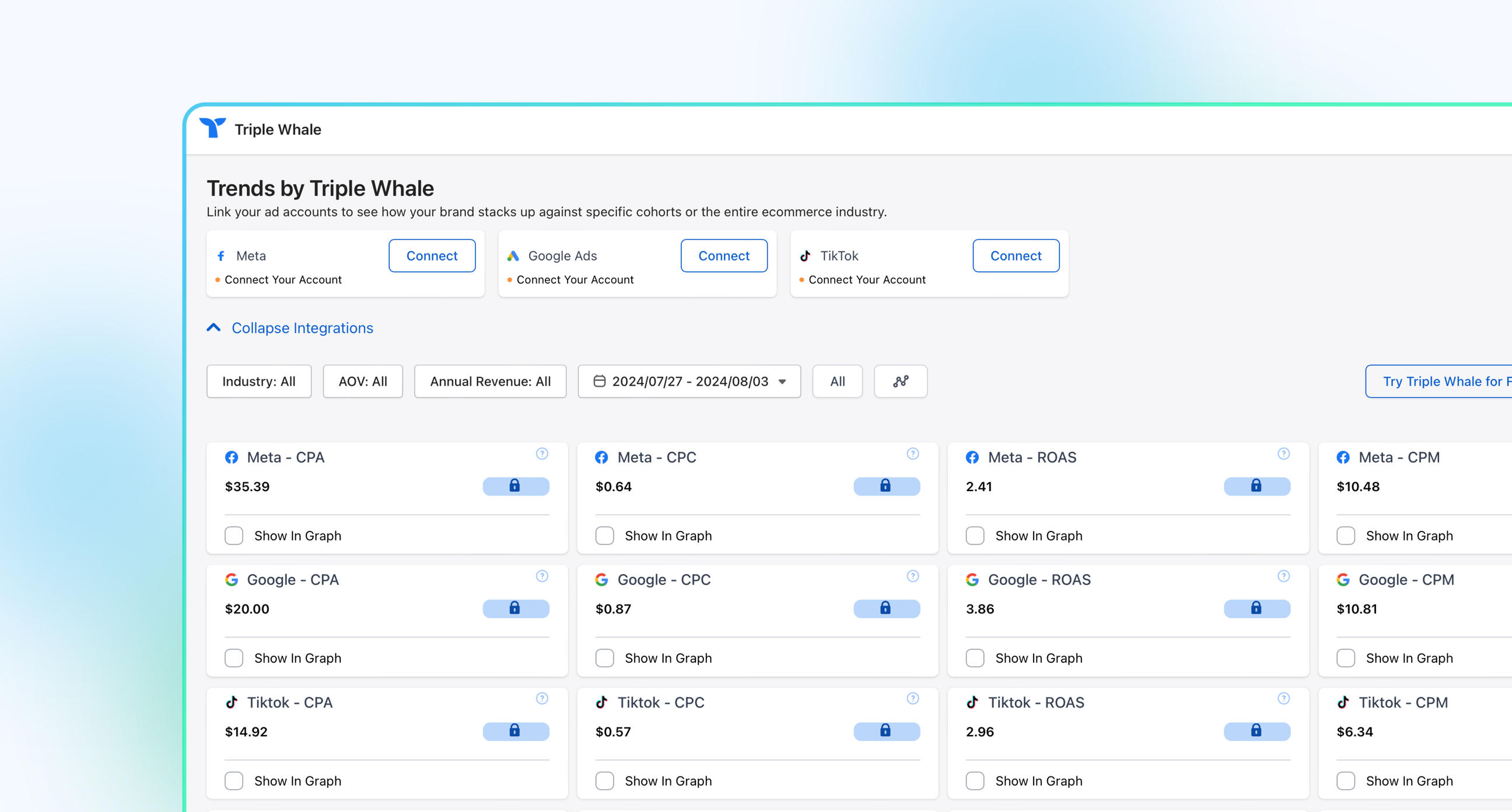
Benchmark your ecommerce brand against industry leaders
If you’re doing it right, your relationship with your customer won’t end the second they make a purchase from your ecommerce brand.
Instead, you’ll start focusing on engaging them in long-term retention and loyalty as soon as they first become aware you exist. This is called the customer lifecycle — the start-to-finish experience customers have with your business at all stages.
Customer lifecycle marketing is valuable in ecommerce: Retaining existing customers is generally more profitable than acquiring new ones.
Keep reading to learn more about the various stages of the customer lifecycle, how to identify where your customers are in that journey, and marketing strategies for each stage.
Key takeaways
Customer lifecycle marketing is the practice of tailoring your marketing efforts based on where customers are in the customer lifecycle, or their entire experience with your business, from awareness to advocacy.
Building a solid strategy for marketing across the five stages of the customer lifecycle takes time, money, and effort, but it can improve conversion rates, customer retention, and customer lifetime value, thereby increasing profits.
Start by establishing specific goals, the metrics you’ll use to track your progress toward them, and the right channels and tactics for marketing to your audience at every stage.
The Five Stages of the Customer Lifecycle
The customer lifecycle consists of five stages: awareness, reach, conversion, retention, and advocacy.
Each of the lifecycle marketing stages has its unique challenges and opportunities, and it's essential to understand where your customers are in this cycle so you can tailor your marketing efforts accordingly. Learn more about each stage below, including lifecycle marketing examples per stage.
Awareness
Definition/objective: Discovery. Introduce your brand and your offerings to potential customers
Behavioral signals: Visiting your site for the first time, visiting your social media pages
The awareness stage is the first step in the customer journey. This is the discovery stage, where potential customers become aware of your brand and what you have to offer. At this stage, your goal is to make a great first impression and create brand recognition. You can do this through various channels, such as social media, paid advertising, SEO content marketing, and influencer partnerships.
Examples:
Run paid social media ads based on demographics, interests, and behaviors
Partner with a TikTok influencer
Build and execute on an SEO content marketing strategy to drive education around your product, specialty, or expertise
Reach
Definition/objective: Acquisition. Begin to build trust and nurture leads with potential customers
Behavioral signals: Following your social media accounts, signing up for your newsletter
Core metrics: Email opt-in rate, returning visitors, engagement rate (such as social media likes, follows, and shares)
Common channels: Email marketing, paid social, SEO, content marketing, referral programs
Once someone is aware of your brand, the next stage is reach, which is sometimes also called acquisition or engagement. This is where you start to build a relationship with your potential customer by encouraging them to take action, such as signing up for a newsletter or following you on social media.
There’s more of a focus on customer acquisition, nurturing leads, and building trust with potential customers than during the awareness stage, which is where you’re primarily focused on making sure potential customers know your brand exists.
At this stage, the channels you use to market to your audience shift toward your owned assets, like your website, email list, and social media accounts. This reduces your reliance on paid media and cuts down on costs.
Examples:
Interact with followers on social media
Provide customer support across several channels
Send personalized email messages on certain milestones or special occasions
Distribute relevant blog posts or other information from your website
Offer incentives, such as discounts or freebies, to encourage sign-ups and subscriptions
Use retargeting ads to reach people who have engaged with your brand but haven't yet converted
Conversion
Definition/objective: Completed desired actions. A customer makes a purchase, signs up for your free trial, downloads your ebook, or converts in some other way you’re tracking
Behavioral signals: Making a purchase, downloading a digital product, signing up for a free trial
Core metrics: Conversion rate, average order value, customer acquisition cost
The conversion stage is where the actual transaction takes place. Whether it's making a purchase, signing up for a subscription, or booking a service, this stage is where the potential customer takes action and becomes an actual paying customer.
Your goal at this stage is to make the transaction as easy and seamless as possible. This means reducing friction to nudge shoppers toward conversions. Make sure your product pages are optimized with testimonials, reviews, and social proof that encourage a browser to add to their cart. Your checkout experience should be smooth, too, so they don’t abandon their cart before completing the purchase.
Examples:
Add social proof, such as customer reviews or testimonials, to your product pages
Simplify your checkout experience with one-click checkout options
Add flexible payment, such as installment plans or “buy now, pay later”, to reduce purchase friction
Offer free shipping
Create a sense of urgency with limited-time offers or low-stock warnings
Retention
Definition/objective: Relationship-building. Now that your customer has converted, you want to retain them and encourage repeat purchases
Behavioral signals: Opening post-purchase emails, completing a post-purchase survey
Once a customer has made a purchase, retention begins. This is where you focus on building a long-term relationship with your customers to ensure they have a positive experience with your brand. That can look like providing excellent customer service, personalized communication, and rewards or loyalty programs to incentivize repeat purchases.
It may also look like offering a subscription service to keep loyal customers automatically engaged, or finessing your lifecycle email marketing.
Your goal at this stage is to have a high repeat purchase rate, or the percentage of your shoppers who have made at least two purchases with you. You also want a low churn rate, or the percentage of your customers who have left your business over a certain period of time.
Examples:
Offer perks and discounts through a loyalty program or subscription model
Make it easy and fast for shoppers to contact customer support on your website and provide excellent service
Create personalized experiences on your website based on customer behavior and preferences
Use customer lifecycle email marketing to keep customers engaged and informed about new products, promotions, and updates
Advocacy
Definition/objective: Ambassadorship. Existing customers build awareness of your brand throughout their own networks
Behavioral signals: Leaving a review, tagging your account on social media, recommending your product to family and friends offline
Core metrics: Net promoter score, referral rate, customer lifetime value
Common channels: Loyalty programs, social media (user-generated content and reviews), referral programs
The final stage of the customer lifecycle is advocacy. This is where existing customers become growth multipliers, actively promoting your brand to others. The goal at this stage is to turn satisfied existing customers into loyal fans who will recommend your brand to their friends and family. For example, they might write a positive review on your website or post a picture of themselves using your product and tag you on social media.
This ultimately lowers your customer acquisition costs because you get the benefit of word-of-mouth marketing, which is entirely free.
Examples:
Offer exclusive early access to loyalty program members
Provide discounts to frequent shoppers to reward their loyalty
Send personalized thank-you notes
Encourage customers to leave reviews and ratings on your website and other review platforms
Implement a referral program to incentivize customers to tell their friends and family about your business
Share user-generated content on social media to showcase how customers are using and enjoying your products or services
Engage with customers on social media and respond to their comments and feedback
Stage
Primary Goal
Core Metrics
Revenue Impact
Awareness
Introduce your brand to high-quality potential customers
How to Create a Customer Lifecycle Marketing Strategy
To build a successful customer lifecycle marketing strategy, you’ll need to know your audience, clearly define the action you want them to take, and understand how best to motivate them to do so. But this shouldn’t be a one-off brainstorming session; rather, you should aim to create a practical, repeatable system that you can iterate on and continue to apply in the future.
Here’s a step-by-step guide to creating a strategy that sticks.
Step 1: Define Your Own Lifecycle Stages
While the five stages of the customer lifecycle above are generally agreed upon across industries, they may vary a bit depending on your business model. For example, a newer business likely needs to heavily prioritize awareness and reach stages and may not focus much strategy at all on advocacy in the early days.
You can define the stages however they work best for your brand. The best place to start is by getting clear on your goals and metrics for success. This will help you stay focused on your return on investment. Then, make sure you have alignment on your goals and your lifecycle stages from members of other teams.
Think about the best channels for your self-defined lifecycle stages, too. You need to choose the ones that align with your goals and resonate with your target audience. For example, social media might be effective for building brand awareness, but email marketing might be better for retention.
Step 2: Map Behaviors to Each Stage
Behavioral signals (also sometimes called behavioral triggers) are actions your customers (or potential customers) take that suggest they intend to make a purchase, or at least intend to further engage with your brand.
For example, website clicks are behavioral signals that users are interested in learning more about your offerings.
Tracking page views, cart abandonment, email engagement, and other similar behaviors sets you up for the next step, where you’ll group your users into segments that allow you to optimize your marketing efforts, called customer segmentation.
Step 3: Segment Your Customers
Customer segmentation allows you to create cohorts of shoppers based on their revenue potential and then optimize your budget by spending most efficiently on the segments or cohorts most likely to convert.
One common way of doing this is by grouping customers based on three vectors of past purchase behavior: recency, frequency, and monetary value. This technique is called RFM segmentation, and it allows you to sort your shoppers into high-value and low-value segments. High-value customers are more engaged and more likely to purchase again. Low-value customers are the least engaged and less likely to shop with you again, so your customer engagement efforts are typically best directed elsewhere.
Another effective approach is cohort analysis, which can be successfully used for lifecycle marketing when you group customers by purchase date. This cohort will, in theory, move through your customer lifecycle together. Of course, this doesn’t take into account individual differences in shopping intent and preferences, but it can be a helpful starting point.
Step 4: Assign a Metric to Each Stage
As any marketer knows, it’s easy to get bogged down by data. But you need to have clarity and focus in your customer lifecycle marketing strategy to be successful. The best way to do this is to focus on one primary metric per customer lifecycle stage. You can decide on which metric to measure based on your business goals.
Then, you can establish key performance indicators (KPIs) for each metric. These are benchmarks or outcomes you hope to achieve for each metric. For example, you may decide to track site traffic as your primary metric for your awareness stage. Your KPI may be to see a 35% increase in website traffic over the next 6 months.
Step 5: Activate Campaigns that Match Your Goals
Once you prioritize a metric for each stage of your customer lifecycle, you can target your segments appropriately with campaigns that drive results in those areas. Campaigns will always differ by lifecycle stage: How you attempt to drive awareness is very different from how you attempt to drive retention, for example.
Automation can help. Let’s say you set up an automation to send a specific, personalized reengagement email to anyone who abandons a cart. This helps you deliver personalized attention to improve loyalty and engagement with less of a lift on you and your team. It can also help prevent certain interactions from falling through the cracks that busy humans may miss.
Step 6: Measure Incremental Revenue Growth
As always, you’ll need to measure how your efforts are working. To determine the effectiveness of your customer lifecycle marketing strategy, it helps to look at incremental revenue growth. This is the extra income you make from a specific activity, like increasing your marketing efforts due to this new strategy you’ve created.
It’s calculated by subtracting your historic revenue over a specific time frame from your new revenue.
Keep in mind that market conditions, pricing changes, and changes in your offerings can also affect incremental revenue, so it doesn’t give you a perfect snapshot of the efficacy of your marketing efforts alone, but it’s a helpful estimate.
Because you segmented your customers per step 3 above, you can also look at your revenue by cohort, which can give you some insight into how your efforts are paying off by lifecycle stage.
Your CAC versus LTV ratio can also be helpful. This gives you a dollar number for how much value a customer delivers to your brand over their whole relationship with you, per Harvard Business School.
Remember too that it’s natural for retention to wane over time, which is often visualized by the retention curve: You want your curve to level off at some point rather than approach zero so you know some percentage of users have stuck with you over time. You can analyze your curve in the context of your cohorts or segments to see if you can identify any changes in retention based on the patterns, preferences, or other factors unique to these groups.
However you choose to measure your customer lifecycle marketing efforts, you need to track and analyze your results regularly. This will help you identify what's working and what's not and make data-driven decisions. You can use a tool like Triple Whale’s Triple Pixel for zero-party data attribution.
Common Challenges When Building a Lifecycle Marketing Strategy
Don’t let your lifecycle marketing strategy underperform or leave opportunities on the table. Try to avoid these common mistakes and challenges to guarantee success:
Treating the lifecycle as linear
The customer lifecycle is a generalization of a common trajectory for shoppers, but in reality, the path to conversion for most people — especially online shoppers — isn’t quite so simple. There is no straight line from awareness to advocacy. All customers are unique, which is why it’s important to understand the difference between customer lifecycle and customer journey.
Over-investing in acquisition
Yes, you want to expand your customer base, but focusing too much on early stages of the customer lifecycle can mean you’re ignoring the post-purchase experience, which is when you really build retention and loyalty.
Ignoring contribution margin
Your contribution margin is how much you profit from a sale after subtracting your costs. If you’re not keeping a careful eye on how much money you’re spending on your customer lifecycle marketing strategy, the incremental revenue growth may not be enough to move your bottom line.
Measuring vanity metrics
More data isn’t always better. Improving vanity metrics, which might include impressions or list size, doesn’t necessarily drive profitability. Make sure you’re measuring the metrics that matter most for your business and goals.
Relying too heavily on automation
Automation can be helpful, but your automated campaigns still need to be monitored and tweaked regularly. Copy, images, and offers can quickly become outdated if you don’t devote ongoing attention here.
Relying too heavily on historical data
Similarly, it’s important to keep in mind that your data surrounding your audience’s behaviors and preferences is all from the past. Predictive analytics and real-time data can help you evolve as quickly as your customers do.
Not centralizing data
Different teams in your organization may have different data systems that can fragment your understanding of your customer lifecycle. Centralized data can help you more accurately understand and track customer behavior.
Using the same messaging for all your segments
The whole point of this type of marketing is to tailor your marketing messages to each stage of the lifecycle. Recycling the same messaging across segments isn’t typically as effective.
Stretching yourself too thin
Customer lifecycle marketing requires managing and monitoring tailored strategies and campaigns across multiple channels. There’s no denying that’s a lot of work and requires a fair amount of marketing spend. If you don’t have the bandwidth or budget, this type approach can be more challenging to implement.
Benefits of a Strong Lifecycle Marketing Strategy
Implementing a customer lifecycle marketing strategy can have a significant effect on your business because you’ve worked hard to turn potential shoppers into customers and one-time customers into dedicated repeat purchasers.
Here are some of the benefits of customer lifecycle marketing you can expect.
Increased Customer Retention and Loyalty
By focusing on building relationships with your customers, you're more likely to retain them and turn them into loyal fans. This means lower churn rates and lower customer acquisition costs, leading to higher profitability over time.
Higher Customer Lifetime Value
When you retain customers and increase their customer loyalty, you also increase their customer lifetime value. This is the amount of money a customer will spend on your products or services over their long-term relationship with your business. By upselling, cross-selling, and providing excellent customer service, you can increase your customer's lifetime value and boost your revenue.
Improved Customer Experience and Satisfaction
A customer lifecycle marketing strategy helps you provide a better customer experience and increase customer satisfaction. By personalizing communication, offering relevant offers, and providing excellent customer service, you create a positive brand image and build trust with your customers.
Stronger Brand Reputation
Nielsen research shows 92% of shoppers trust word-of-mouth recommendations over any other kind of advertising. This type of advocacy is the goal of customer lifecycle marketing and can lead to more sales over time with no acquisition cost.
Better ROI
When you implement a customer lifecycle marketing strategy, you can expect a better return on investment (ROI) compared to traditional marketing tactics. This is because you're targeting customers who have already shown interest in your brand and are more likely to convert and become loyal customers.
Smarter Budget Allocation
Tailoring your messaging to a specific lifecycle stage ensures that your marketing and advertising budgets are being spent where they can have the greatest effect — and you can cut back on spending in areas that aren’t as effective. You’ll essentially be able to better address media reinvestment, shifting spending away from high-cost efforts and into high-ROI approaches.
Higher Revenue
At the end of the day, all of the benefits above lead to what’s likely the primary goal of your business: making more money. Customer lifecycle marketing is an investment that can improve your bottom line, when implemented strategically.
Final Thoughts
Customer lifecycle marketing is a powerful way to help you grow your business and increase your revenue. By understanding the lifecycle stages and implementing strategies that align with your goals and target audience, you can create a seamless and personalized experience that keeps customers coming back.
Remember to set specific goals and metrics, use a customer-centric approach, choose the right channels and tactics for each stage, and measure and analyze your results regularly. By doing so, you can enjoy the benefits of successful customer lifecycle marketing, such as increased customer retention and loyalty, higher customer lifetime value, improved customer experience and satisfaction, and better ROI.
Start implementing a customer lifecycle marketing strategy and see the results for yourself with Triple Whale. Book a demo today!
FAQs
What are the 5 stages of the customer lifecycle?
The five stages of the customer lifecycle are awareness, reach, conversion, retention, and advocacy.
How does lifecycle marketing differ from traditional marketing?
Lifecycle marketing focuses more on nurturing long-term relationships with your customers, rather than a one-time transaction like traditional marketing.
How does segmentation improve lifecycle marketing?
Segmentation improves lifecycle marketing because it allows marketers to group customers by various factors that can identify where they are currently in the customer lifecycle. This ensures that the right marketing messaging reaches them at the right time.
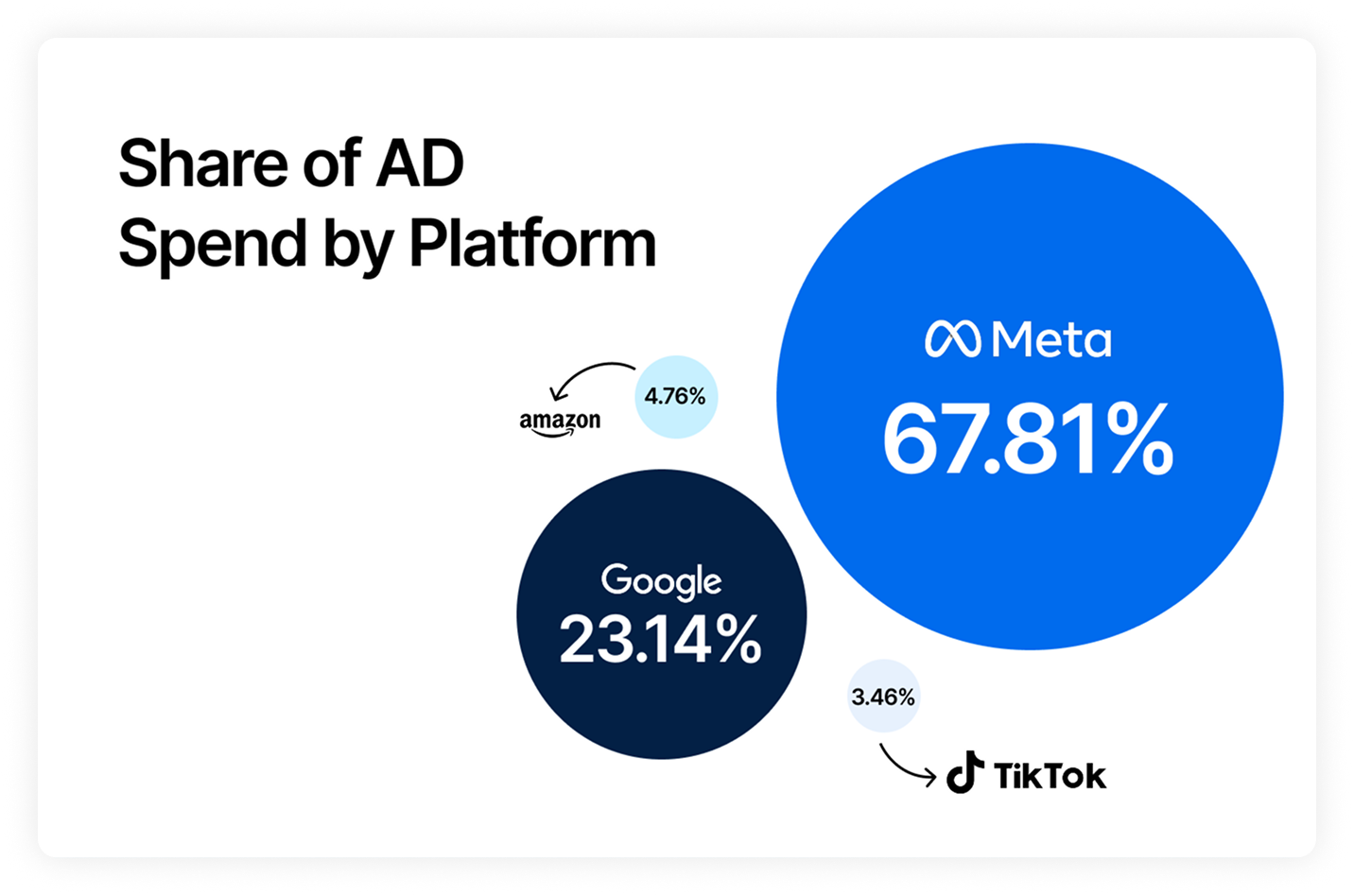
Body Copy: The following benchmarks compare advertising metrics from April 1-17 to the previous period. Considering President Trump first unveiled his tariffs on April 2, the timing corresponds with potential changes in advertising behavior among ecommerce brands (though it isn’t necessarily correlated).


 Moby AIAsk questions, analyze performance, and work with your business context.
 ActionsTake governed action across the tools that run your business.
 AutomationsSchedule recurring analysis and work that runs on your terms.
 Landing PagesCreative conversion-focused ecommerce pages with Moby.
 Creative StudioGenerate and refine creative grounded in your brand.




.webp)



.webp)

.webp)
