Customer segmentation is the process of categorizing your customers based on shared characteristics like age, behaviors, spending habits, and preferences. Then, through customer segmentation analysis, you can learn more about your customers and tailor your campaigns, offers, and products to their specific desires and needs.
What is customer segmentation?
The more you understand your customers, the better you can sell to them and the more successful your business will be. Segmenting customers allows you to visualize major differences between different categories of customers, then finetune your marketing efforts to the behaviors of these various groups.
So what is customer segmentation? Put simply, it’s grouping your customers based on similarities that help you market to them effectively.
It might look like categorizing your audience by factors such as:
Age
Gender
Values
Hobbies
Technology use
…and many more! Scroll down to the section on types of customer segmentation for additional details.
Once you’ve identified your customer segments, you can dig deep into the analysis of how these groups behave and why, with answers to the following questions, according to the National Institutes of Health Office of Management:
Who is purchasing and using your products and services?
Are your offerings more popular among customers of certain ages, genders, racial or ethnic backgrounds, or other demographic factors?
Have purchases increased, decreased, or stayed steady in certain segments?
The next step of the customer segmentation process is creating hypotheses around why you observe these trends. This can help your campaigns evolve to more effectively target the right customers.
This customer segmentation definition is similar to but distinct from marketing segmentation. Marketing segmentation is a similar process of dividing consumers into segments. But it involves looking at everyone in a target audience or market. Customer segmentation deals solely with your brand’s existing customer base.
Why customer segmentation matters
Customer segmentation is important because it improves your bottom line by increasing key marketing metrics like customer engagement and conversion rate.
Here are some of the benefits of customer segmentation that help you get there:
More efficient marketing: You’ll allocate the appropriate amount of ad spend on the most effective campaigns for the specific segments you’re targeting. That includes choosing the right marketing channels for each segment and optimizing the creative aspects of each campaign to best address the unique interests and/or pain points for each segment.
Better customer service: You can tailor your communication with customers based on your segmentation. This results in a more personalized experience, a tried-and-true technique for improving customer service and engagement.
Higher-quality products: Learning more about specific customer segments helps you gather valuable feedback on your offerings. In the process, you’ll likely discover ways you can improve your products or add new products to your existing lines.
Improved AOV: When you understand your segments deeply, you’ll be able to seamlessly identify opportunities to upsell and cross-sell other offerings from your ecommerce store. This can result in a higher average order value, which generally means higher profitability and return on ad spend, too.
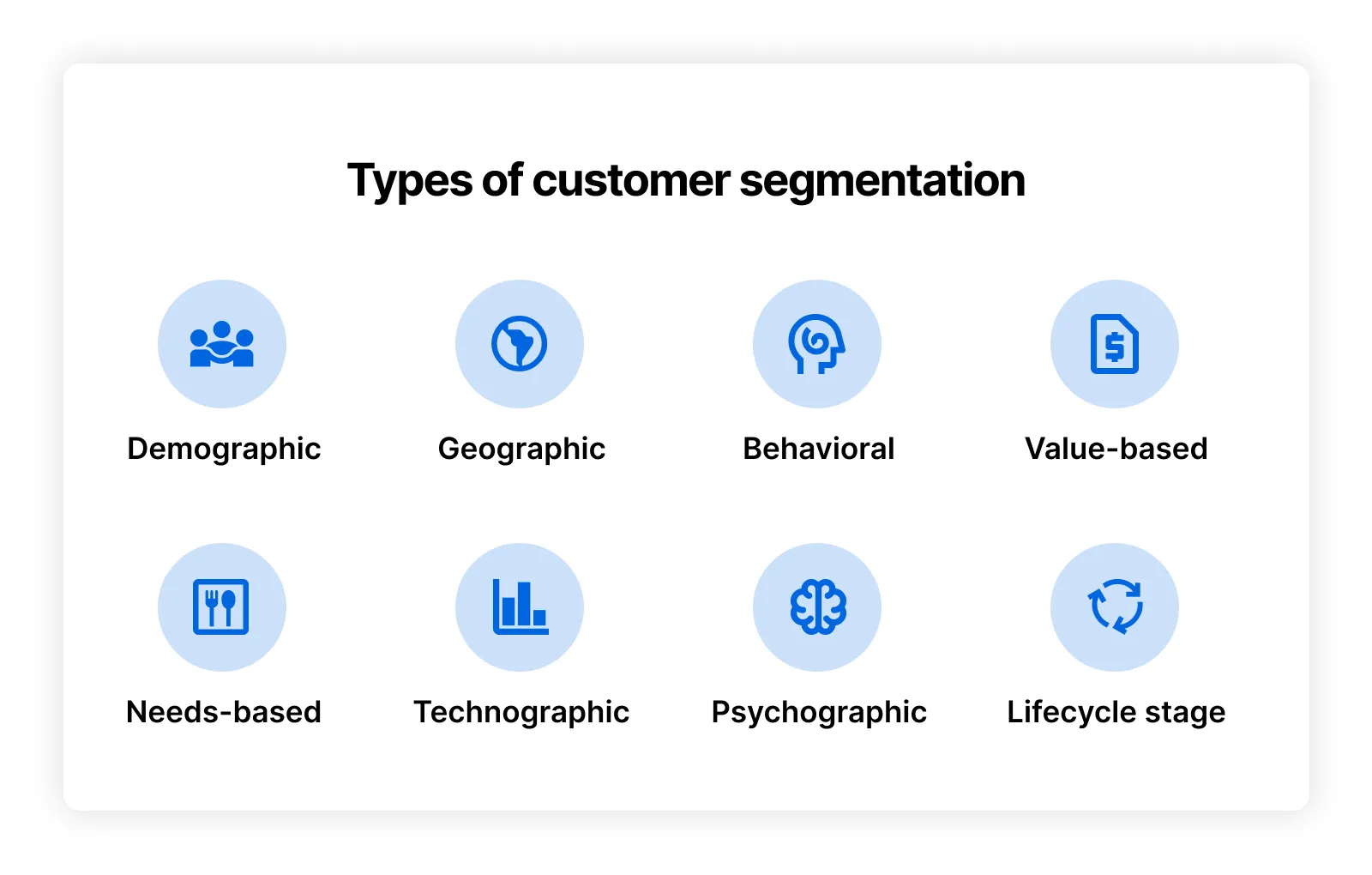
8 types of customer segmentation
But consumer segmentation isn’t just about grouping your customers by their ages and hometowns. There are a number of different types of customer segmentation you can use, depending on your industry, the size of your business, and the data you have available. These are also sometimes called customer segmentation models.
1. Demographic segmentation
Demographic segmentation is likely the type of segmentation that’s familiar to most people. It involves grouping customers by demographic characteristics such as:
Gender
Age
Family size
Race
Ethnicity
Education level
Household income
Religion
Marital status
For example, if you run a catering business and you segment your customers by families with school-age children, you can craft tailored marketing campaigns about graduation parties to send to this segment.
2. Geographic segmentation
As the name implies, this type of customer segmentation involves grouping your customers by their physical location. This can be at any number of levels, such as:
Continent
Region
Country
Time zone
State
County
City/town
Real-time location
For example, you might send push notifications with a limited-time offer to a segment of your app users currently located near your brick-and-mortar location.
3. Behavioral segmentation
Behavioral segmentation is a little more nuanced: Instead of segmenting customers by tangible facts about who they are and where they come from, this model groups them by their past interactions with your online brand, such as:
Previous purchases
Items added to cart and/or cart abandonment
Loyalty
Pages viewed
Product and category preferences
Responses to prior campaigns
This might look like segmenting your users into those who have previously made purchases on certain days of the week and timing your marketing sends to them accordingly.
4. Psychographic segmentation
This approach groups customers by characteristics that are closer to personality traits, such as:
Attitudes
Values
Interests
Lifestyle habits
Hobbies
Opinions
If you run an online apparel business, you might segment your customers by activity and send running-specific messaging to the runners and hiking-specific messaging to the outdoorsy shoppers, for example.
5. Technographic segmentation
Then, there’s segmentation based on the technology your customers use. This segmentation strategy looks at how much a customer uses different:
Devices
Software
Applications
To put it into practice, you might segment your customers by social media use and capitalize on trending topics in your messaging to those users on their preferred platforms.
6. RFM segmentation
RFM segmentation groups customers based on three vectors of their past purchasing behaviors: recency, frequency, and monetary value. Customers are ranked based on each of these three vectors and then divided into groups based on their scores. The groups might include new customers, high-risk customers, high-value customers, and low-value customers, for example.
7. Needs-based segmentation
While less commonly used than the tactics above, needs-based segmentation is still a valid approach. As the name implies, it involves grouping customers by their needs, such as:
The problem they need solved
Features they need in your product
The delivery method they need
The level of customer service they need
You might discover a segment of your customers is turned off by your customer service chatbot and instead needs to be able to reach a representative over the phone before making a purchase. Clearly communicate the hours when someone will be available to this segment. Delivering compelling creative and successful solutions targeted to a segment’s needs builds trust, loyalty, and retention.
8. Value-based segmentation
Using customer journey analytics, you can segment your users by their value to your business. Then, you can allocate more resources to the segments that generate the highest lifetime value, which can help you cut down on costs and increase efficiency.
This might look like offering special promotions only to your highest-value customers to encourage repeat purchases.
How to segment customers
Before you can capitalize on customer segmentation, you need to lay the groundwork of segmenting your users and visitors.
Step 1: Gather the data
No matter which type of customer segmentation you decide to use, the process begins with gathering data about your customers.
You can do this via many pathways, including:
Purchasing information
Purchase history
Surveys
Focus groups
Reviews
Online analytics
Loyalty program data
Customer service use history
Step 2: Analyze your findings
Then, your brand will need to analyze this data, looking for the most valuable patterns that can be used to create your segments.
Step 3: Create your segments
Once you’ve identified patterns among your customers, it’s time to gather the appropriate shoppers into the appropriate segments. This is often done using either rule-based or cluster-based segmentation.
Rule-based segmentation. With this approach, any customer who meets a certain threshold (or rule) you establish will be sorted into a specific segment. This is relatively straightforward, but also more rigid.
Cluster-based segmentation. Segments formed by clusters instead of rules are less rigid and instead group customers into as equal segments as possible. This takes more knowledge and experience to set up, but once you’re up and running, you’ll typically get more advanced insights than you would from rule-based segmentation.
Step 4: Do customer segmentation analysis
Once you have your segments, it’s time to learn meaningful insights about those groups of shoppers. Customer segmentation analysis is what helps your brand understand each segment more fully and hypothesize about how best to market to them in the future.
Analyzing the behaviors of each segment will help you highlight patterns and trends so you can develop targeted marketing strategies that are more likely to be successful for each customer segment.
Here are some of our favorite customer segmentation examples.
Dixxon Flannel Company
We helped Dixxon gain insights into which customer segments delivered the highest lifetime value. Customers who purchased country music-themed flannels were worth more than $1,000 after one year, nearly double the $503 value of motorsports customers. This insight has directly informed Dixxon’s product development strategy.
"This helps us understand where we should start doubling down from a product development standpoint—what categories we should really focus on based on the true value we're getting from these specific cohorts," Austin Urlocker, a marketing strategist at Dixxon, told us.
This supplement brand relied on our Customer Cohorts to track first-order revenue and monitor spending patterns over time, providing insights into the lifetime value and behavior of different customer segments. They also compared customer acquisition cost to LTV for specific cohorts to gain clarity into the profitability of key customer segments. Along with other Triple Whale insights, Create scaled from $0 of revenue to $4.5 million in one year!
RFM segmentation helped this mattress, bedding, and sleep accessories brand improve their Meta ROAS by 30%. Triple Whale’s easy-to-use segmentation builder helped them better target high-value customers, improving both campaign targeting and CRM flows. “We synced our high-value segments to Meta and Google. It led to better targeting and higher AOV,” Jon Moore, Simba Sleep’s marketing and ecommerce director told us. This resulted in the highest ROAS return from all their Meta lookalike audiences.
Boutique digital marketing agency RSN8 Media partnered with Triple Whale to supercharge brand growth for the apparel business TALENTLESS. Understanding and segmenting customer behaviors became pivotal, so RSN8 employed Triple Whale’s Audience Builder tool to gather and analyze demographic and behavioral data.
They targeted very specific audiences, such as couples celebrating anniversaries. A curated creative approach using couple-focused copy and imagery led to a new customer ROAS improvement of 300%. This outcome underscored the value of tailored creatives for specific audience segments.
“It's been extremely helpful to understand and try to tell the full story as to why certain products actually drive better long-term value for each individual customer acquired,” Shayan Doosty, CEO and founder of RSN8 Media told us. “Just trying to dissect that and working backwards to reverse engineer the [customer] journey has been really effective for TALENTLESS.”
Of course, you can’t just create these segments out of thin air. Audience segmentation tools like the following can help you create and analyze your segments.
Triple Whale: Our suite of customer retention tools includes options to help you build smarter segments with our Segment Builder and then put those segments to work for you with our Segment Sync and Cohort Analysis.
Shopify: If you operate your ecommerce store using Shopify, you have segmentation tools built in. Their straightforward segmentation templates allow you to create some groupings in just two clicks.
Hotjar: This software allows you to easily conduct surveys and interviews and generate heatmaps to help you learn more about your customers and segments.
Google Analytics:Google’s analytics suite allows you to segment users based on certain attributes and actions.
Sprout Social: The social media management tool also offers segmentation options for a comprehensive list of social platforms.
The future of customer segmentation
Increasingly, customer segmentation tools and software use artificial intelligence and machine learning to analyze larger amounts of data faster to more accurately and efficiently create and learn from customer segments.
Triple Whale’s AI Moby Agents work behind the scenes in our RFM segmentation process to identify your most valuable customers and prospects, then syncs them to your marketing channels automatically. This results in 50 to 100% larger segments than typical segmentation tools, meaning you’re reaching more of the right people.
Conclusion
Customer segmentation involves grouping your customers into categories based on their shared characteristics, then marketing to them differently based on their unique desires, needs, preferences, and behaviors.
This can help you increase customer retention, average order value, and lifetime value, as long as you’re constantly evaluating your segmentation process and tweaking it to make it work best for your brand. There are lots of different ways to segment your customers and various ways to analyze the data you gather from each segment. And Triple Whale can help with all of it, including building smarter segments and analyzing various cohorts of shoppers. Book a demo today!
Component Sales
5.32K
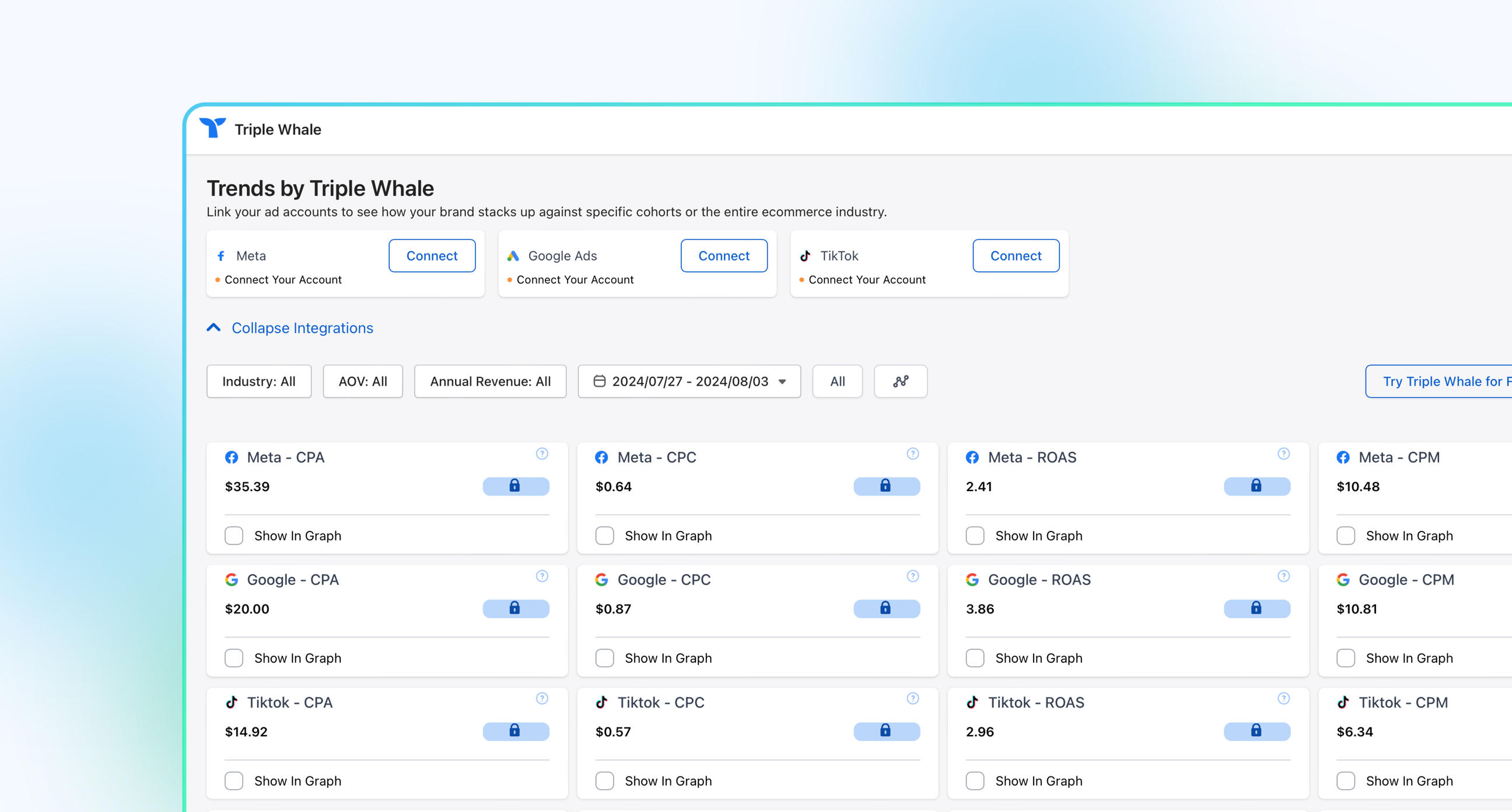
Benchmark your ecommerce brand against industry leaders
Customer segmentation is the process of categorizing your customers based on shared characteristics like age, behaviors, spending habits, and preferences. Then, through customer segmentation analysis, you can learn more about your customers and tailor your campaigns, offers, and products to their specific desires and needs.
What is customer segmentation?
The more you understand your customers, the better you can sell to them and the more successful your business will be. Segmenting customers allows you to visualize major differences between different categories of customers, then finetune your marketing efforts to the behaviors of these various groups.
So what is customer segmentation? Put simply, it’s grouping your customers based on similarities that help you market to them effectively.
It might look like categorizing your audience by factors such as:
Age
Gender
Values
Hobbies
Technology use
…and many more! Scroll down to the section on types of customer segmentation for additional details.
Once you’ve identified your customer segments, you can dig deep into the analysis of how these groups behave and why, with answers to the following questions, according to the National Institutes of Health Office of Management:
Who is purchasing and using your products and services?
Are your offerings more popular among customers of certain ages, genders, racial or ethnic backgrounds, or other demographic factors?
Have purchases increased, decreased, or stayed steady in certain segments?
The next step of the customer segmentation process is creating hypotheses around why you observe these trends. This can help your campaigns evolve to more effectively target the right customers.
This customer segmentation definition is similar to but distinct from marketing segmentation. Marketing segmentation is a similar process of dividing consumers into segments. But it involves looking at everyone in a target audience or market. Customer segmentation deals solely with your brand’s existing customer base.
Why customer segmentation matters
Customer segmentation is important because it improves your bottom line by increasing key marketing metrics like customer engagement and conversion rate.
Here are some of the benefits of customer segmentation that help you get there:
More efficient marketing: You’ll allocate the appropriate amount of ad spend on the most effective campaigns for the specific segments you’re targeting. That includes choosing the right marketing channels for each segment and optimizing the creative aspects of each campaign to best address the unique interests and/or pain points for each segment.
Better customer service: You can tailor your communication with customers based on your segmentation. This results in a more personalized experience, a tried-and-true technique for improving customer service and engagement.
Higher-quality products: Learning more about specific customer segments helps you gather valuable feedback on your offerings. In the process, you’ll likely discover ways you can improve your products or add new products to your existing lines.
Improved AOV: When you understand your segments deeply, you’ll be able to seamlessly identify opportunities to upsell and cross-sell other offerings from your ecommerce store. This can result in a higher average order value, which generally means higher profitability and return on ad spend, too.
8 types of customer segmentation
But consumer segmentation isn’t just about grouping your customers by their ages and hometowns. There are a number of different types of customer segmentation you can use, depending on your industry, the size of your business, and the data you have available. These are also sometimes called customer segmentation models.
1. Demographic segmentation
Demographic segmentation is likely the type of segmentation that’s familiar to most people. It involves grouping customers by demographic characteristics such as:
Gender
Age
Family size
Race
Ethnicity
Education level
Household income
Religion
Marital status
For example, if you run a catering business and you segment your customers by families with school-age children, you can craft tailored marketing campaigns about graduation parties to send to this segment.
2. Geographic segmentation
As the name implies, this type of customer segmentation involves grouping your customers by their physical location. This can be at any number of levels, such as:
Continent
Region
Country
Time zone
State
County
City/town
Real-time location
For example, you might send push notifications with a limited-time offer to a segment of your app users currently located near your brick-and-mortar location.
3. Behavioral segmentation
Behavioral segmentation is a little more nuanced: Instead of segmenting customers by tangible facts about who they are and where they come from, this model groups them by their past interactions with your online brand, such as:
Previous purchases
Items added to cart and/or cart abandonment
Loyalty
Pages viewed
Product and category preferences
Responses to prior campaigns
This might look like segmenting your users into those who have previously made purchases on certain days of the week and timing your marketing sends to them accordingly.
4. Psychographic segmentation
This approach groups customers by characteristics that are closer to personality traits, such as:
Attitudes
Values
Interests
Lifestyle habits
Hobbies
Opinions
If you run an online apparel business, you might segment your customers by activity and send running-specific messaging to the runners and hiking-specific messaging to the outdoorsy shoppers, for example.
5. Technographic segmentation
Then, there’s segmentation based on the technology your customers use. This segmentation strategy looks at how much a customer uses different:
Devices
Software
Applications
To put it into practice, you might segment your customers by social media use and capitalize on trending topics in your messaging to those users on their preferred platforms.
6. RFM segmentation
RFM segmentation groups customers based on three vectors of their past purchasing behaviors: recency, frequency, and monetary value. Customers are ranked based on each of these three vectors and then divided into groups based on their scores. The groups might include new customers, high-risk customers, high-value customers, and low-value customers, for example.
7. Needs-based segmentation
While less commonly used than the tactics above, needs-based segmentation is still a valid approach. As the name implies, it involves grouping customers by their needs, such as:
The problem they need solved
Features they need in your product
The delivery method they need
The level of customer service they need
You might discover a segment of your customers is turned off by your customer service chatbot and instead needs to be able to reach a representative over the phone before making a purchase. Clearly communicate the hours when someone will be available to this segment. Delivering compelling creative and successful solutions targeted to a segment’s needs builds trust, loyalty, and retention.
8. Value-based segmentation
Using customer journey analytics, you can segment your users by their value to your business. Then, you can allocate more resources to the segments that generate the highest lifetime value, which can help you cut down on costs and increase efficiency.
This might look like offering special promotions only to your highest-value customers to encourage repeat purchases.
How to segment customers
Before you can capitalize on customer segmentation, you need to lay the groundwork of segmenting your users and visitors.
Step 1: Gather the data
No matter which type of customer segmentation you decide to use, the process begins with gathering data about your customers.
You can do this via many pathways, including:
Purchasing information
Purchase history
Surveys
Focus groups
Reviews
Online analytics
Loyalty program data
Customer service use history
Step 2: Analyze your findings
Then, your brand will need to analyze this data, looking for the most valuable patterns that can be used to create your segments.
Step 3: Create your segments
Once you’ve identified patterns among your customers, it’s time to gather the appropriate shoppers into the appropriate segments. This is often done using either rule-based or cluster-based segmentation.
Rule-based segmentation. With this approach, any customer who meets a certain threshold (or rule) you establish will be sorted into a specific segment. This is relatively straightforward, but also more rigid.
Cluster-based segmentation. Segments formed by clusters instead of rules are less rigid and instead group customers into as equal segments as possible. This takes more knowledge and experience to set up, but once you’re up and running, you’ll typically get more advanced insights than you would from rule-based segmentation.
Step 4: Do customer segmentation analysis
Once you have your segments, it’s time to learn meaningful insights about those groups of shoppers. Customer segmentation analysis is what helps your brand understand each segment more fully and hypothesize about how best to market to them in the future.
Analyzing the behaviors of each segment will help you highlight patterns and trends so you can develop targeted marketing strategies that are more likely to be successful for each customer segment.
Here are some of our favorite customer segmentation examples.
Dixxon Flannel Company
We helped Dixxon gain insights into which customer segments delivered the highest lifetime value. Customers who purchased country music-themed flannels were worth more than $1,000 after one year, nearly double the $503 value of motorsports customers. This insight has directly informed Dixxon’s product development strategy.
"This helps us understand where we should start doubling down from a product development standpoint—what categories we should really focus on based on the true value we're getting from these specific cohorts," Austin Urlocker, a marketing strategist at Dixxon, told us.
This supplement brand relied on our Customer Cohorts to track first-order revenue and monitor spending patterns over time, providing insights into the lifetime value and behavior of different customer segments. They also compared customer acquisition cost to LTV for specific cohorts to gain clarity into the profitability of key customer segments. Along with other Triple Whale insights, Create scaled from $0 of revenue to $4.5 million in one year!
RFM segmentation helped this mattress, bedding, and sleep accessories brand improve their Meta ROAS by 30%. Triple Whale’s easy-to-use segmentation builder helped them better target high-value customers, improving both campaign targeting and CRM flows. “We synced our high-value segments to Meta and Google. It led to better targeting and higher AOV,” Jon Moore, Simba Sleep’s marketing and ecommerce director told us. This resulted in the highest ROAS return from all their Meta lookalike audiences.
Boutique digital marketing agency RSN8 Media partnered with Triple Whale to supercharge brand growth for the apparel business TALENTLESS. Understanding and segmenting customer behaviors became pivotal, so RSN8 employed Triple Whale’s Audience Builder tool to gather and analyze demographic and behavioral data.
They targeted very specific audiences, such as couples celebrating anniversaries. A curated creative approach using couple-focused copy and imagery led to a new customer ROAS improvement of 300%. This outcome underscored the value of tailored creatives for specific audience segments.
“It's been extremely helpful to understand and try to tell the full story as to why certain products actually drive better long-term value for each individual customer acquired,” Shayan Doosty, CEO and founder of RSN8 Media told us. “Just trying to dissect that and working backwards to reverse engineer the [customer] journey has been really effective for TALENTLESS.”
Of course, you can’t just create these segments out of thin air. Audience segmentation tools like the following can help you create and analyze your segments.
Triple Whale: Our suite of customer retention tools includes options to help you build smarter segments with our Segment Builder and then put those segments to work for you with our Segment Sync and Cohort Analysis.
Shopify: If you operate your ecommerce store using Shopify, you have segmentation tools built in. Their straightforward segmentation templates allow you to create some groupings in just two clicks.
Hotjar: This software allows you to easily conduct surveys and interviews and generate heatmaps to help you learn more about your customers and segments.
Google Analytics:Google’s analytics suite allows you to segment users based on certain attributes and actions.
Sprout Social: The social media management tool also offers segmentation options for a comprehensive list of social platforms.
The future of customer segmentation
Increasingly, customer segmentation tools and software use artificial intelligence and machine learning to analyze larger amounts of data faster to more accurately and efficiently create and learn from customer segments.
Triple Whale’s AI Moby Agents work behind the scenes in our RFM segmentation process to identify your most valuable customers and prospects, then syncs them to your marketing channels automatically. This results in 50 to 100% larger segments than typical segmentation tools, meaning you’re reaching more of the right people.
Conclusion
Customer segmentation involves grouping your customers into categories based on their shared characteristics, then marketing to them differently based on their unique desires, needs, preferences, and behaviors.
This can help you increase customer retention, average order value, and lifetime value, as long as you’re constantly evaluating your segmentation process and tweaking it to make it work best for your brand. There are lots of different ways to segment your customers and various ways to analyze the data you gather from each segment. And Triple Whale can help with all of it, including building smarter segments and analyzing various cohorts of shoppers. Book a demo today!
Body Copy: The following benchmarks compare advertising metrics from April 1-17 to the previous period. Considering President Trump first unveiled his tariffs on April 2, the timing corresponds with potential changes in advertising behavior among ecommerce brands (though it isn’t necessarily correlated).


 Moby AIAsk questions, analyze performance, and work with your business context.
 ActionsTake governed action across the tools that run your business.
 AutomationsSchedule recurring analysis and work that runs on your terms.
 Landing PagesCreative conversion-focused ecommerce pages with Moby.
 Creative StudioGenerate and refine creative grounded in your brand.




.webp)



.webp)

.webp)
