Attribution is about crediting the right ad or channel for your customer’s purchase. And it’s a critical part of your marketing strategy.
But the question on every marketer’s mind is: Does one channel take the crown — or do you divvy up the credit across different touchpoints? If so, how?
At Triple Whale, we don’t believe there’s a one-size-fits-all solution for that. Our platform offers several attribution models, each designed to provide unique insights and help optimize different marketing strategies.
In this guide, we’ll walk through the attribution models available so you can confidently choose the right one for you at any given moment.
First, What Exactly Is an Attribution Model?
Let’s start with the basics. The primary purpose of marketing attribution is to help you understand which touchpoints influence customer conversions — not just what’s getting attention.
It’s also important to understand which channels and campaigns are driving the greatest return on investment (ROI), so marketers can double down on those efforts.
Those conversions can be sales, newsletter signups, downloads, or any other desired action you identify for your customers.
The touchpoints that drive those conversions can be any number of marketing channels, like organic search, display ads, and email.
Consider this classic example of a customer journey:
A shopper sees an ad, clicks on it and lands on your site.
The next day, they are retargeted by another ad.
On the third day, they search your brand on Google. They click on a branded term and make a purchase.
Which of those touchpoints deserves the full credit?
Because the customer journey often involves multiple interactions across various channels, there are different ways to assign credit. That’s where an attribution model comes in. Each model provides its own set of rules for assigning value.
Attribution models generally fall into two main categories — single-touch and multi-touch — which we will dive into. Before you choose a tool, however, you need the right data flow powering it. Higher-quality data powers deeper analysis, precise attribution, and sharper audience segmentation.
With Triple Whale’s Triple Pixel, every touchpoint in your customer’s journey is tracked, so you can see exactly how each interaction contributes to the final purchase. This means you can assign credit to the right ad clicks and understand their true impact.
What About Attribution Settings?
Before you choose an attribution model, it helps to understand the settings that shape what the model is allowed to see. Here is what you need to know.
Attribution Windows
An attribution window is the time frame during which events are tracked and credited to an ad. Different businesses need different windows.
For some, crediting an ad from a month ago might be too long, but for others with longer sales cycles (such as furniture or luxury goods), even a month might be too short.
Triple Whale gives you flexibility on this matter, meaning you can choose from several attribution windows:
1 Day
7 Days
14 Days
28 Days
Lifetime (covers the entire customer journey, no matter how long)
The default is Lifetime, but the best window is the one that matches the average length of your customer journey.
Types of Touchpoints & Attribution Lenses
Attribution models can only give credit to the touchpoints they’re able to “see.” In Triple Whale, most models fall into three touchpoint styles — think of these as different attribution lenses, or different ways to look at the same customer journey.
The lens isn’t the model itself: the lens is what kinds of signals count, and the model is the math that splits the credit using those signals.
Click-based: Gives credit only for trackable clicks. Best for simplified, single-touch views of the journey. (Examples: First-Click, Last-Click, Triple Attribution, Total Impact)
Event-based: Credits clicks plus other meaningful interactions like ad views and first-party site events (e.g., product views, add-to-carts, etc.). This keeps upper-funnel influence in the story. (Examples: Clicks & Deterministic Views)
Single Touch
Okay, let’s get started with the meat of the matter — attribution models. The ones most people are familiar with are single touch — first-click and last-click.
In these models, 100% of credit is assigned to the first or last click of the customer journey, respectively.
Single-touch models intentionally simplify the journey, which can be beneficial for certain moments or smaller brands. But if you’re running paid media on more than one marketing channel, you’ll want to look at a more advanced attribution model.
First-click
Choose first-click attribution for a deep understanding of top of funnel impact. That’s typically best for industries where discovery is important, such as apparel, beauty, and lifestyle.
It’s also beneficial for brands investing heavily in top-of-funnel strategies such as creators, PR, SEO content, and awareness campaigns.
Last-click
Choose last-click attribution to understand which ads are driving conversion. It’s useful for seeing what closes, especially in shorter buying cycles. Another pivotal moment is for industries where intent is high at the end of the funnel, such as supplement reorders, flash sales, and branded search-heavy categories.
Multi-Touch Attribution (MTA) Model
Multi-touch attribution considers all of the touchpoints that contributed to your desired conversion across different marketing channels. Different models within this category weigh touchpoints differently.
Triple Attribution Model
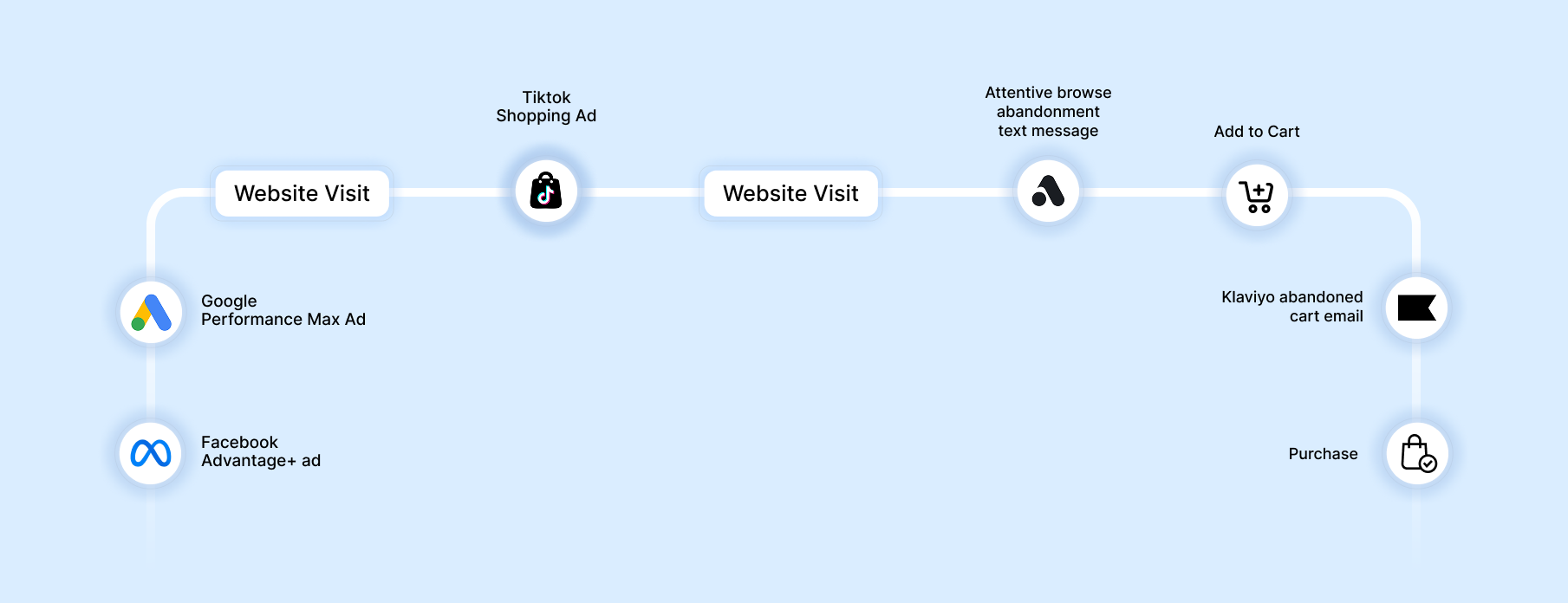
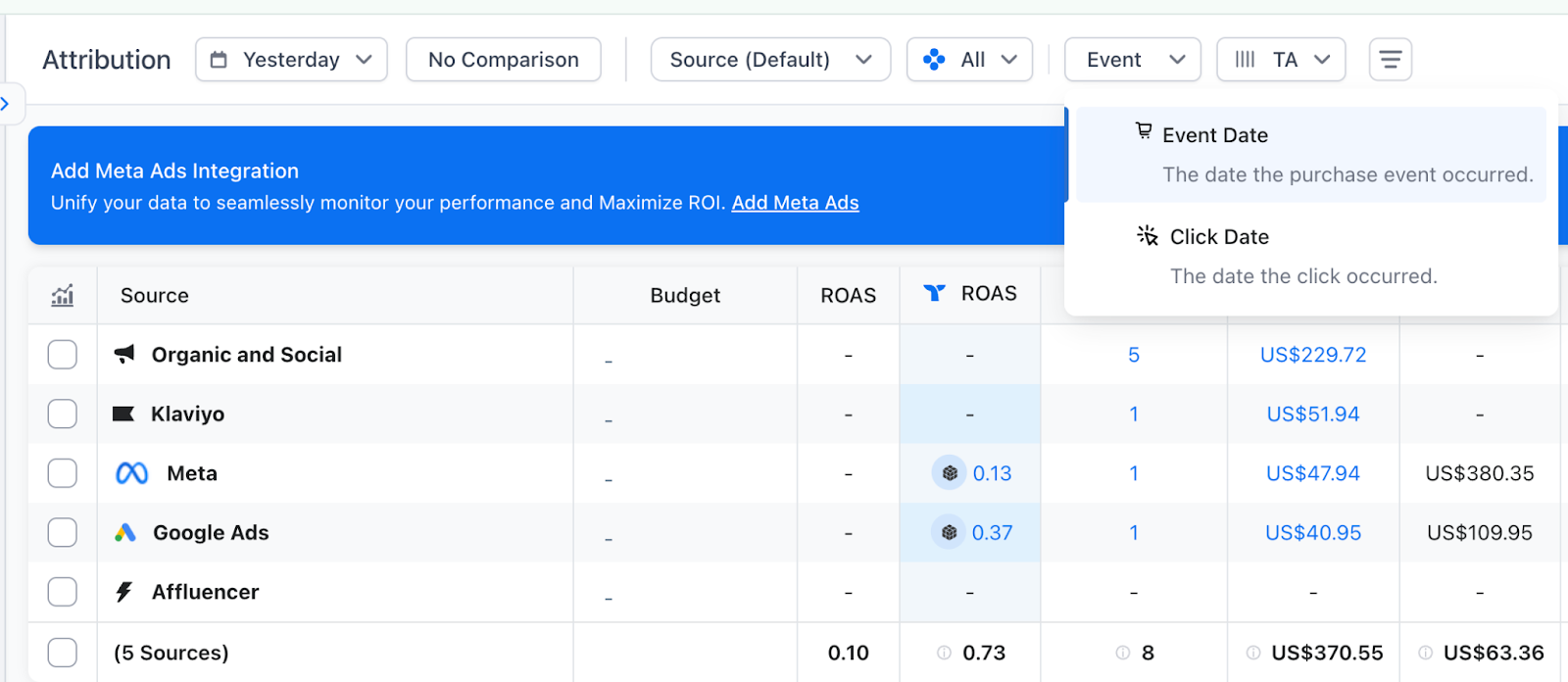
The Triple Attribution (TA) is sophisticated in the sense that it gives 100% of credit to the last click per marketing channel. So, if your customer interacts with ads on Facebook, Google, and Klaviyo, Triple Attribution will allow you to look into each specific channel’s performance.
For instance, if a customer clicks on a Facebook ad #1 and Facebook ad #2, then a Google ad, and finally a Klaviyo ad before making a purchase, the credit for the sale would go to the last ad click of each platform.
So, in this scenario, Facebook ad #2 would receive credit for the sale when looking at Facebook data, and the Google ad would receive credit when viewing Google data, and so on.
Best for: Day-to-day channel-level optimization and decision-making; Reviewing the order overlap between channels.
Total Impact Attribution Model
Total Impact (TI) gives a comprehensive view of all interactions a customer has before making a purchase. It blends your first-party pixel data together with zero-party data and a proprietary algorithm to offer a holistic perspective.
That said, it considers a wide range of factors, including survey data, ad impressions, clicks, website visits, and email opens, to determine the most impactful touchpoints.
For instance, if a click on Facebook aligns with a survey response indicating Facebook, the model gives more credit to Facebook.
As new data becomes available, the model continuously learns and adapts, providing increasingly accurate insights over time. This capability helps you stay ahead of the curve and make data-driven decisions.
Note: This model requires the use of either the Triple Whale Post-Purchase Survey or an integrated post-purchase survey from KnoCommerce or Fairing.
Best for: Complex multi-channel strategies or with a long sales cycle.
While the Total Impact model is highly effective for long-term analysis, it is not suitable to assess immediate impact.
If you need to understand the impact of a new ad, campaign, or marketing channel on the same day, you should use Triple Attribution instead.
Total Impact is best viewed based on a seven-day average to provide accurate insights and inform data-driven decisions.
Best for: A comprehensive view of your various marketing efforts.
Use Total Impact when you want to visualize the weighted success of your marketing sources, channels, campaigns, and ads, with your store’s revenue distributed based on which channels provide the most impact on the purchase decision.
Best for: An alternative to MMM
Creating a full Marketing Mix Model (MMM) usually takes a lot of time, money, and data — often months of waiting and millions in spend before you get reliable results. Total Impact offers a more practical alternative.
It’s been tested against MMM and shows similar directional insights, but without the heavy data requirements or long setup. That makes it a strong option for businesses that want a dependable, click-informed view.
Can you use TA combined with TI?
While it allows for the review of Triple Attribution metrics against Total Impact metrics down to the ad level, you cannot click on specific orders or journeys (as revenue can be split among channels).
However, this comprehensive approach provides clarity on advertising investments and enhances understanding of which marketing tactics are successful.
Clicks & Deterministic Views Model
This is a holistic, blended model using both high-intent actions (clicks) with qualified exposures (views). Clicks & Deterministic Views delivers more accurate and fair credit distribution across marketing channels.
Channels without view-sharing still participate, though their clicks may naturally earn more credit. Credit naturally decreases the further a touchpoint is from the conversion.
Best for:
Social-heavy advertisers (currently available for Meta, TikTok, Pinterest).
Brands with large impression-based influence.
Creative/video-focused advertisers.
In-channel optimizations when your campaigns have significant view-through conversions in addition to clicks.
For instance, let’s say a shopper sees a Pinterest ad, then later clicks a Meta ad before purchasing. Both touchpoints get credit. The Meta click receives the major share (reflecting higher intent), while the Pinterest view receives a smaller assist for influencing the purchase.
Does Clicks & Deterministic Views replace TI for cross-channel analysis?
Not entirely. Clicks & Deterministic Views is primarily a cross-channel model, so it can serve as a replacement for Total Impact in that context.
However, TI is still recommended if a brand runs non-click-generating channels, such as awareness or offline campaigns. This will remain true until more view integrations are added.
Linear Attribution Model
This model distributes credit equally across all touchpoints in the customer journey. Each interaction, from first touch to conversion, receives the same percentage of credit.
It allows you to understand and analyze the impact of your marketing efforts across all platforms without weighting credit to a particular channel or touchpoint.
Triple Whale provides two versions of linear attribution.
Linear (All) distributes credit amongst all traffic sources, including organic and non-paid traffic.
Linear (Paid) only assigns equal credit to paid interactions (i.e. marketing channels) along the customer’s journey.
Imagine a customer clicks on a Twitter ad, followed by a blog post link in a marketing email. Then, they click on a retargeting ad on Facebook. Finally, they click on a Google search ad and make a purchase.
In the Linear (All) model, credit is equally distributed among all aforementioned touchpoints. In the Linear (Paid) model, credit is equally distributed among all paid touchpoints (Twitter ads, Facebook retargeting ad, and Google search ad).
Best for: An equitable analysis of all marketing efforts.
When you want a balanced view of the contribution of each marketing touchpoint.
Campaigns where every interaction plays a significant role in the conversion process.
How to Choose the Right Attribution Model for Your Brand
To recap, Triple Whale offers seven attribution models to fit various marketing strategies. The diverse mix allows you to select the attribution approach that best aligns with your specific marketing goals and business needs.
As mentioned, there’s no single model that does it all. The most effective models mix touch-based data with testing and contextual clues. Choose based on your goals, business, channel mix, and data maturity.
Social-heavy brands; video & creative-led strategies; fashion, beauty, home, lifestyle
Choose By Goal
If you log into Triple Whale thinking: “What should I look at today?” “What am I optimizing for?” this one’s for you. Remember, it’s normal to use more than one model at the same time.
Daily Media Optimization
If you’re making day-to-day decisions on budgets, bids, or creative, you need a model that reacts quickly and stays close to observable signals.
Recommended models:
Triple Attribution, for when you need channel-level clarity without forcing channels to compete for the same conversion.
Last Click with 1-day click window, for when you want a strict “what closed” view for fast-moving optimizations.
Awareness Campaigns
When your goal is to understand which channels introduce new customers and spark interest, you want to focus on the first meaningful touch.
Recommended model:
First Click, which assigns 100% of the conversion credit to the last trackable channel click in the customer journey.
It highlights discovery channels and upper-funnel paid media that rarely get credit in last-touch and BOFU models.
Conversion-Focused Campaigns
If your focus is improving efficiency at the bottom of the funnel, you need a model that clearly shows which touchpoints convert intent into purchases.
Recommended model:
Last Click, which assigns 100% of the conversion credit to the last trackable click before purchase.
This is especially useful for short buying cycles, retargeting, branded search, and promo-driven campaigns.
Comprehensive Performance Insights
When you want a full picture of how different channels and touchpoints contribute to revenue, especially over longer sales cycles, you need a holistic view.
Recommended model:
Total Impact, which is best for strategic analysis, budget planning, and understanding how multiple channels work together over time.
Balanced, Full-Funnel Understanding
Want a steady, unbiased view of performance? It’s ideal for paid media planning and budget allocation or brands where organic is naturally strong and would otherwise dominate the path, for example. .
Recommended model:
Linear Attribution (All or Paid)
Linear attribution is useful for long consideration journeys and for aligning teams around a shared view. This model remains neutral, and won’t over-credit openers (First Click) or closers (Last Click).
Pick Linear Paid when you want a balanced view of paid channel contribution only, without organic traffic soaking up credit.
Platform-Specific Analysis
When you’re running campaigns across multiple platforms and want to understand performance within each ecosystem, you need a platform-aware lens.
Recommended model:
Triple Attribution, which gives each channel full credit for the conversions it touched, allowing you to evaluate Meta, Google, TikTok, email, and more without forcing them to compete for a single winner.
Capture Both Influence and Intent
If your buyers are influenced by seeing ads, but don’t always click right away, you need a model that credits both exposure and action.
Recommended model:
Clicks & Deterministic Views, which bridges the gap between awareness and conversion by crediting view-through influence alongside high-intent clicks.
This model is ideal for social-heavy brands, creative- or video-led strategies or campaigns with meaningful view-through performance.
Choose by Industry
Industry matters because it shapes how people buy: quick impulse vs. long research, click-heavy vs. view-heavy, single channel vs. multi-touch.
Note: For larger or more complex organizations, unified measurement adds another layer, serving as a future-ready lens that brings multiple attribution signals together to support deeper, more data-driven decision-making across the business.
Apparel & Fashion
Discovery-led, highly visual, and often influenced by repeated exposure before purchase. Best models include:
Clicks & Deterministic Views
First Click
Total Impact
Choose Clicks & Deterministic Views and Total Impact over click-only models like Last Click or First Click when repeated exposure drives demand, and use First Click when you specifically want to measure discovery (not what closed).
Beauty & Lifestyle
A mix of impulse and consideration, with strong creative, education, and repeat exposure. Best models include:
Clicks & Deteministic Views
Triple Attribution
Total Impact
Choose Clicks & Deterministic Views and Total Impact over Last Click when creative and education influence purchases before the final touch, and choose Triple Attribution over Linear when you need clear platform-by-platform performance for daily optimization.
Home Goods & Decor
Longer consideration cycles with multiple touchpoints across channels. Best models include:
Total Impact
Linear Attribution
Triple Attribution
Choose Total Impact and Linear Attribution over Last Click when long consideration journeys mean multiple touches share credit, and choose Triple Attribution over First Click when you’re comparing how Meta/Google/email each contributes throughout the path -- not just who started it.
Furniture & High-Ticket Products
Research-heavy journeys where decisions take time and involve many interactions. Best models include:
Total Impact
Linear Attribution
Last Click
Choose Total Impact and Linear Attribution over First Click when research and multiple interactions shape the decision over time, and use Last Click (instead of Clicks & Deterministic Views) when purchases are driven by high-intent closers like branded search, retargeting, or promos.
Choose by Stage of the Funnel
Attribution models answer different questions depending on where you’re measuring impact in the customer journey.
If you use the wrong lens for the wrong stage, performance can look misleading. Use a funnel stage to sanity-check that you’re measuring the right thing.
Top of Funnel
At this stage, you’re trying to understand what introduces new customers and creates awareness. The following models highlight top-of-funnel impact:
First Click
Clicks & Deterministic Views
Mid Funnel
Here, customers are comparing options, engaging with content, and seeing multiple touchpoints before deciding. The following models focus on mid-funnel through full-funnel contribution:
Linear Attribution
Clicks & Deterministic Views
Total Impact
Bottom of Funnel
At this stage, the question is simple: what actually pushed the customer to buy? The following models highlight the mid-to-BOFU journey and conversion moment:
Last Click
Triple Attribution
Full Funnel
When you zoom out, it can help you with campaign strategy and budget planning. The following models reflect the entire customer journey:
Total Impact
Linear Attribution
Clicks & Deterministic Views
Conclusion
In short, every attribution model has its application. By understanding and using the right ones, you’ll be able to gain accurate insights that help you improve your marketing strategies and drive more profitability for your brand.
If you still have questions about attribution models, check out this quick-start guide or book a free demo to learn how Triple Whale can show you the real impact of every touchpoint.
Component Sales
5.32K
Benchmark your ecommerce brand against industry leaders
Attribution is about crediting the right ad or channel for your customer’s purchase. And it’s a critical part of your marketing strategy.
But the question on every marketer’s mind is: Does one channel take the crown — or do you divvy up the credit across different touchpoints? If so, how?
At Triple Whale, we don’t believe there’s a one-size-fits-all solution for that. Our platform offers several attribution models, each designed to provide unique insights and help optimize different marketing strategies.
In this guide, we’ll walk through the attribution models available so you can confidently choose the right one for you at any given moment.
First, What Exactly Is an Attribution Model?
Let’s start with the basics. The primary purpose of marketing attribution is to help you understand which touchpoints influence customer conversions — not just what’s getting attention.
It’s also important to understand which channels and campaigns are driving the greatest return on investment (ROI), so marketers can double down on those efforts.
Those conversions can be sales, newsletter signups, downloads, or any other desired action you identify for your customers.
The touchpoints that drive those conversions can be any number of marketing channels, like organic search, display ads, and email.
Consider this classic example of a customer journey:
A shopper sees an ad, clicks on it and lands on your site.
The next day, they are retargeted by another ad.
On the third day, they search your brand on Google. They click on a branded term and make a purchase.
Which of those touchpoints deserves the full credit?
Because the customer journey often involves multiple interactions across various channels, there are different ways to assign credit. That’s where an attribution model comes in. Each model provides its own set of rules for assigning value.
Attribution models generally fall into two main categories — single-touch and multi-touch — which we will dive into. Before you choose a tool, however, you need the right data flow powering it. Higher-quality data powers deeper analysis, precise attribution, and sharper audience segmentation.
With Triple Whale’s Triple Pixel, every touchpoint in your customer’s journey is tracked, so you can see exactly how each interaction contributes to the final purchase. This means you can assign credit to the right ad clicks and understand their true impact.
What About Attribution Settings?
Before you choose an attribution model, it helps to understand the settings that shape what the model is allowed to see. Here is what you need to know.
Attribution Windows
An attribution window is the time frame during which events are tracked and credited to an ad. Different businesses need different windows.
For some, crediting an ad from a month ago might be too long, but for others with longer sales cycles (such as furniture or luxury goods), even a month might be too short.
Triple Whale gives you flexibility on this matter, meaning you can choose from several attribution windows:
1 Day
7 Days
14 Days
28 Days
Lifetime (covers the entire customer journey, no matter how long)
The default is Lifetime, but the best window is the one that matches the average length of your customer journey.
Types of Touchpoints & Attribution Lenses
Attribution models can only give credit to the touchpoints they’re able to “see.” In Triple Whale, most models fall into three touchpoint styles — think of these as different attribution lenses, or different ways to look at the same customer journey.
The lens isn’t the model itself: the lens is what kinds of signals count, and the model is the math that splits the credit using those signals.
Click-based: Gives credit only for trackable clicks. Best for simplified, single-touch views of the journey. (Examples: First-Click, Last-Click, Triple Attribution, Total Impact)
Event-based: Credits clicks plus other meaningful interactions like ad views and first-party site events (e.g., product views, add-to-carts, etc.). This keeps upper-funnel influence in the story. (Examples: Clicks & Deterministic Views)
Single Touch
Okay, let’s get started with the meat of the matter — attribution models. The ones most people are familiar with are single touch — first-click and last-click.
In these models, 100% of credit is assigned to the first or last click of the customer journey, respectively.
Single-touch models intentionally simplify the journey, which can be beneficial for certain moments or smaller brands. But if you’re running paid media on more than one marketing channel, you’ll want to look at a more advanced attribution model.
First-click
Choose first-click attribution for a deep understanding of top of funnel impact. That’s typically best for industries where discovery is important, such as apparel, beauty, and lifestyle.
It’s also beneficial for brands investing heavily in top-of-funnel strategies such as creators, PR, SEO content, and awareness campaigns.
Last-click
Choose last-click attribution to understand which ads are driving conversion. It’s useful for seeing what closes, especially in shorter buying cycles. Another pivotal moment is for industries where intent is high at the end of the funnel, such as supplement reorders, flash sales, and branded search-heavy categories.
Multi-Touch Attribution (MTA) Model
Multi-touch attribution considers all of the touchpoints that contributed to your desired conversion across different marketing channels. Different models within this category weigh touchpoints differently.
Triple Attribution Model
The Triple Attribution (TA) is sophisticated in the sense that it gives 100% of credit to the last click per marketing channel. So, if your customer interacts with ads on Facebook, Google, and Klaviyo, Triple Attribution will allow you to look into each specific channel’s performance.
For instance, if a customer clicks on a Facebook ad #1 and Facebook ad #2, then a Google ad, and finally a Klaviyo ad before making a purchase, the credit for the sale would go to the last ad click of each platform.
So, in this scenario, Facebook ad #2 would receive credit for the sale when looking at Facebook data, and the Google ad would receive credit when viewing Google data, and so on.
Best for: Day-to-day channel-level optimization and decision-making; Reviewing the order overlap between channels.
Total Impact Attribution Model
Total Impact (TI) gives a comprehensive view of all interactions a customer has before making a purchase. It blends your first-party pixel data together with zero-party data and a proprietary algorithm to offer a holistic perspective.
That said, it considers a wide range of factors, including survey data, ad impressions, clicks, website visits, and email opens, to determine the most impactful touchpoints.
For instance, if a click on Facebook aligns with a survey response indicating Facebook, the model gives more credit to Facebook.
As new data becomes available, the model continuously learns and adapts, providing increasingly accurate insights over time. This capability helps you stay ahead of the curve and make data-driven decisions.
Note: This model requires the use of either the Triple Whale Post-Purchase Survey or an integrated post-purchase survey from KnoCommerce or Fairing.
Best for: Complex multi-channel strategies or with a long sales cycle.
While the Total Impact model is highly effective for long-term analysis, it is not suitable to assess immediate impact.
If you need to understand the impact of a new ad, campaign, or marketing channel on the same day, you should use Triple Attribution instead.
Total Impact is best viewed based on a seven-day average to provide accurate insights and inform data-driven decisions.
Best for: A comprehensive view of your various marketing efforts.
Use Total Impact when you want to visualize the weighted success of your marketing sources, channels, campaigns, and ads, with your store’s revenue distributed based on which channels provide the most impact on the purchase decision.
Best for: An alternative to MMM
Creating a full Marketing Mix Model (MMM) usually takes a lot of time, money, and data — often months of waiting and millions in spend before you get reliable results. Total Impact offers a more practical alternative.
It’s been tested against MMM and shows similar directional insights, but without the heavy data requirements or long setup. That makes it a strong option for businesses that want a dependable, click-informed view.
Can you use TA combined with TI?
While it allows for the review of Triple Attribution metrics against Total Impact metrics down to the ad level, you cannot click on specific orders or journeys (as revenue can be split among channels).
However, this comprehensive approach provides clarity on advertising investments and enhances understanding of which marketing tactics are successful.
Clicks & Deterministic Views Model
This is a holistic, blended model using both high-intent actions (clicks) with qualified exposures (views). Clicks & Deterministic Views delivers more accurate and fair credit distribution across marketing channels.
Channels without view-sharing still participate, though their clicks may naturally earn more credit. Credit naturally decreases the further a touchpoint is from the conversion.
Best for:
Social-heavy advertisers (currently available for Meta, TikTok, Pinterest).
Brands with large impression-based influence.
Creative/video-focused advertisers.
In-channel optimizations when your campaigns have significant view-through conversions in addition to clicks.
For instance, let’s say a shopper sees a Pinterest ad, then later clicks a Meta ad before purchasing. Both touchpoints get credit. The Meta click receives the major share (reflecting higher intent), while the Pinterest view receives a smaller assist for influencing the purchase.
Does Clicks & Deterministic Views replace TI for cross-channel analysis?
Not entirely. Clicks & Deterministic Views is primarily a cross-channel model, so it can serve as a replacement for Total Impact in that context.
However, TI is still recommended if a brand runs non-click-generating channels, such as awareness or offline campaigns. This will remain true until more view integrations are added.
Linear Attribution Model
This model distributes credit equally across all touchpoints in the customer journey. Each interaction, from first touch to conversion, receives the same percentage of credit.
It allows you to understand and analyze the impact of your marketing efforts across all platforms without weighting credit to a particular channel or touchpoint.
Triple Whale provides two versions of linear attribution.
Linear (All) distributes credit amongst all traffic sources, including organic and non-paid traffic.
Linear (Paid) only assigns equal credit to paid interactions (i.e. marketing channels) along the customer’s journey.
Imagine a customer clicks on a Twitter ad, followed by a blog post link in a marketing email. Then, they click on a retargeting ad on Facebook. Finally, they click on a Google search ad and make a purchase.
In the Linear (All) model, credit is equally distributed among all aforementioned touchpoints. In the Linear (Paid) model, credit is equally distributed among all paid touchpoints (Twitter ads, Facebook retargeting ad, and Google search ad).
Best for: An equitable analysis of all marketing efforts.
When you want a balanced view of the contribution of each marketing touchpoint.
Campaigns where every interaction plays a significant role in the conversion process.
How to Choose the Right Attribution Model for Your Brand
To recap, Triple Whale offers seven attribution models to fit various marketing strategies. The diverse mix allows you to select the attribution approach that best aligns with your specific marketing goals and business needs.
As mentioned, there’s no single model that does it all. The most effective models mix touch-based data with testing and contextual clues. Choose based on your goals, business, channel mix, and data maturity.
Social-heavy brands; video & creative-led strategies; fashion, beauty, home, lifestyle
Choose By Goal
If you log into Triple Whale thinking: “What should I look at today?” “What am I optimizing for?” this one’s for you. Remember, it’s normal to use more than one model at the same time.
Daily Media Optimization
If you’re making day-to-day decisions on budgets, bids, or creative, you need a model that reacts quickly and stays close to observable signals.
Recommended models:
Triple Attribution, for when you need channel-level clarity without forcing channels to compete for the same conversion.
Last Click with 1-day click window, for when you want a strict “what closed” view for fast-moving optimizations.
Awareness Campaigns
When your goal is to understand which channels introduce new customers and spark interest, you want to focus on the first meaningful touch.
Recommended model:
First Click, which assigns 100% of the conversion credit to the last trackable channel click in the customer journey.
It highlights discovery channels and upper-funnel paid media that rarely get credit in last-touch and BOFU models.
Conversion-Focused Campaigns
If your focus is improving efficiency at the bottom of the funnel, you need a model that clearly shows which touchpoints convert intent into purchases.
Recommended model:
Last Click, which assigns 100% of the conversion credit to the last trackable click before purchase.
This is especially useful for short buying cycles, retargeting, branded search, and promo-driven campaigns.
Comprehensive Performance Insights
When you want a full picture of how different channels and touchpoints contribute to revenue, especially over longer sales cycles, you need a holistic view.
Recommended model:
Total Impact, which is best for strategic analysis, budget planning, and understanding how multiple channels work together over time.
Balanced, Full-Funnel Understanding
Want a steady, unbiased view of performance? It’s ideal for paid media planning and budget allocation or brands where organic is naturally strong and would otherwise dominate the path, for example. .
Recommended model:
Linear Attribution (All or Paid)
Linear attribution is useful for long consideration journeys and for aligning teams around a shared view. This model remains neutral, and won’t over-credit openers (First Click) or closers (Last Click).
Pick Linear Paid when you want a balanced view of paid channel contribution only, without organic traffic soaking up credit.
Platform-Specific Analysis
When you’re running campaigns across multiple platforms and want to understand performance within each ecosystem, you need a platform-aware lens.
Recommended model:
Triple Attribution, which gives each channel full credit for the conversions it touched, allowing you to evaluate Meta, Google, TikTok, email, and more without forcing them to compete for a single winner.
Capture Both Influence and Intent
If your buyers are influenced by seeing ads, but don’t always click right away, you need a model that credits both exposure and action.
Recommended model:
Clicks & Deterministic Views, which bridges the gap between awareness and conversion by crediting view-through influence alongside high-intent clicks.
This model is ideal for social-heavy brands, creative- or video-led strategies or campaigns with meaningful view-through performance.
Choose by Industry
Industry matters because it shapes how people buy: quick impulse vs. long research, click-heavy vs. view-heavy, single channel vs. multi-touch.
Note: For larger or more complex organizations, unified measurement adds another layer, serving as a future-ready lens that brings multiple attribution signals together to support deeper, more data-driven decision-making across the business.
Apparel & Fashion
Discovery-led, highly visual, and often influenced by repeated exposure before purchase. Best models include:
Clicks & Deterministic Views
First Click
Total Impact
Choose Clicks & Deterministic Views and Total Impact over click-only models like Last Click or First Click when repeated exposure drives demand, and use First Click when you specifically want to measure discovery (not what closed).
Beauty & Lifestyle
A mix of impulse and consideration, with strong creative, education, and repeat exposure. Best models include:
Clicks & Deteministic Views
Triple Attribution
Total Impact
Choose Clicks & Deterministic Views and Total Impact over Last Click when creative and education influence purchases before the final touch, and choose Triple Attribution over Linear when you need clear platform-by-platform performance for daily optimization.
Home Goods & Decor
Longer consideration cycles with multiple touchpoints across channels. Best models include:
Total Impact
Linear Attribution
Triple Attribution
Choose Total Impact and Linear Attribution over Last Click when long consideration journeys mean multiple touches share credit, and choose Triple Attribution over First Click when you’re comparing how Meta/Google/email each contributes throughout the path -- not just who started it.
Furniture & High-Ticket Products
Research-heavy journeys where decisions take time and involve many interactions. Best models include:
Total Impact
Linear Attribution
Last Click
Choose Total Impact and Linear Attribution over First Click when research and multiple interactions shape the decision over time, and use Last Click (instead of Clicks & Deterministic Views) when purchases are driven by high-intent closers like branded search, retargeting, or promos.
Choose by Stage of the Funnel
Attribution models answer different questions depending on where you’re measuring impact in the customer journey.
If you use the wrong lens for the wrong stage, performance can look misleading. Use a funnel stage to sanity-check that you’re measuring the right thing.
Top of Funnel
At this stage, you’re trying to understand what introduces new customers and creates awareness. The following models highlight top-of-funnel impact:
First Click
Clicks & Deterministic Views
Mid Funnel
Here, customers are comparing options, engaging with content, and seeing multiple touchpoints before deciding. The following models focus on mid-funnel through full-funnel contribution:
Linear Attribution
Clicks & Deterministic Views
Total Impact
Bottom of Funnel
At this stage, the question is simple: what actually pushed the customer to buy? The following models highlight the mid-to-BOFU journey and conversion moment:
Last Click
Triple Attribution
Full Funnel
When you zoom out, it can help you with campaign strategy and budget planning. The following models reflect the entire customer journey:
Total Impact
Linear Attribution
Clicks & Deterministic Views
Conclusion
In short, every attribution model has its application. By understanding and using the right ones, you’ll be able to gain accurate insights that help you improve your marketing strategies and drive more profitability for your brand.
If you still have questions about attribution models, check out this quick-start guide or book a free demo to learn how Triple Whale can show you the real impact of every touchpoint.
Share
Kaleena Stroud
Kaleena Stroud is a copywriter for SaaS and DTC businesses.
Kaleena Stroud
Kaleena Stroud is a content writer at Triple Whale, bringing data stories to life. She spent many years running an online copywriting business, where she helped brands launch and revamp their Shopify stores. Her work has been featured in Practical Ecommerce, Convert, and Create & Cultivate.
Body Copy: The following benchmarks compare advertising metrics from April 1-17 to the previous period. Considering President Trump first unveiled his tariffs on April 2, the timing corresponds with potential changes in advertising behavior among ecommerce brands (though it isn’t necessarily correlated).


 Moby AIAsk questions, analyze performance, and work with your business context.
 ActionsTake governed action across the tools that run your business.
 AutomationsSchedule recurring analysis and work that runs on your terms.
 Landing PagesCreative conversion-focused ecommerce pages with Moby.
 Creative StudioGenerate and refine creative grounded in your brand.








.webp)

.webp)
