In order to figure out how effective your marketing efforts are, you need to know where your sales come from. The process of assigning credit for a sale or conversion to the various marketing channels that led to it is called marketing attribution.
But with so many different channels at play and so many different touchpoints with your customers, it’s not always easy to isolate what exactly drove a specific sale.
There’s where attribution modeling comes in. Attribution modeling uses different strategies to measure the effects of your marketing efforts. One of those key models is last-click attribution. Last-click attribution, also sometimes called the last-touch attribution model or last-interaction attribution model, assigns all of the credit for a conversion to a customer’s final touchpoint with your brand.
Keep reading for a deeper understanding of this approach to attribution, its benefits and limitations, and how it differs from data-driven attribution and other types of multi-touch attribution.
What is Last-Click Attribution?
The last-click attribution model gives credit for a conversion to the last touchpoint the customer engaged with before converting. That might be a Google ad they clicked on, a marketing email they opened, or one of your social media posts, as long as it’s their very last interaction with your brand before they make a purchase or take some other desired action.
A helpful analogy is to think about your conversion as a goal in a game of soccer. Last-click attribution credits the player who scored, not their teammates who set up the play.
For example, let’s say your customer first saw an ad for your business on Google. A week later, they opened one of your marketing emails and clicked on a link to your blog. Three days after that, they saw one of your Instagram ads in their feed and made a purchase that day. If you apply last-click attribution to this conversion, the Instagram ad will get all the credit for the sale.
Over time, you’ll collect more data and analyze it through the lens of your attribution model. You’ll start to see where your closing efforts really pay off, which allows you to optimize your digital ad spend.
Benefits of Last-Click Attribution
There are a number of reasons last-click attribution has been such a popular model for marketers.
It Identifies the Touchpoints that Drive Sales
Last-click attribution allows you to see which touchpoints are driving conversions. By giving credit to a customer’s final interaction with your brand before a conversion, you can easily identify which channels and campaigns are driving sales.
It Clarifies the Customer Journey
Understanding which touchpoints drive sales for your brand can also help you understand the motivation, behaviors, and preferences of your customers as they move through your sales funnel. Customer journey analytics can help you identify what’s working and what’s not.
For example, was it a user-generated testimonial video that drove the sale, or was it a comparison between the product and a competitor's product? This can be especially useful for businesses that have a complex sales funnel or multiple products and services. It’s also helpful if your primary focus is to drive sales, rather than improve awareness or reach.
It's Simple
A customer sees an ad, clicks, and converts. The same ad gets the credit. Setting up and implementing a last-click attribution is extremely simple, because you don't have to worry about any other touchpoints. This makes it one of the most beginner-friendly attribution models.
Challenges of Last-Click Attribution
That said, last-click attribution also has its limitations and isn’t the right choice for every business.
It Overlooks the Full Path to Conversion
The biggest con of using last-click attribution is it ignores the wider customer journey, especially the very start of the buyer journey. Essentially, it marks every touchpoint before the conversion as irrelevant. But that means you’re essentially ignoring the effects of the metaphorical salesperson who got the customer in the door in favor of the metaphorical salesperson who closed the deal.
This can lead to an incomplete understanding of your customer journey (also called a fragmented customer journey) and a lack of insight into how different marketing channels contribute to conversions.
For example, let’s say you sell sustainable clothing with an average order value of $150. You rely heavily on TikTok videos to build brand awareness. But while your typical customer first learns about your business on social, they later click on a retargeting ad, then finally Google your brand before making a purchase through a paid search click.
Last-click attribution would give 100% of the credit for that conversion to your Google ads, neglecting the fact that your shopper wouldn’t have even known you existed if it weren’t for TikTok. This skewed data might (mistakenly) result in doubling down on search spend and cutting budget for social media.
It Can Contribute to an Imbalance in Marketing Efforts
If you have an incomplete understanding of your customer journey and the ways various marketing channels work together to result in conversions, you might misallocate your ad spend. By only giving credit to the last touchpoint, you may be inclined to invest more heavily in that channel, regardless of its overall effectiveness and its position in your sales funnel. That could result in your neglecting valuable channels for building brand awareness and driving potential customers to your website to begin with, for example.
Most last-click conversions will be on more bottom-of-the-funnel marketing efforts. Although these clicks are important to capture, it's also important to understand what gets new customers into the last stage of the funnel.
Last-Click Attribution vs. Other Attribution Models
You might be wondering how the last-touch approach measures up against other attribution models, like last-click vs. data-driven attribution or first-click attribution. Here’s a look at some of the most popular models.
First-Click vs. Last-Click Attribution
Both of these approaches are known as single-touch attribution models or single-source attribution. That’s because they ultimately give credit for a conversion to a single touchpoint, either the first or the last.
While last-click attribution gives all the credit to the last touchpoint before the conversion, first-click attribution gives credit to—you guessed it!—the first touchpoint. Essentially, first-click attribution and last-click attribution are two different methods of assigning credit for a conversion to one touchpoint in a customer journey that’s deemed the most important.
Let’s apply first-click attribution to our same example above: Your customer first sees one of your Google ads, clicks on one of your marketing emails a week later, and ultimately makes a purchase after engaging with your Instagram ad. First-click attribution will assign all the credit for this sale to your Google ad campaign.
Last-Click vs. Multi-Touch Attribution
But both first- and last-click attribution miss out on the complete picture of your customer journey because they don’t take into consideration the overall effect all of a customer’s touchpoints with your brand have in ultimately closing the deal.
Multi-touch attribution models account for this by giving credit to every touchpoint. And 75% of marketers take a multi-touch approach instead of using last- or first-click attribution, according to data from UK marketing and attribution firm Ruler Analytics.
Here are a few common approaches to multi-touch attribution:
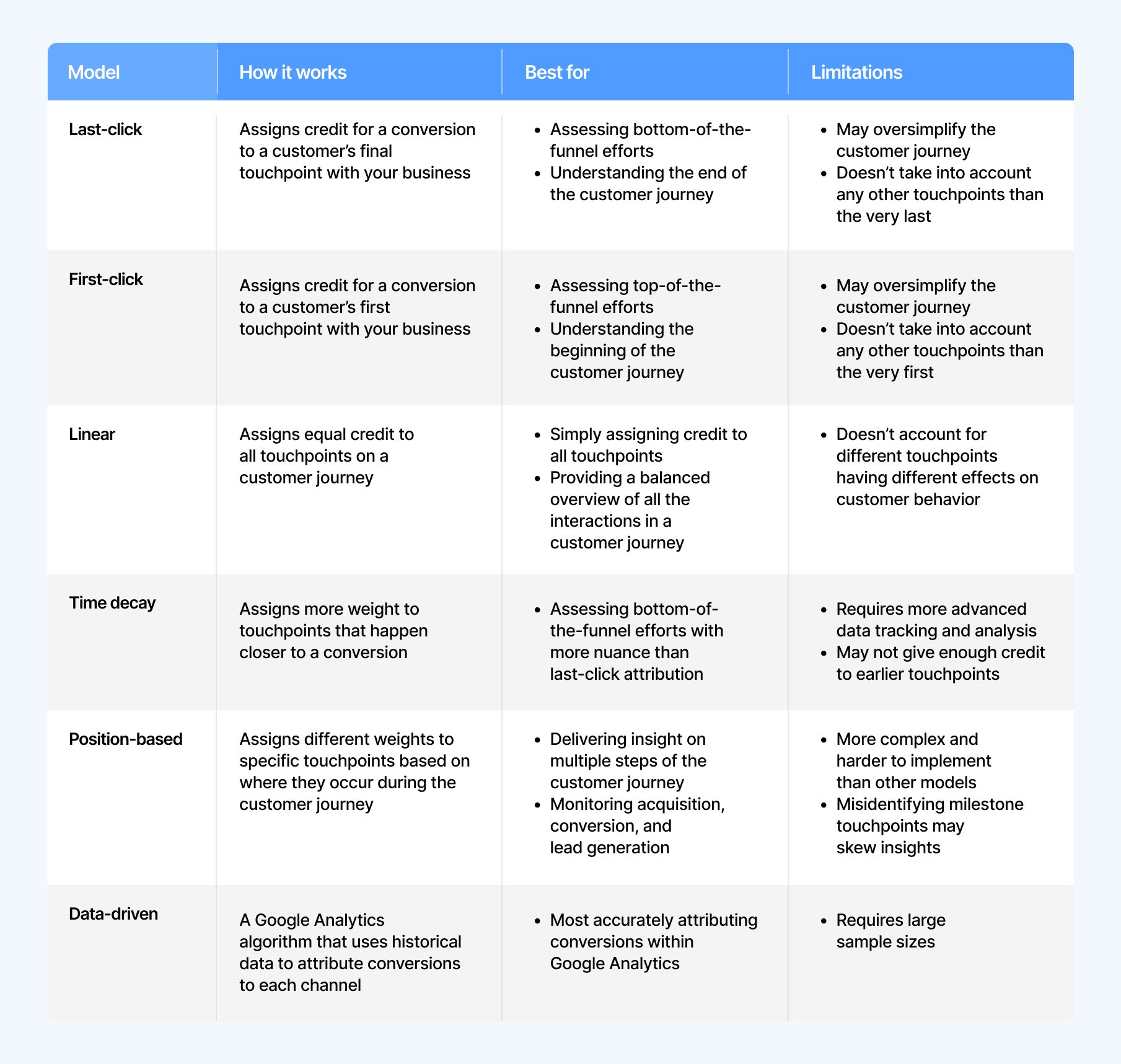
Linear: Linear attribution assigns the same credit for a conversion to all the touchpoints on the customer journey. This makes it a simple model to implement while providing more nuance than last-click attribution. But it still doesn’t account for how customers interact with different touchpoints.
Time decay: Time decay attribution assigns more credit to the touchpoints that happened closer to the conversion. This offers more nuance than last-click attribution while still focusing on the effectiveness of your bottom-of-the-funnel efforts.
Position-based: While there are different ways to set up a positioned-based attribution model, all of them involve identifying milestone touchpoints in a customer journey that get the most credit for a conversion. This gives you more insight than relying on a single interaction, but it’s a little harder to implement. Plus, if your milestone touchpoints aren’t actually the most important to your customer, your data will be skewed.
Data-driven attribution: DDA is a specific type of algorithmic model in Google Analytics that uses statistical algorithms to assign credit to different touchpoints using historical data and machine learning. It’s the default model used in GA4.
Is Last-Click Attribution Still Relevant?
In Google Analytics 4, Google Ads switched to defaulting to data-driven attribution from last-click. Last-click attribution is still available, but first-click, linear, time decay, and position-based attribution models aren’t supported in GA anymore. Given this new standard, many marketers have wondered if last-touch attribution still has a seat at the table.
Changes in online privacy and cookieless tracking mean that tracking your customers across devices and channels is much more challenging than in the past, resulting in incomplete customer journey data that could then skew your last-click attribution models. Data-driven approaches use machine learning to fill in these gaps based on patterns in historical data.
That said, some brands still use last-click attribution. Compared to other models, it’s simple to implement and understand and usually less expensive, according to the American Marketing Association. And it can still be helpful if you’re running single-channel ad campaigns or your sales cycles are relatively short, meaning your customers don’t interact with your brand a ton before converting. Plus, if your business is still relatively small, you simply might not have the large amounts of historical data needed for DDA to be most effective.
For example, let’s say you sell artisanal candles through Shopify. Most of your customers convert after searching for “soy lavender candles” and clicking through to your site. They almost always make a purchase in the same session, so your customer journey and decision-making cycle is short enough that last-click attribution tells you a lot. In this case, the last touchpoint is really the only touchpoint that matters, so multi-touch attribution wouldn’t provide much more meaningful insight.
Generally speaking, though, using a data-driven approach or some other multi-touch attribution model is more likely to capture a nuanced, complete picture of your customer journey.
With Triple Whale, you get access to our Total Impact Attribution Model, what we like to consider the all-inclusive package of marketing attribution. We use first-party data, zero-party data, and a proprietary algorithm to deliver the clearest understanding of your investments and performance across touchpoints and channels.
Final Thoughts
Last-click attribution is a simple, straightforward way of assigning credit to a marketing channel that drove a conversion, but it isn’t perfect. By assigning 100% of that credit to a customer’s final touchpoint with your business, you risk overlooking and undervaluing other touchpoints that are essential in building brand awareness, driving consideration, and ultimately tipping shoppers over their buying decision point.
Knowing how to attribute your conversions is crucial to understanding the return on your investment and scaling your brand. But every attribution model has its pros and cons. It’s your job to decide which piece of your marketing strategy makes the most sense for your brand, and which model tells the right story.
Last-click attribution is still available in Google Analytics 4, but it’s no longer the default attribution model. Instead, GA4 defaults to data-driven attribution, or DDA. First-click, linear, time decay, and position-based attribution models aren’t supported in GA anymore.
What’s the difference between last-touch and last-click attribution?
“Last-touch” and “last-click” are two different ways of saying the same thing. They both mean assigning all credit for a conversion to a customer’s final touchpoint before making a purchase with your brand.
What are the advantages of using last-click attribution?
Last-click attribution is simple to understand and implement. It gives you clarity on your bottom-of-the-funnel marketing efforts and a better understanding of the end of your typical customer journey.
What are the drawbacks of using last-click attribution?
Last-click attribution may oversimplify the customer journey because it doesn’t take into account any other touchpoints. This may skew your data and lead to inefficient marketing spend.
Last-click vs. first-click attribution: Which is better?
That depends on your business, goals, and priorities.
Both options:
Are simple to use and understand
Prioritize a single touchpoint
Work best for businesses with short sales cycles
First-click attribution is better if you want to focus on your top-of-the-funnel marketing efforts and measure how effectively you’re building brand awareness and attracting new customers.
Last-click attribution is better if you want to focus on your bottom-of-the-funnel marketing efforts.
Component Sales
5.32K
Benchmark your ecommerce brand against industry leaders
In order to figure out how effective your marketing efforts are, you need to know where your sales come from. The process of assigning credit for a sale or conversion to the various marketing channels that led to it is called marketing attribution.
But with so many different channels at play and so many different touchpoints with your customers, it’s not always easy to isolate what exactly drove a specific sale.
There’s where attribution modeling comes in. Attribution modeling uses different strategies to measure the effects of your marketing efforts. One of those key models is last-click attribution. Last-click attribution, also sometimes called the last-touch attribution model or last-interaction attribution model, assigns all of the credit for a conversion to a customer’s final touchpoint with your brand.
Keep reading for a deeper understanding of this approach to attribution, its benefits and limitations, and how it differs from data-driven attribution and other types of multi-touch attribution.
What is Last-Click Attribution?
The last-click attribution model gives credit for a conversion to the last touchpoint the customer engaged with before converting. That might be a Google ad they clicked on, a marketing email they opened, or one of your social media posts, as long as it’s their very last interaction with your brand before they make a purchase or take some other desired action.
A helpful analogy is to think about your conversion as a goal in a game of soccer. Last-click attribution credits the player who scored, not their teammates who set up the play.
For example, let’s say your customer first saw an ad for your business on Google. A week later, they opened one of your marketing emails and clicked on a link to your blog. Three days after that, they saw one of your Instagram ads in their feed and made a purchase that day. If you apply last-click attribution to this conversion, the Instagram ad will get all the credit for the sale.
Over time, you’ll collect more data and analyze it through the lens of your attribution model. You’ll start to see where your closing efforts really pay off, which allows you to optimize your digital ad spend.
Benefits of Last-Click Attribution
There are a number of reasons last-click attribution has been such a popular model for marketers.
It Identifies the Touchpoints that Drive Sales
Last-click attribution allows you to see which touchpoints are driving conversions. By giving credit to a customer’s final interaction with your brand before a conversion, you can easily identify which channels and campaigns are driving sales.
It Clarifies the Customer Journey
Understanding which touchpoints drive sales for your brand can also help you understand the motivation, behaviors, and preferences of your customers as they move through your sales funnel. Customer journey analytics can help you identify what’s working and what’s not.
For example, was it a user-generated testimonial video that drove the sale, or was it a comparison between the product and a competitor's product? This can be especially useful for businesses that have a complex sales funnel or multiple products and services. It’s also helpful if your primary focus is to drive sales, rather than improve awareness or reach.
It's Simple
A customer sees an ad, clicks, and converts. The same ad gets the credit. Setting up and implementing a last-click attribution is extremely simple, because you don't have to worry about any other touchpoints. This makes it one of the most beginner-friendly attribution models.
Challenges of Last-Click Attribution
That said, last-click attribution also has its limitations and isn’t the right choice for every business.
It Overlooks the Full Path to Conversion
The biggest con of using last-click attribution is it ignores the wider customer journey, especially the very start of the buyer journey. Essentially, it marks every touchpoint before the conversion as irrelevant. But that means you’re essentially ignoring the effects of the metaphorical salesperson who got the customer in the door in favor of the metaphorical salesperson who closed the deal.
This can lead to an incomplete understanding of your customer journey (also called a fragmented customer journey) and a lack of insight into how different marketing channels contribute to conversions.
For example, let’s say you sell sustainable clothing with an average order value of $150. You rely heavily on TikTok videos to build brand awareness. But while your typical customer first learns about your business on social, they later click on a retargeting ad, then finally Google your brand before making a purchase through a paid search click.
Last-click attribution would give 100% of the credit for that conversion to your Google ads, neglecting the fact that your shopper wouldn’t have even known you existed if it weren’t for TikTok. This skewed data might (mistakenly) result in doubling down on search spend and cutting budget for social media.
It Can Contribute to an Imbalance in Marketing Efforts
If you have an incomplete understanding of your customer journey and the ways various marketing channels work together to result in conversions, you might misallocate your ad spend. By only giving credit to the last touchpoint, you may be inclined to invest more heavily in that channel, regardless of its overall effectiveness and its position in your sales funnel. That could result in your neglecting valuable channels for building brand awareness and driving potential customers to your website to begin with, for example.
Most last-click conversions will be on more bottom-of-the-funnel marketing efforts. Although these clicks are important to capture, it's also important to understand what gets new customers into the last stage of the funnel.
Last-Click Attribution vs. Other Attribution Models
You might be wondering how the last-touch approach measures up against other attribution models, like last-click vs. data-driven attribution or first-click attribution. Here’s a look at some of the most popular models.
First-Click vs. Last-Click Attribution
Both of these approaches are known as single-touch attribution models or single-source attribution. That’s because they ultimately give credit for a conversion to a single touchpoint, either the first or the last.
While last-click attribution gives all the credit to the last touchpoint before the conversion, first-click attribution gives credit to—you guessed it!—the first touchpoint. Essentially, first-click attribution and last-click attribution are two different methods of assigning credit for a conversion to one touchpoint in a customer journey that’s deemed the most important.
Let’s apply first-click attribution to our same example above: Your customer first sees one of your Google ads, clicks on one of your marketing emails a week later, and ultimately makes a purchase after engaging with your Instagram ad. First-click attribution will assign all the credit for this sale to your Google ad campaign.
Last-Click vs. Multi-Touch Attribution
But both first- and last-click attribution miss out on the complete picture of your customer journey because they don’t take into consideration the overall effect all of a customer’s touchpoints with your brand have in ultimately closing the deal.
Multi-touch attribution models account for this by giving credit to every touchpoint. And 75% of marketers take a multi-touch approach instead of using last- or first-click attribution, according to data from UK marketing and attribution firm Ruler Analytics.
Here are a few common approaches to multi-touch attribution:
Linear: Linear attribution assigns the same credit for a conversion to all the touchpoints on the customer journey. This makes it a simple model to implement while providing more nuance than last-click attribution. But it still doesn’t account for how customers interact with different touchpoints.
Time decay: Time decay attribution assigns more credit to the touchpoints that happened closer to the conversion. This offers more nuance than last-click attribution while still focusing on the effectiveness of your bottom-of-the-funnel efforts.
Position-based: While there are different ways to set up a positioned-based attribution model, all of them involve identifying milestone touchpoints in a customer journey that get the most credit for a conversion. This gives you more insight than relying on a single interaction, but it’s a little harder to implement. Plus, if your milestone touchpoints aren’t actually the most important to your customer, your data will be skewed.
Data-driven attribution: DDA is a specific type of algorithmic model in Google Analytics that uses statistical algorithms to assign credit to different touchpoints using historical data and machine learning. It’s the default model used in GA4.
Is Last-Click Attribution Still Relevant?
In Google Analytics 4, Google Ads switched to defaulting to data-driven attribution from last-click. Last-click attribution is still available, but first-click, linear, time decay, and position-based attribution models aren’t supported in GA anymore. Given this new standard, many marketers have wondered if last-touch attribution still has a seat at the table.
Changes in online privacy and cookieless tracking mean that tracking your customers across devices and channels is much more challenging than in the past, resulting in incomplete customer journey data that could then skew your last-click attribution models. Data-driven approaches use machine learning to fill in these gaps based on patterns in historical data.
That said, some brands still use last-click attribution. Compared to other models, it’s simple to implement and understand and usually less expensive, according to the American Marketing Association. And it can still be helpful if you’re running single-channel ad campaigns or your sales cycles are relatively short, meaning your customers don’t interact with your brand a ton before converting. Plus, if your business is still relatively small, you simply might not have the large amounts of historical data needed for DDA to be most effective.
For example, let’s say you sell artisanal candles through Shopify. Most of your customers convert after searching for “soy lavender candles” and clicking through to your site. They almost always make a purchase in the same session, so your customer journey and decision-making cycle is short enough that last-click attribution tells you a lot. In this case, the last touchpoint is really the only touchpoint that matters, so multi-touch attribution wouldn’t provide much more meaningful insight.
Generally speaking, though, using a data-driven approach or some other multi-touch attribution model is more likely to capture a nuanced, complete picture of your customer journey.
With Triple Whale, you get access to our Total Impact Attribution Model, what we like to consider the all-inclusive package of marketing attribution. We use first-party data, zero-party data, and a proprietary algorithm to deliver the clearest understanding of your investments and performance across touchpoints and channels.
Final Thoughts
Last-click attribution is a simple, straightforward way of assigning credit to a marketing channel that drove a conversion, but it isn’t perfect. By assigning 100% of that credit to a customer’s final touchpoint with your business, you risk overlooking and undervaluing other touchpoints that are essential in building brand awareness, driving consideration, and ultimately tipping shoppers over their buying decision point.
Knowing how to attribute your conversions is crucial to understanding the return on your investment and scaling your brand. But every attribution model has its pros and cons. It’s your job to decide which piece of your marketing strategy makes the most sense for your brand, and which model tells the right story.
Last-click attribution is still available in Google Analytics 4, but it’s no longer the default attribution model. Instead, GA4 defaults to data-driven attribution, or DDA. First-click, linear, time decay, and position-based attribution models aren’t supported in GA anymore.
What’s the difference between last-touch and last-click attribution?
“Last-touch” and “last-click” are two different ways of saying the same thing. They both mean assigning all credit for a conversion to a customer’s final touchpoint before making a purchase with your brand.
What are the advantages of using last-click attribution?
Last-click attribution is simple to understand and implement. It gives you clarity on your bottom-of-the-funnel marketing efforts and a better understanding of the end of your typical customer journey.
What are the drawbacks of using last-click attribution?
Last-click attribution may oversimplify the customer journey because it doesn’t take into account any other touchpoints. This may skew your data and lead to inefficient marketing spend.
Last-click vs. first-click attribution: Which is better?
That depends on your business, goals, and priorities.
Both options:
Are simple to use and understand
Prioritize a single touchpoint
Work best for businesses with short sales cycles
First-click attribution is better if you want to focus on your top-of-the-funnel marketing efforts and measure how effectively you’re building brand awareness and attracting new customers.
Last-click attribution is better if you want to focus on your bottom-of-the-funnel marketing efforts.
Body Copy: The following benchmarks compare advertising metrics from April 1-17 to the previous period. Considering President Trump first unveiled his tariffs on April 2, the timing corresponds with potential changes in advertising behavior among ecommerce brands (though it isn’t necessarily correlated).


 Moby AIAsk questions, analyze performance, and work with your business context.
 ActionsTake governed action across the tools that run your business.
 AutomationsSchedule recurring analysis and work that runs on your terms.
 Landing PagesCreative conversion-focused ecommerce pages with Moby.
 Creative StudioGenerate and refine creative grounded in your brand.







.webp)





.webp)

.webp)
