Linear attribution is a type of marketing attribution model that gives equal credit to each touchpoint across the customer journey.
In this guide, we’ll break down how linear attribution works, where it’s most useful, its tradeoffs, and how to apply the strategy so you can make smarter marketing decisions moving forward.
First, What Exactly Is Linear Attribution?
Linear attribution is a multi-touch attribution (MTA) model that helps brands understand how different marketing channels contribute to a conversion.
In this approach, every touchpoint in the customer journey receives equal credit. Because each interaction is weighted the same, linear attribution is also known as an even-weighted model.
Think of the path to purchase like a relay race: each touchpoint passes the baton forward until the customer reaches the finish line — AKA the sale. Linear attribution doesn’t try to guess which runner mattered most; it assumes every handoff played an equally important role.
Touchpoints can include anything from a social ad click to an email open to a direct website visit. Each one is treated as a meaningful step that helped move the customer closer to conversion.
Triple Whale provides two versions of linear attribution.
Linear (All) distributes credit amongst all traffic sources, including organic and non-paid traffic.
Linear (Paid) only assigns equal credit to paid interactions (i.e. marketing channels) along the customer’s journey.
Linear Attribution Model Example
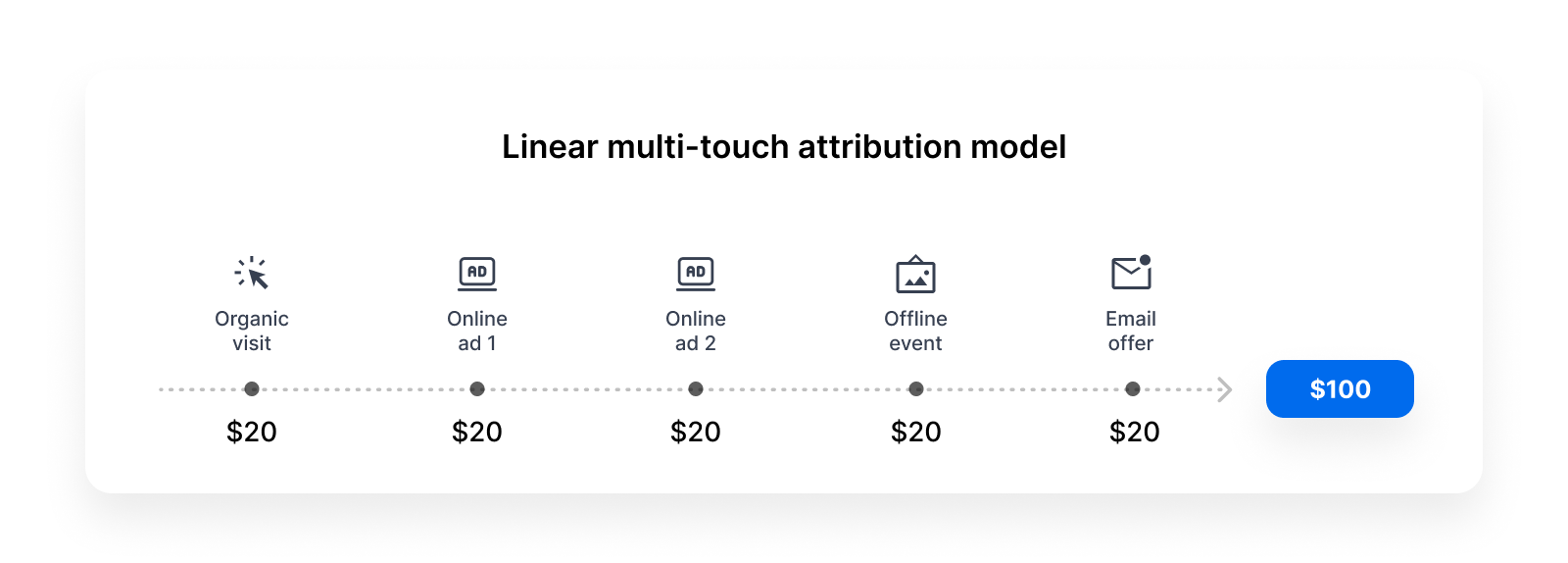
Elijah is shopping for a new pair of running shoes.
He Googles “best shoes for flat feet,” and finds your website. He browses for a minute but doesn’t buy yet.
Later that week, he sees an ad on Instagram featuring the exact mode he wanted. He clicks through, checks colors, and leaves again to think about it.
Two days later a retargeting ad follows him on a news site.
That weekend he goes to a local 5K expo. Your company has a booth there, and Elijah tries on the shoes, loves the fit, and grabs a card.
On Monday he gets an email with a promo code. He clicks, returns to hus cart, and considers buying.
Before committing, he texts his running-club friend, who sends him a referral link. Feeling confident, he finally purchases.
This total purchase order is $100.
In this scenario, each touch point earns equal credit for the sale – which is 15% of the value, or $15 each.
Mathematical Formulas
Linear attribution can be expressed through a simple formula:
Conversion value ÷ Number of touchpoints = Credit per touchpoint
Using the example above:
$100 ÷ 5 = $20 per touchpoint
Here, the conversion value could be the revenue generated from a purchase or another relevant metric you’re measuring (like a lead or subscription).
What Are the Benefits of Linear Attribution?
Linear attribution is a great middle ground model. It’s not as fixated as single-attribution, and not as complicated to run as other weighted or causal approaches. Here are the main benefits to consider.
Every Touchpoint Matters
Remember that viral video you saw shared by a friend that eventually led you to a purchase? Linear attribution recognizes the significance of such seemingly indirect interactions in the sales funnel and those marketing channels.
It acknowledges that every touchpoint, regardless of its timing or proximity to the conversion to sales, plays a role in influencing the customer's decision-making process.
Fair Representation
Because linear attribution gives equal credit to every touchpoint, it avoids the bias of single-touch models like first-click or last-click.
That makes it especially useful in a multi-channel world where awareness, consideration, and conversion often happen across different platforms and over time.
The result is a more balanced view of which channels are consistently supporting conversions — not just which one happened to show up first or last.
Simplicity in Implementation
Linear attribution is also one of the easiest multi-touch models to operationalize. There’s no complex weighting system or advanced modeling required — credit is simply distributed evenly across touchpoints.
That simplicity makes the model approachable for teams with limited technical resources, while still providing meaningful insight into how customers move through your funnel.
Are There Limitations to Linear Attribution?
As we celebrate the advantages we still have to acknowledge the limitations of this marketing attribution model. Below are a few examples.
Ignores Time Sensitivity
Linear assumes each touchpoint influences the conversion equally, no matter when it happens.
But in many journeys, touches closer to conversion (like retargeting or branded search) may have more impact. Linear doesn’t reflect that.
Overlooks User Behavior Nuances
Customer journeys aren’t uniform. Someone might read blog posts early on, compare products later, then convert through a high-intent ad.
Linear doesn’t capture those differences, so it can over-credit lighter touches and under-credit decisive ones.
Gets Diluted During Long Sales Cycles
If customers hit 20+ touchpoints before converting, linear spreads credit so thin that interpretation becomes messy.
In long, complex journeys, a weighted or data-driven model may offer clearer insight.
How Does Linear Attribution Compare to Other Attribution Models?
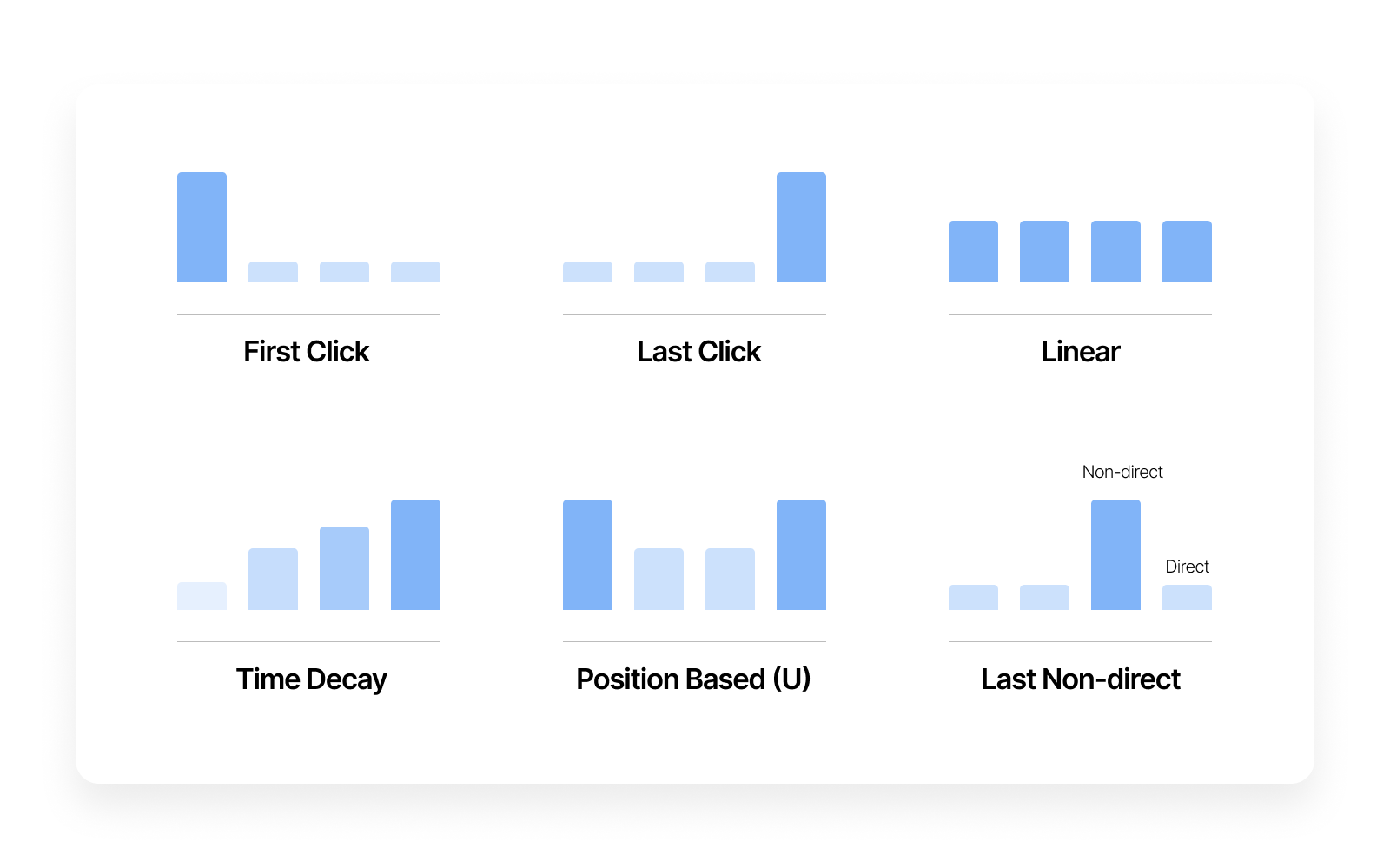
Linear is a multi-touch model, meaning it distributes credit across multiple steps. Other multi-touch models apply uneven weighting:
Time decay: More credit to touches closer to conversion
Last non-direct click: All the credit goes to the most recent non-direct touchpoint before conversion, ignoring any direct visit that happened after it.
Position-based: Different weights based on where a touch happens in the journey
U-shaped: 40% first + 40% last + 20% split across the middle
W-shaped: 30% each to first touch, lead creation, and conversion + 10% split across others
Z-shaped: 22.5% each to first touch, lead creation, opportunity creation, and conversion + 10% split across others
You can also use data-driven attribution, which uses your historical data to estimate influence and assign credit unevenly based on real patterns. Linear is rule-based, so it won’t adapt by channel performance.
Finally, there are incrementality tests and marketing mix modeling (MMM). These aim to measure causal lift (what actually created new conversions). Linear measures contribution within observed paths, not causation. It’s simpler, but can also work well alongside causal methods.
When Should You Use a Linear Attribution Model?
There are a few key moments when a linear attribution model makes the most sense. You should consider using linear attribution when:
You want a balanced view of performance. Linear attribution is great when you want to move into multi-touch attribution, rather than spotlighting only the first or last interaction.
Your path to purchase has multiple steps, but isn’t overly long. Linear works well for multi-touch journeys that happen over a reasonable timeframe, where buyers engage a few times before converting.
You need a straightforward model. If you are working with a small team and need a simple, data-driven model, this provides an intuitive view that’s easy to act on.
As mentioned, we offer two types of linear attribution: Linear (All) and Linear (Paid).
Linear (All): Credit is distributed equally across all touchpoints — paid and organic. This is the model described in this post, highlighting how your full-funnel mix works together across the entire customer journey.
Linear (Paid): Credit is distributed equally across only paid touchpoints. This model excludes organic touchpoints. This model is especially helpful when you’re evaluating paid performance in isolation, such as when you’re optimizing budgets or comparing channels strictly on ad-driven influence.
Here’s How to Implement Linear Attribution
Implementing linear attribution is pretty straightforward, but the quality of your results depends heavily on the tools you use and the data you feed them. Here’s a clean way to approach it.
1. Choose an Attribution Tool
GA4 includes several free attribution models, including linear, but it often falls short in accuracy. Cookie consent opt-outs, cross-device gaps, and data sampling can leave you with an incomplete view of the customer journey.
2. Collect High-quality Data
Attribution is only as good as the data behind it. If your tracking is partial or inconsistent, even the “right” model won’t give you trustworthy insights.
Triple Whale Pixel is an advanced tracking technology that captures more customer behavior data than standard tracking solutions, giving you a more accurate view of your marketing performance and ROI.
3. Set Up Goals
Before you analyze anything, define what a “conversion” actually means for your business. That could be purchases, subscriptions, lead form completions, or even micro-conversions like add-to-carts or product view depth.
Clear goals make linear attribution far more useful because you know exactly what outcome each touchpoint is sharing credit for.
4. Analyze Contributions
Now you’re ready to look at what linear attribution is telling you. Because every touchpoint shares credit, this view is especially helpful for spotting:
The lookback window changes the story. Too short and you under-credit upper funnel. Too long and you over-credit noise.
In general, the best practice is to evaluate performance over enough volume (such as weeks, not days). Try the following:
Match the window to your typical consideration cycle
Sanity-check how many touchpoints you’re averaging per order
Adjust if your paths look unrealistically short or long
3. Pair with at Least One Other Model
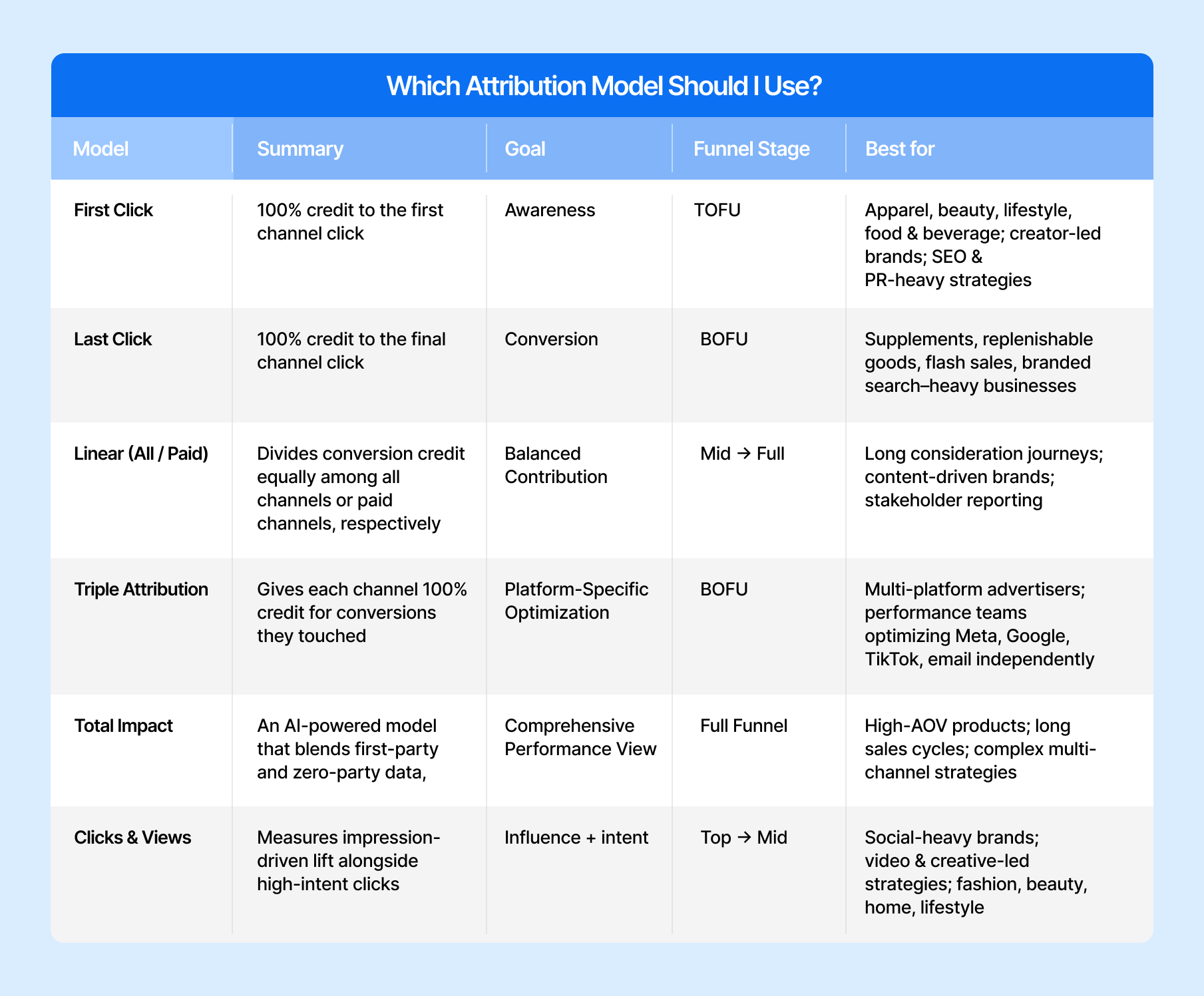
Linear is democratic, which is useful, but can fall too flat. Ideally, you run different models. You can compare linear to:
Last click
First click
Time decay or position-based
For example, if linear and time decay tell the same story, your funnel is stable. If they diverge a lot, it’s a clue about where influence is really concentrated.
4. Segment Your Analysis
Different cohorts often have totally different path structures, and linear helps you see that without biasing to first touch and last touch.
Try segments such as:
New vs returning customers
High-AOV vs low-AOV orders
Product lines
Geo or device segments
Attribution and Beyond
Linear attribution provides a valuable lens through which your business can move beyond simplistic single-touch models and gain a deeper understanding of the journey customers take before conversion.
Triple Whale gives you linear attribution and a lot more—like AI-powered insights, agentic decisioning, and a complete ecommerce intelligence layer that helps you act on what attribution reveals. If you want a clearer view of performance and a smarter way to scale, Triple Whale is here. Book a demo today.
Linear Attribution FAQs
How does the linear attribution model calculate credit?
This model distributes credit evenly along all touchpoints in the path to conversion.
It can be calculated as: Conversion value ÷ Number of touchpoints = Credit per touchpoint.
What is an attribution model?
A marketing attribution model determines how credit for a conversion is distributed across touchpoints in a customer journey. In the case of linear attribution, the credits are equally weighted.
Component Sales
5.32K
Benchmark your ecommerce brand against industry leaders
Linear attribution is a type of marketing attribution model that gives equal credit to each touchpoint across the customer journey.
In this guide, we’ll break down how linear attribution works, where it’s most useful, its tradeoffs, and how to apply the strategy so you can make smarter marketing decisions moving forward.
First, What Exactly Is Linear Attribution?
Linear attribution is a multi-touch attribution (MTA) model that helps brands understand how different marketing channels contribute to a conversion.
In this approach, every touchpoint in the customer journey receives equal credit. Because each interaction is weighted the same, linear attribution is also known as an even-weighted model.
Think of the path to purchase like a relay race: each touchpoint passes the baton forward until the customer reaches the finish line — AKA the sale. Linear attribution doesn’t try to guess which runner mattered most; it assumes every handoff played an equally important role.
Touchpoints can include anything from a social ad click to an email open to a direct website visit. Each one is treated as a meaningful step that helped move the customer closer to conversion.
Triple Whale provides two versions of linear attribution.
Linear (All) distributes credit amongst all traffic sources, including organic and non-paid traffic.
Linear (Paid) only assigns equal credit to paid interactions (i.e. marketing channels) along the customer’s journey.
Linear Attribution Model Example
Elijah is shopping for a new pair of running shoes.
He Googles “best shoes for flat feet,” and finds your website. He browses for a minute but doesn’t buy yet.
Later that week, he sees an ad on Instagram featuring the exact mode he wanted. He clicks through, checks colors, and leaves again to think about it.
Two days later a retargeting ad follows him on a news site.
That weekend he goes to a local 5K expo. Your company has a booth there, and Elijah tries on the shoes, loves the fit, and grabs a card.
On Monday he gets an email with a promo code. He clicks, returns to hus cart, and considers buying.
Before committing, he texts his running-club friend, who sends him a referral link. Feeling confident, he finally purchases.
This total purchase order is $100.
In this scenario, each touch point earns equal credit for the sale – which is 15% of the value, or $15 each.
Mathematical Formulas
Linear attribution can be expressed through a simple formula:
Conversion value ÷ Number of touchpoints = Credit per touchpoint
Using the example above:
$100 ÷ 5 = $20 per touchpoint
Here, the conversion value could be the revenue generated from a purchase or another relevant metric you’re measuring (like a lead or subscription).
What Are the Benefits of Linear Attribution?
Linear attribution is a great middle ground model. It’s not as fixated as single-attribution, and not as complicated to run as other weighted or causal approaches. Here are the main benefits to consider.
Every Touchpoint Matters
Remember that viral video you saw shared by a friend that eventually led you to a purchase? Linear attribution recognizes the significance of such seemingly indirect interactions in the sales funnel and those marketing channels.
It acknowledges that every touchpoint, regardless of its timing or proximity to the conversion to sales, plays a role in influencing the customer's decision-making process.
Fair Representation
Because linear attribution gives equal credit to every touchpoint, it avoids the bias of single-touch models like first-click or last-click.
That makes it especially useful in a multi-channel world where awareness, consideration, and conversion often happen across different platforms and over time.
The result is a more balanced view of which channels are consistently supporting conversions — not just which one happened to show up first or last.
Simplicity in Implementation
Linear attribution is also one of the easiest multi-touch models to operationalize. There’s no complex weighting system or advanced modeling required — credit is simply distributed evenly across touchpoints.
That simplicity makes the model approachable for teams with limited technical resources, while still providing meaningful insight into how customers move through your funnel.
Are There Limitations to Linear Attribution?
As we celebrate the advantages we still have to acknowledge the limitations of this marketing attribution model. Below are a few examples.
Ignores Time Sensitivity
Linear assumes each touchpoint influences the conversion equally, no matter when it happens.
But in many journeys, touches closer to conversion (like retargeting or branded search) may have more impact. Linear doesn’t reflect that.
Overlooks User Behavior Nuances
Customer journeys aren’t uniform. Someone might read blog posts early on, compare products later, then convert through a high-intent ad.
Linear doesn’t capture those differences, so it can over-credit lighter touches and under-credit decisive ones.
Gets Diluted During Long Sales Cycles
If customers hit 20+ touchpoints before converting, linear spreads credit so thin that interpretation becomes messy.
In long, complex journeys, a weighted or data-driven model may offer clearer insight.
How Does Linear Attribution Compare to Other Attribution Models?
Linear is a multi-touch model, meaning it distributes credit across multiple steps. Other multi-touch models apply uneven weighting:
Time decay: More credit to touches closer to conversion
Last non-direct click: All the credit goes to the most recent non-direct touchpoint before conversion, ignoring any direct visit that happened after it.
Position-based: Different weights based on where a touch happens in the journey
U-shaped: 40% first + 40% last + 20% split across the middle
W-shaped: 30% each to first touch, lead creation, and conversion + 10% split across others
Z-shaped: 22.5% each to first touch, lead creation, opportunity creation, and conversion + 10% split across others
You can also use data-driven attribution, which uses your historical data to estimate influence and assign credit unevenly based on real patterns. Linear is rule-based, so it won’t adapt by channel performance.
Finally, there are incrementality tests and marketing mix modeling (MMM). These aim to measure causal lift (what actually created new conversions). Linear measures contribution within observed paths, not causation. It’s simpler, but can also work well alongside causal methods.
When Should You Use a Linear Attribution Model?
There are a few key moments when a linear attribution model makes the most sense. You should consider using linear attribution when:
You want a balanced view of performance. Linear attribution is great when you want to move into multi-touch attribution, rather than spotlighting only the first or last interaction.
Your path to purchase has multiple steps, but isn’t overly long. Linear works well for multi-touch journeys that happen over a reasonable timeframe, where buyers engage a few times before converting.
You need a straightforward model. If you are working with a small team and need a simple, data-driven model, this provides an intuitive view that’s easy to act on.
As mentioned, we offer two types of linear attribution: Linear (All) and Linear (Paid).
Linear (All): Credit is distributed equally across all touchpoints — paid and organic. This is the model described in this post, highlighting how your full-funnel mix works together across the entire customer journey.
Linear (Paid): Credit is distributed equally across only paid touchpoints. This model excludes organic touchpoints. This model is especially helpful when you’re evaluating paid performance in isolation, such as when you’re optimizing budgets or comparing channels strictly on ad-driven influence.
Here’s How to Implement Linear Attribution
Implementing linear attribution is pretty straightforward, but the quality of your results depends heavily on the tools you use and the data you feed them. Here’s a clean way to approach it.
1. Choose an Attribution Tool
GA4 includes several free attribution models, including linear, but it often falls short in accuracy. Cookie consent opt-outs, cross-device gaps, and data sampling can leave you with an incomplete view of the customer journey.
2. Collect High-quality Data
Attribution is only as good as the data behind it. If your tracking is partial or inconsistent, even the “right” model won’t give you trustworthy insights.
Triple Whale Pixel is an advanced tracking technology that captures more customer behavior data than standard tracking solutions, giving you a more accurate view of your marketing performance and ROI.
3. Set Up Goals
Before you analyze anything, define what a “conversion” actually means for your business. That could be purchases, subscriptions, lead form completions, or even micro-conversions like add-to-carts or product view depth.
Clear goals make linear attribution far more useful because you know exactly what outcome each touchpoint is sharing credit for.
4. Analyze Contributions
Now you’re ready to look at what linear attribution is telling you. Because every touchpoint shares credit, this view is especially helpful for spotting:
The lookback window changes the story. Too short and you under-credit upper funnel. Too long and you over-credit noise.
In general, the best practice is to evaluate performance over enough volume (such as weeks, not days). Try the following:
Match the window to your typical consideration cycle
Sanity-check how many touchpoints you’re averaging per order
Adjust if your paths look unrealistically short or long
3. Pair with at Least One Other Model
Linear is democratic, which is useful, but can fall too flat. Ideally, you run different models. You can compare linear to:
Last click
First click
Time decay or position-based
For example, if linear and time decay tell the same story, your funnel is stable. If they diverge a lot, it’s a clue about where influence is really concentrated.
4. Segment Your Analysis
Different cohorts often have totally different path structures, and linear helps you see that without biasing to first touch and last touch.
Try segments such as:
New vs returning customers
High-AOV vs low-AOV orders
Product lines
Geo or device segments
Attribution and Beyond
Linear attribution provides a valuable lens through which your business can move beyond simplistic single-touch models and gain a deeper understanding of the journey customers take before conversion.
Triple Whale gives you linear attribution and a lot more—like AI-powered insights, agentic decisioning, and a complete ecommerce intelligence layer that helps you act on what attribution reveals. If you want a clearer view of performance and a smarter way to scale, Triple Whale is here. Book a demo today.
Linear Attribution FAQs
How does the linear attribution model calculate credit?
This model distributes credit evenly along all touchpoints in the path to conversion.
It can be calculated as: Conversion value ÷ Number of touchpoints = Credit per touchpoint.
What is an attribution model?
A marketing attribution model determines how credit for a conversion is distributed across touchpoints in a customer journey. In the case of linear attribution, the credits are equally weighted.
Share
Kaleena Stroud
Kaleena Stroud is a copywriter for SaaS and DTC businesses.
Kaleena Stroud
Kaleena Stroud is a content writer at Triple Whale, bringing data stories to life. She spent many years running an online copywriting business, where she helped brands launch and revamp their Shopify stores. Her work has been featured in Practical Ecommerce, Convert, and Create & Cultivate.
Body Copy: The following benchmarks compare advertising metrics from April 1-17 to the previous period. Considering President Trump first unveiled his tariffs on April 2, the timing corresponds with potential changes in advertising behavior among ecommerce brands (though it isn’t necessarily correlated).


 Moby AIAsk questions, analyze performance, and work with your business context.
 ActionsTake governed action across the tools that run your business.
 AutomationsSchedule recurring analysis and work that runs on your terms.
 Landing PagesCreative conversion-focused ecommerce pages with Moby.
 Creative StudioGenerate and refine creative grounded in your brand.













.webp)

.webp)
