If you're a marketer in the world of digital advertising, you've likely heard of target ROAS (tROAS). Part of Google Ads Smart Bidding, this strategy allows you to set a specific goal for your campaigns, helping you inch closer to the desired revenue.
This guide will cover everything you need to know about tROAS marketing, including how to set it up, how to troubleshoot your campaigns, plus an actionable ROAS formula for Google ads you can use today.
Key takeaways:
Target ROAS is a Smart Bidding strategy that uses AI to optimize campaigns for the highest possible conversion value relative to ad spend.
Target ROAS requires accurate revenue tracking, consistent conversion data, and clear value assignments to guide Google’s algorithm effectively.
Triple Whale unifies your first-party and ad platform data to reveal true ROAS, optimize bids, and drive smarter growth.
What is Target ROAS?
Target ROAS, or Target Return on Ad Spend, is an Automated Smart Bidding strategy in Google Ads that lets you set a specific goal for the revenue you want to generate from your ad spend.
Smart Bidding refers to “bid strategies that use Google AI to optimize for conversions or conversion value in each and every auction—a feature known as “auction-time bidding,’” according to Google.
For example, if you set your goal of 500%, then you're telling Google Ads that for every $1 you spend on advertising, you want to generate at least $5 in revenue. Google does this by tactically adjusting CPC (Cost per Click) bids to bring you your desired return.
It's a derivitive of ROAS, much like breakeven ROAS or Facebook ROAS. Wondering how it differs from Return on Investment? See ROI vs ROAS for more.
How Does Target ROAS Work?
Once you set a target ROAS at the campaign level, Google completely takes control over your keyword bids. Google will dictate CPCs for your entire campaign, adjusting bids based on performance.
Non-performing: Google likely reduces or pauses bids for terms that don’t generate revenue, reallocating budget toward more profitable opportunities.
Moderately performing: Google lowers bids for terms that drive a few purchases, helping control costs while increasing profits.
High-performing: Google raises bids for terms that are carrying campaigns, investing more in what’s working best.
Other things to keep in mind:
Google decides how much to pay for each click, so all bid adjustments you’ve made to your campaign are ignored (except a -100% decrease in bids at the device level).
Your tROAS will be reflected in the average ROAS of the campaign, not in the day-to-day results.
Value-based bidding is most helpful if various conversions have different value for your business or if you have a specific ROAS target that you're trying to achieve, according to Google.
When To Use Target ROAS Bidding Strategy
Use this approach when certain conditions make it the right fit for your campaign goals. And don’t be afraid to test other bidding strategies if it’s not the right time for tROAS marketing to shine.
Use tROAS when:
Your store tracks sales with measurable conversion values (e.g., revenue per transaction or average order value).
You have tight profit margins and need to prioritize efficiency and profitability over total conversion volume.
You’ve established consistent conversion data, allowing Google’s algorithm to optimize accurately.
Avoid tROAS if:
You're selling free products, such as digital downloads and guides, because these products don't have any conversion value.
Your Google Ads account is brand new, because Google needs historical conversion data. Reach at least 30 conversions to switch to an automated bidding strategy, preferably 50 for tROAS, Google states.
Your primary goal is scaling traffic or brand awareness, since tROAS focuses on profitability over reach or volume.
Bidding Strategies
To really understand the path to tROAS, it helps to know how it compares to other automated bidding strategies. Let’s review.
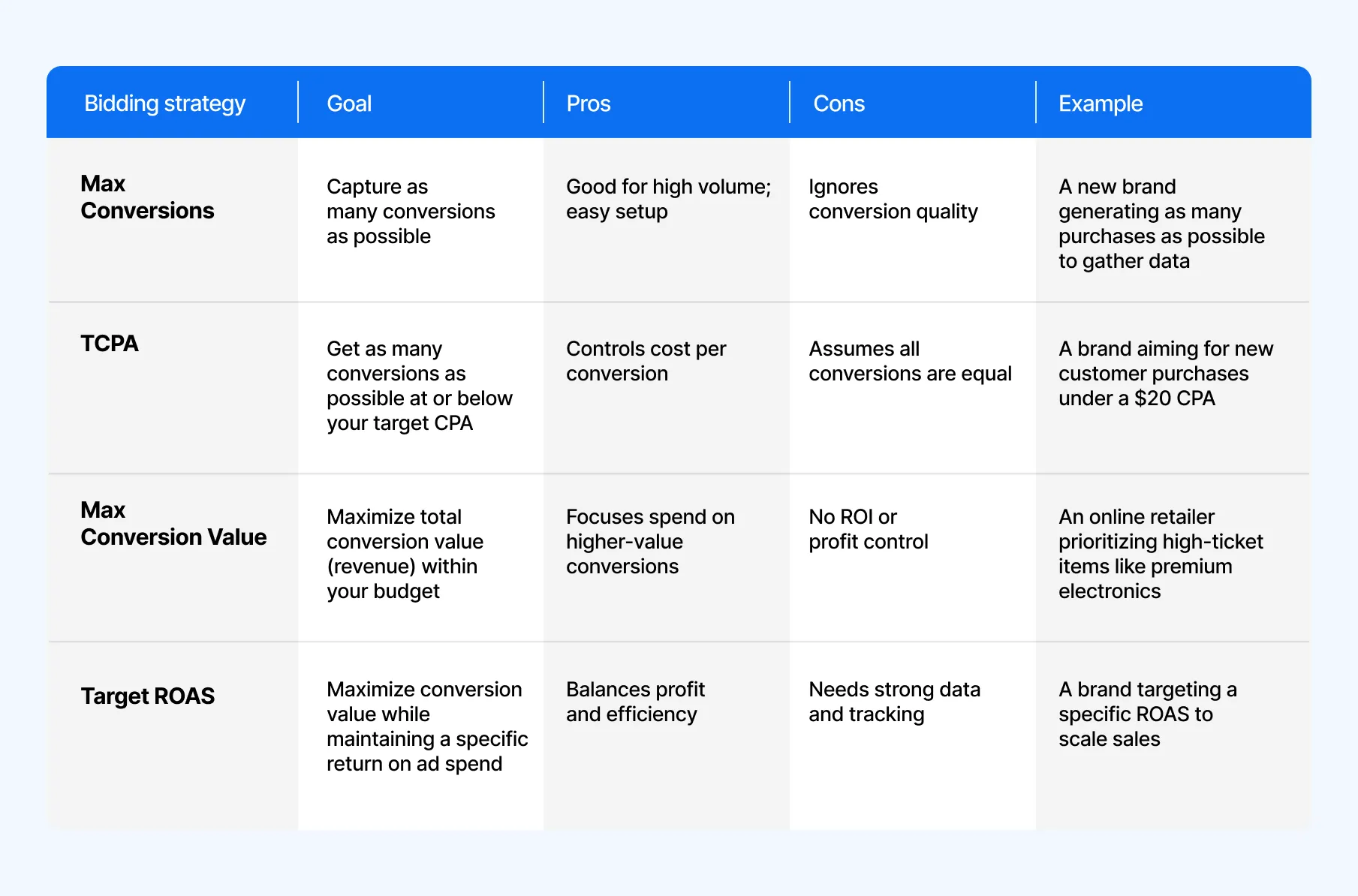
Max Conversions
Max Conversions (Maximize Conversions) is an automated bidding strategy designed to generate the highest possible number of conversions within your daily budget.
TCPA
Target CPA (Target Cost Per Action) is an optional setting within Max Conversions that tries to get as many conversions as possible at or below a specified average cost per conversion. In other words, the meaning of target CPA is when you tell Google how much you’re willing to pay for each acquisition, and Google adjusts bids in real time to try to hit that target.
Max Conversion Value
Unlike Max Conversions, which prioritizes generating the highest number of conversions, this strategy focuses on driving the greatest conversion value from your budget.
Target ROAS
Target ROAS is located under the Max Conversion Value option. Using Google’s AI, this strategy predicts the value of each potential conversion whenever a user searches for products or services you’re advertising. So, if Google’s AI determines that a search is likely to lead to a high-value conversion, target ROAS will bid higher on that auction. If the search is less likely to result in a valuable conversion, it will bid lower.
Target CPA vs. Target ROAS: What's the Difference?
These two bidding strategies function very similarly, but there is a key difference to keep in mind when choosing one over the other.
You set the target ROAS when you choose the "max conversion value" bidding strategy on Google. tROAS pushes Google to generate a specific return on your ad spend.
For example, you set tROAS to 500%, which means you plan to earn $5 for every $1 you spend. Therefore, tROAS also takes into account your order value.
Target CPA meaning, however, when you choose the "max conversions" bidding strategy. So, Google will adjust your bids to hit your CPA goal. You're asking for a specific cost per conversion with tCPA. I.e: I want to spend $15 for a purchase! tCPA does not take your account order value into consideration.
Setting Up Target ROAS in Google Ads
You can set an automated bid strategy in any (or all) of your Search campaigns, Display campaigns, Shopping campaigns, and Performance Max campaigns.
Go to the "settings" of a campaign that is already running on Manual (or Enhanced) CPC.
Click on "Change Bid Strategy" under "Bidding."
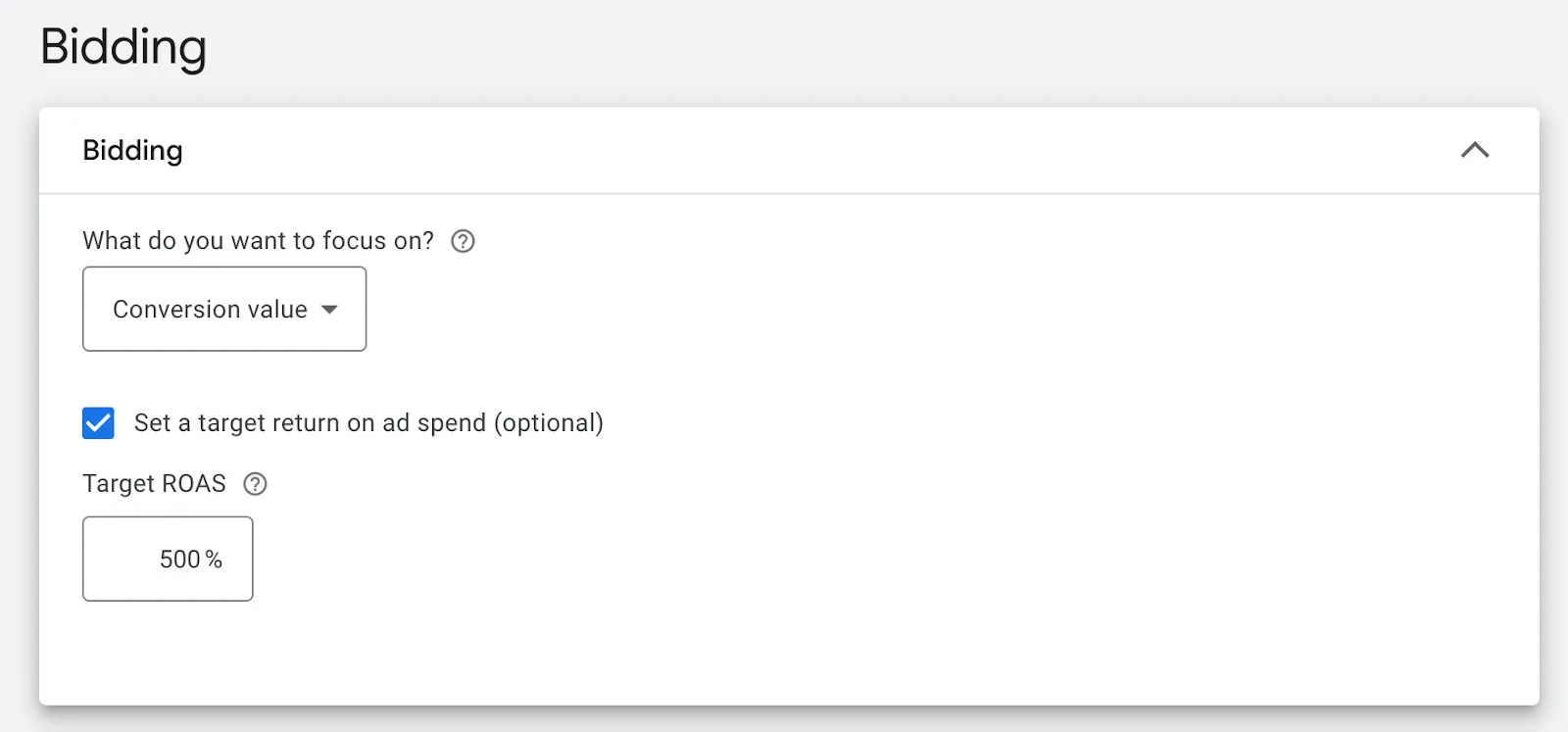
Choose "Maximize Conversion Value" as your bidding strategy.
Enable "Set a target return on ad spend."
Set your desired ROAS as your Target ROAS.
Click "Save."
How to Calculate Target ROAS
To calculate your Google ads ROAS number, you'll need to know three key pieces of information:
Your Google ad revenue
Your Google ad spend
Your desired return on ad spend (i.e: what will make you profitable!)
Google sets the ROAS target as a percentage, so you'll have to multiply your ROAS equation by 100. Here is the ROAS formula for Google ads:
ROAS = (Revenue / Ad Spend) x 100
So, if your campaign spent $5,000 and generated $10,000 in revenue, the ROAS for the campaign is 200%. (10000 / 5000 x 100 = 200)
If you are targeting to spend $5,000 and generate $15,000, you would set your ROAS target to 300%. (15000 / 5000 x 100 = 300)
Most companies aim to achieve a ROAS of 4x, or 400%. Data shows, however, that the average ROAS across ecommerce is around 2X, or 200%.
What you consider a good ROAS for Google ads depends on your historical data. Google states your “ROAS target should be at or below the ROAS compared to your historical performance.”
So think of this bidding strategy as a way to put cruise control on all the hard work you’ve done arriving at your target ROAS percentage, not as a way to steer all your results.
How Target ROAS Fits Into Your Overall Marketing Strategy
Integrating target ROAS with strategies like Maximize Conversions or Manual CPC can enhance your ad performance by utilizing the strengths of each approach.
Use target ROAS when you're focused on achieving a specific return on ad spend, while pairing it with Maximize Conversions can drive volume, especially in growth phases. Manual CPC might be employed for precision, adjusting bids where automation won't suffice.
Scaling Your Marketing with Target ROAS
Target ROAS provides a structured approach to scaling campaigns, supporting long-term growth by allocating spend efficiently. Set realistic ROAS targets based on historical performance and gradually increase targets as your campaigns stabilize and deliver consistent returns.
Balancing Budget and Target ROAS
Manage ad spend by monitoring performance metrics and adjusting budgets as needed to maximize returns. Ensure your tROAS goals align with your overall budget strategies, and be prepared to adjust targets in response to seasonal shifts or changing market conditions for optimal results.
How to Troubleshoot Underperforming Target ROAS Campaigns
When dealing with underperforming target ROAS campaigns, it's crucial first to identify whether your ROAS setting is too aggressive or conservative.
Warning signs might include decreased conversion rates or unexpected ad spending.
Once identified, adjust your target ROAS based on current performance metrics — lower it if your targets aren't being met or raise it if your performance exceeds expectations.
Additionally, consider the impact of seasonality, as consumer behavior often shifts with seasonal trends or events. These changes can influence campaign outcomes, requiring careful monitoring and timely adjustments.
By understanding these dynamics and responding proactively, you can optimize your campaigns for better performance and ensure they align with your business objectives.
4 Mistakes To Avoid With Target ROAS
While target ROAS can significantly improve performance for many advertisers, it’s not a one-size-fits-all strategy. Understanding its limitations is key to using it effectively.
1. Not Having Conversion Values
Using a target ROAS bidding strategy only works for businesses that carry a dollar-value revenue. It won't work for any free products, including digital products and tools. This means that it's important for Google Ads to be recording revenue that comes in from purchases.
In the Google Ads dashboard, if your "conversions" metric is >1, but your "Conversion value" metric does not reflect the true value of the goods bought, then your product prices aren't linked to Google Ads. Make sure Google is recording the actual conversion value of a sale.
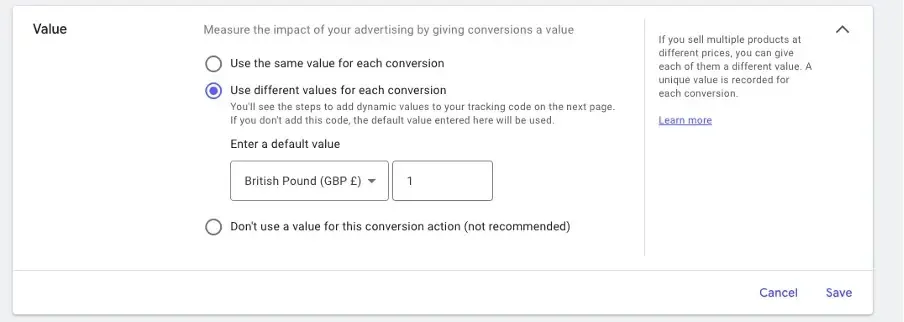
To fix this, go to Tools & Settings, then choose:
Conversions
Purchases
Edit Settings.
Set your "Value" to "Use different values for each conversion.” If there's no value, use $1 (or any other number you want to put).
It’s important to note that the target ROAS bidding strategy will not work with lead accounts, though.
2. Not Having Proper Conversion Tracking
To follow up on the last point, proper conversion tracking is imperative for any of Google's automated bidding strategies to work properly.
Make sure your account records "Purchases" only as a primary conversion action, with all other actions, including "Add To Cart," and "Page view" being counted as secondary conversions.
Make sure there is only one Purchase action set to Primary. If you import Google Analytics actions to your accounts, and you have website conversions set up, have one set to "Primary," and another set to "Secondary." It does not matter which one you choose, but this prevents double-counting and over-reporting conversions into your account, which will also mess with any of Google's automated bidding strategies.
3. Not Having Enough Data
Another common mistake is not having enough conversion data. Google's Smart Bidding thrives on data. Do not set a campaign up from scratch and set it to "Maximize Conversion Value."
Google does not know what your values are at that stage, your actual ROAS, or who is most likely to buy at which costs.
Start with Manual CPC until you have 50 conversions in the campaign, and then switch over to Maximize Conversion Value, continuing with your target ROAS bidding strategy.
4. Being Too Aggressive
To really understand what good tROAS is, it helps to start with good historical data. That data lets you make smarter, more informed decisions as an advertiser.
Think of tROAS as a way to use Google’s automation to your advantage — it helps lighten your workload and keep things efficient, rather than aiming for unrealistic goals.
For example, if your current ROAS is around 200%, try nudging your target to 250% instead of shooting for 900%. Setting it too high can actually stop Google from delivering your ads.
The learning phase usually takes about a week, and once you’re hitting your target, you can slowly raise it by about 20%. In the meantime, use that time to fine-tune your campaigns and optimize your account.
3 tROAS Tactics To Keep In Mind
Now that you know some of the pitfalls, take a look at these key tactics so you can make the most of your target ROAS bidding campaigns and drive efficient growth.
1. Have Varying Prices
TROAS works best if your products have similar ROAS performance. If your Google Ads account has varying products with a wide range of prices, setting a target ROAS can cause Google to focus only on a few of your highest return products.
For example, if you have a product that is $8, while another product is $80, and you spent $4 to acquire each. The first product generates a very different ROAS from the second product (ROAS of 2 vs. ROAS of 20). Google will focus its budget on the second product since it's more likely to achieve your desired ROAS.
Although you'll still be making more revenue, you'll probably have a few products that are not generating any revenue through Google Ads, in this case.
A solution for this is to group your keywords with similar ROAS by campaign, then run a tROAS in each of the separate campaigns.
2. Have Good Campaign Performance
Target ROAS is not the solution to your campaigns performing below what you expect. It is the push that some campaigns may need once it's exhausted all its other options. Do not expect a poor-performing campaign to perform well if you include a target ROAS suddenly.
In addition to all of this, you're also able to choose the "Maximize Conversion Value" bidding strategy without a tROAS. This could be a good idea to start off, while you get an understanding of your campaign's ROAS as a whole. Once it performs well without a tROAS, then you can confidently set a target ROAS.
3. Google Might Spend Less
Increasing revenue does not mean that Google is increasing spending. In this case, Google is actually spending less to acquire higher revenue. Therefore, as you continue to increase your tROAS in Google, you may see a dip in spend. This can make it tricky to scale using tROAS, as increasing your target may not necessarily push your Google Ads campaign to spend.
If this is happening, it's a good idea to run the campaign at a Max Conversions to ramp up spend. Once spend is high enough, you can switch it again to a tROAS. Switch it back again once you see that spend is low again and you want to stop spending at a high cost.
Common Myths About Target ROAS
When managing Google Ads campaigns, it's crucial to dispel common myths surrounding Target ROAS.
Automatic Results
The first myth assumes that a higher target ROAS will automatically yield better results. However, aiming for a high tROAS without considering the overall strategy might not increase ROAS and could limit the reach of your ads.
Bidding Issues
The second myth suggests that target ROAS can resolve all bidding issues. In reality, it is only a component of a comprehensive bidding strategy, and relying solely on it might overlook valuable adjustments specific to your campaign needs.
Regular Optimization
Lastly, the myth of "set it and forget it" overlooks the necessity of regular optimization and monitoring. Continuous adjustments and evaluations are essential for adapting to changes in market dynamics and maximizing campaign performance.
Advanced Optimization Tips for Target ROAS Campaigns
Now that you know the depths of what tROAS is, advanced optimization involves refining strategies to maximize effectiveness.
Audience Segmentation
One key technique is leveraging audience segmentation, which allows advertisers to adjust bids based on specific customer groups, thereby increasing conversion rates and optimizing the return on ad spend.
Dayparting and Device Targeting
They enable advertisers to schedule ads during peak times and optimize for devices with higher conversion rates, ensuring resources are allocated efficiently.
Bid Modifiers
Additionally, incorporating bid modifiers for location, audience, and demographic factors provides further precision in campaign adjustments. These bid modifiers allow for tailored targeting that can address dynamic market conditions and consumer behavior, ultimately enhancing the performance and profitability of the campaigns.
Tracking Performance: Which Metrics Matter Most?
When running a target ROAS strategy, it is crucial to focus on specific KPIs such as conversion value, cost per action, and conversion rate.
These metrics help assess the effectiveness of your campaigns in achieving the desired return on ad spend. Consistently monitoring these indicators allows you to make data-driven decisions and optimize your overall strategy.
How to Monitor ROAS Trends Over Time
Analyzing sufficient conversion data is vital for spotting trends that can inform future ROAS goals. Use past performance insights to identify patterns in customer behavior and adjust your strategies accordingly. Regularly review and update your ROAS targets based on these findings to maintain campaign effectiveness.
Attribution Models and Target ROAS
Understanding attribution models is essential as they impact ROAS calculations and allow you to implement smart bidding strategies.
Different models allocate credit to conversion paths in varied ways, affecting how you interpret campaign performance. Choose an appropriate attribution model to ensure accurate ROI measurement and better-informed bidding decisions.
The Importance of Accurate Revenue Tracking
Accurate revenue tracking is essential for the success of a target ROAS campaign because it ensures that the returns measured truly reflect the ads' effectiveness. Proper tracking allows advertisers to optimize bids and strategies, leading to better allocation of advertising budgets and improved campaign performance.
To set up conversion tracking effectively in Google Ads:
Ensure that tracking pixels are correctly placed across all desired conversion points.
Utilize Google Analytics for granular insights.
Regularly test the tracking setup to verify data consistency.
Common mistakes in revenue tracking include inaccurate tracking codes, incomplete data integration, and neglecting cross-device and cross-platform behaviors.
Avoid these by conducting regular audits, using comprehensive tracking methods, and continually refining the tracking process to adapt to changes in consumer behavior.
Your Next Steps to Smarter Bidding
Although there are a lot of nuances when it comes to setting a target ROAS in Google Ads, it’s a valuable tool for businesses looking to generate a specific return on their ad spend. Depending on your business objectives, it's a great idea to dive into different bidding strategies, leaning on Google's automation to drive your efforts.
No matter your next move – great bidding strategies always start with great data. Track, measure, and optimize your ad performance in real time with Triple Whale, the smarter way for brands to understand and grow with confidence. Book a demo today.
Component Sales
5.32K
Benchmark your ecommerce brand against industry leaders
If you're a marketer in the world of digital advertising, you've likely heard of target ROAS (tROAS). Part of Google Ads Smart Bidding, this strategy allows you to set a specific goal for your campaigns, helping you inch closer to the desired revenue.
This guide will cover everything you need to know about tROAS marketing, including how to set it up, how to troubleshoot your campaigns, plus an actionable ROAS formula for Google ads you can use today.
Key takeaways:
Target ROAS is a Smart Bidding strategy that uses AI to optimize campaigns for the highest possible conversion value relative to ad spend.
Target ROAS requires accurate revenue tracking, consistent conversion data, and clear value assignments to guide Google’s algorithm effectively.
Triple Whale unifies your first-party and ad platform data to reveal true ROAS, optimize bids, and drive smarter growth.
What is Target ROAS?
Target ROAS, or Target Return on Ad Spend, is an Automated Smart Bidding strategy in Google Ads that lets you set a specific goal for the revenue you want to generate from your ad spend.
Smart Bidding refers to “bid strategies that use Google AI to optimize for conversions or conversion value in each and every auction—a feature known as “auction-time bidding,’” according to Google.
For example, if you set your goal of 500%, then you're telling Google Ads that for every $1 you spend on advertising, you want to generate at least $5 in revenue. Google does this by tactically adjusting CPC (Cost per Click) bids to bring you your desired return.
It's a derivitive of ROAS, much like breakeven ROAS or Facebook ROAS. Wondering how it differs from Return on Investment? See ROI vs ROAS for more.
How Does Target ROAS Work?
Once you set a target ROAS at the campaign level, Google completely takes control over your keyword bids. Google will dictate CPCs for your entire campaign, adjusting bids based on performance.
Non-performing: Google likely reduces or pauses bids for terms that don’t generate revenue, reallocating budget toward more profitable opportunities.
Moderately performing: Google lowers bids for terms that drive a few purchases, helping control costs while increasing profits.
High-performing: Google raises bids for terms that are carrying campaigns, investing more in what’s working best.
Other things to keep in mind:
Google decides how much to pay for each click, so all bid adjustments you’ve made to your campaign are ignored (except a -100% decrease in bids at the device level).
Your tROAS will be reflected in the average ROAS of the campaign, not in the day-to-day results.
Value-based bidding is most helpful if various conversions have different value for your business or if you have a specific ROAS target that you're trying to achieve, according to Google.
When To Use Target ROAS Bidding Strategy
Use this approach when certain conditions make it the right fit for your campaign goals. And don’t be afraid to test other bidding strategies if it’s not the right time for tROAS marketing to shine.
Use tROAS when:
Your store tracks sales with measurable conversion values (e.g., revenue per transaction or average order value).
You have tight profit margins and need to prioritize efficiency and profitability over total conversion volume.
You’ve established consistent conversion data, allowing Google’s algorithm to optimize accurately.
Avoid tROAS if:
You're selling free products, such as digital downloads and guides, because these products don't have any conversion value.
Your Google Ads account is brand new, because Google needs historical conversion data. Reach at least 30 conversions to switch to an automated bidding strategy, preferably 50 for tROAS, Google states.
Your primary goal is scaling traffic or brand awareness, since tROAS focuses on profitability over reach or volume.
Bidding Strategies
To really understand the path to tROAS, it helps to know how it compares to other automated bidding strategies. Let’s review.
Max Conversions
Max Conversions (Maximize Conversions) is an automated bidding strategy designed to generate the highest possible number of conversions within your daily budget.
TCPA
Target CPA (Target Cost Per Action) is an optional setting within Max Conversions that tries to get as many conversions as possible at or below a specified average cost per conversion. In other words, the meaning of target CPA is when you tell Google how much you’re willing to pay for each acquisition, and Google adjusts bids in real time to try to hit that target.
Max Conversion Value
Unlike Max Conversions, which prioritizes generating the highest number of conversions, this strategy focuses on driving the greatest conversion value from your budget.
Target ROAS
Target ROAS is located under the Max Conversion Value option. Using Google’s AI, this strategy predicts the value of each potential conversion whenever a user searches for products or services you’re advertising. So, if Google’s AI determines that a search is likely to lead to a high-value conversion, target ROAS will bid higher on that auction. If the search is less likely to result in a valuable conversion, it will bid lower.
Target CPA vs. Target ROAS: What's the Difference?
These two bidding strategies function very similarly, but there is a key difference to keep in mind when choosing one over the other.
You set the target ROAS when you choose the "max conversion value" bidding strategy on Google. tROAS pushes Google to generate a specific return on your ad spend.
For example, you set tROAS to 500%, which means you plan to earn $5 for every $1 you spend. Therefore, tROAS also takes into account your order value.
Target CPA meaning, however, when you choose the "max conversions" bidding strategy. So, Google will adjust your bids to hit your CPA goal. You're asking for a specific cost per conversion with tCPA. I.e: I want to spend $15 for a purchase! tCPA does not take your account order value into consideration.
Setting Up Target ROAS in Google Ads
You can set an automated bid strategy in any (or all) of your Search campaigns, Display campaigns, Shopping campaigns, and Performance Max campaigns.
Go to the "settings" of a campaign that is already running on Manual (or Enhanced) CPC.
Click on "Change Bid Strategy" under "Bidding."
Choose "Maximize Conversion Value" as your bidding strategy.
Enable "Set a target return on ad spend."
Set your desired ROAS as your Target ROAS.
Click "Save."
How to Calculate Target ROAS
To calculate your Google ads ROAS number, you'll need to know three key pieces of information:
Your Google ad revenue
Your Google ad spend
Your desired return on ad spend (i.e: what will make you profitable!)
Google sets the ROAS target as a percentage, so you'll have to multiply your ROAS equation by 100. Here is the ROAS formula for Google ads:
ROAS = (Revenue / Ad Spend) x 100
So, if your campaign spent $5,000 and generated $10,000 in revenue, the ROAS for the campaign is 200%. (10000 / 5000 x 100 = 200)
If you are targeting to spend $5,000 and generate $15,000, you would set your ROAS target to 300%. (15000 / 5000 x 100 = 300)
Most companies aim to achieve a ROAS of 4x, or 400%. Data shows, however, that the average ROAS across ecommerce is around 2X, or 200%.
What you consider a good ROAS for Google ads depends on your historical data. Google states your “ROAS target should be at or below the ROAS compared to your historical performance.”
So think of this bidding strategy as a way to put cruise control on all the hard work you’ve done arriving at your target ROAS percentage, not as a way to steer all your results.
How Target ROAS Fits Into Your Overall Marketing Strategy
Integrating target ROAS with strategies like Maximize Conversions or Manual CPC can enhance your ad performance by utilizing the strengths of each approach.
Use target ROAS when you're focused on achieving a specific return on ad spend, while pairing it with Maximize Conversions can drive volume, especially in growth phases. Manual CPC might be employed for precision, adjusting bids where automation won't suffice.
Scaling Your Marketing with Target ROAS
Target ROAS provides a structured approach to scaling campaigns, supporting long-term growth by allocating spend efficiently. Set realistic ROAS targets based on historical performance and gradually increase targets as your campaigns stabilize and deliver consistent returns.
Balancing Budget and Target ROAS
Manage ad spend by monitoring performance metrics and adjusting budgets as needed to maximize returns. Ensure your tROAS goals align with your overall budget strategies, and be prepared to adjust targets in response to seasonal shifts or changing market conditions for optimal results.
How to Troubleshoot Underperforming Target ROAS Campaigns
When dealing with underperforming target ROAS campaigns, it's crucial first to identify whether your ROAS setting is too aggressive or conservative.
Warning signs might include decreased conversion rates or unexpected ad spending.
Once identified, adjust your target ROAS based on current performance metrics — lower it if your targets aren't being met or raise it if your performance exceeds expectations.
Additionally, consider the impact of seasonality, as consumer behavior often shifts with seasonal trends or events. These changes can influence campaign outcomes, requiring careful monitoring and timely adjustments.
By understanding these dynamics and responding proactively, you can optimize your campaigns for better performance and ensure they align with your business objectives.
4 Mistakes To Avoid With Target ROAS
While target ROAS can significantly improve performance for many advertisers, it’s not a one-size-fits-all strategy. Understanding its limitations is key to using it effectively.
1. Not Having Conversion Values
Using a target ROAS bidding strategy only works for businesses that carry a dollar-value revenue. It won't work for any free products, including digital products and tools. This means that it's important for Google Ads to be recording revenue that comes in from purchases.
In the Google Ads dashboard, if your "conversions" metric is >1, but your "Conversion value" metric does not reflect the true value of the goods bought, then your product prices aren't linked to Google Ads. Make sure Google is recording the actual conversion value of a sale.
To fix this, go to Tools & Settings, then choose:
Conversions
Purchases
Edit Settings.
Set your "Value" to "Use different values for each conversion.” If there's no value, use $1 (or any other number you want to put).
It’s important to note that the target ROAS bidding strategy will not work with lead accounts, though.
2. Not Having Proper Conversion Tracking
To follow up on the last point, proper conversion tracking is imperative for any of Google's automated bidding strategies to work properly.
Make sure your account records "Purchases" only as a primary conversion action, with all other actions, including "Add To Cart," and "Page view" being counted as secondary conversions.
Make sure there is only one Purchase action set to Primary. If you import Google Analytics actions to your accounts, and you have website conversions set up, have one set to "Primary," and another set to "Secondary." It does not matter which one you choose, but this prevents double-counting and over-reporting conversions into your account, which will also mess with any of Google's automated bidding strategies.
3. Not Having Enough Data
Another common mistake is not having enough conversion data. Google's Smart Bidding thrives on data. Do not set a campaign up from scratch and set it to "Maximize Conversion Value."
Google does not know what your values are at that stage, your actual ROAS, or who is most likely to buy at which costs.
Start with Manual CPC until you have 50 conversions in the campaign, and then switch over to Maximize Conversion Value, continuing with your target ROAS bidding strategy.
4. Being Too Aggressive
To really understand what good tROAS is, it helps to start with good historical data. That data lets you make smarter, more informed decisions as an advertiser.
Think of tROAS as a way to use Google’s automation to your advantage — it helps lighten your workload and keep things efficient, rather than aiming for unrealistic goals.
For example, if your current ROAS is around 200%, try nudging your target to 250% instead of shooting for 900%. Setting it too high can actually stop Google from delivering your ads.
The learning phase usually takes about a week, and once you’re hitting your target, you can slowly raise it by about 20%. In the meantime, use that time to fine-tune your campaigns and optimize your account.
3 tROAS Tactics To Keep In Mind
Now that you know some of the pitfalls, take a look at these key tactics so you can make the most of your target ROAS bidding campaigns and drive efficient growth.
1. Have Varying Prices
TROAS works best if your products have similar ROAS performance. If your Google Ads account has varying products with a wide range of prices, setting a target ROAS can cause Google to focus only on a few of your highest return products.
For example, if you have a product that is $8, while another product is $80, and you spent $4 to acquire each. The first product generates a very different ROAS from the second product (ROAS of 2 vs. ROAS of 20). Google will focus its budget on the second product since it's more likely to achieve your desired ROAS.
Although you'll still be making more revenue, you'll probably have a few products that are not generating any revenue through Google Ads, in this case.
A solution for this is to group your keywords with similar ROAS by campaign, then run a tROAS in each of the separate campaigns.
2. Have Good Campaign Performance
Target ROAS is not the solution to your campaigns performing below what you expect. It is the push that some campaigns may need once it's exhausted all its other options. Do not expect a poor-performing campaign to perform well if you include a target ROAS suddenly.
In addition to all of this, you're also able to choose the "Maximize Conversion Value" bidding strategy without a tROAS. This could be a good idea to start off, while you get an understanding of your campaign's ROAS as a whole. Once it performs well without a tROAS, then you can confidently set a target ROAS.
3. Google Might Spend Less
Increasing revenue does not mean that Google is increasing spending. In this case, Google is actually spending less to acquire higher revenue. Therefore, as you continue to increase your tROAS in Google, you may see a dip in spend. This can make it tricky to scale using tROAS, as increasing your target may not necessarily push your Google Ads campaign to spend.
If this is happening, it's a good idea to run the campaign at a Max Conversions to ramp up spend. Once spend is high enough, you can switch it again to a tROAS. Switch it back again once you see that spend is low again and you want to stop spending at a high cost.
Common Myths About Target ROAS
When managing Google Ads campaigns, it's crucial to dispel common myths surrounding Target ROAS.
Automatic Results
The first myth assumes that a higher target ROAS will automatically yield better results. However, aiming for a high tROAS without considering the overall strategy might not increase ROAS and could limit the reach of your ads.
Bidding Issues
The second myth suggests that target ROAS can resolve all bidding issues. In reality, it is only a component of a comprehensive bidding strategy, and relying solely on it might overlook valuable adjustments specific to your campaign needs.
Regular Optimization
Lastly, the myth of "set it and forget it" overlooks the necessity of regular optimization and monitoring. Continuous adjustments and evaluations are essential for adapting to changes in market dynamics and maximizing campaign performance.
Advanced Optimization Tips for Target ROAS Campaigns
Now that you know the depths of what tROAS is, advanced optimization involves refining strategies to maximize effectiveness.
Audience Segmentation
One key technique is leveraging audience segmentation, which allows advertisers to adjust bids based on specific customer groups, thereby increasing conversion rates and optimizing the return on ad spend.
Dayparting and Device Targeting
They enable advertisers to schedule ads during peak times and optimize for devices with higher conversion rates, ensuring resources are allocated efficiently.
Bid Modifiers
Additionally, incorporating bid modifiers for location, audience, and demographic factors provides further precision in campaign adjustments. These bid modifiers allow for tailored targeting that can address dynamic market conditions and consumer behavior, ultimately enhancing the performance and profitability of the campaigns.
Tracking Performance: Which Metrics Matter Most?
When running a target ROAS strategy, it is crucial to focus on specific KPIs such as conversion value, cost per action, and conversion rate.
These metrics help assess the effectiveness of your campaigns in achieving the desired return on ad spend. Consistently monitoring these indicators allows you to make data-driven decisions and optimize your overall strategy.
How to Monitor ROAS Trends Over Time
Analyzing sufficient conversion data is vital for spotting trends that can inform future ROAS goals. Use past performance insights to identify patterns in customer behavior and adjust your strategies accordingly. Regularly review and update your ROAS targets based on these findings to maintain campaign effectiveness.
Attribution Models and Target ROAS
Understanding attribution models is essential as they impact ROAS calculations and allow you to implement smart bidding strategies.
Different models allocate credit to conversion paths in varied ways, affecting how you interpret campaign performance. Choose an appropriate attribution model to ensure accurate ROI measurement and better-informed bidding decisions.
The Importance of Accurate Revenue Tracking
Accurate revenue tracking is essential for the success of a target ROAS campaign because it ensures that the returns measured truly reflect the ads' effectiveness. Proper tracking allows advertisers to optimize bids and strategies, leading to better allocation of advertising budgets and improved campaign performance.
To set up conversion tracking effectively in Google Ads:
Ensure that tracking pixels are correctly placed across all desired conversion points.
Utilize Google Analytics for granular insights.
Regularly test the tracking setup to verify data consistency.
Common mistakes in revenue tracking include inaccurate tracking codes, incomplete data integration, and neglecting cross-device and cross-platform behaviors.
Avoid these by conducting regular audits, using comprehensive tracking methods, and continually refining the tracking process to adapt to changes in consumer behavior.
Your Next Steps to Smarter Bidding
Although there are a lot of nuances when it comes to setting a target ROAS in Google Ads, it’s a valuable tool for businesses looking to generate a specific return on their ad spend. Depending on your business objectives, it's a great idea to dive into different bidding strategies, leaning on Google's automation to drive your efforts.
No matter your next move – great bidding strategies always start with great data. Track, measure, and optimize your ad performance in real time with Triple Whale, the smarter way for brands to understand and grow with confidence. Book a demo today.
Share
Allie Mistakidis
Allie Mistakidis
Allie Mistakidis is a Content Writer at Triple Whale, silversmith at Aloraflora Jewelry, and retail store co-owner at Whiskeyjack Boutique in Windsor, ON, Canada. She has a Masters degree in plumage evolution in birds, and spent several years doing technical support, including at Shopify. You can connect with her on LinkedIn.
Body Copy: The following benchmarks compare advertising metrics from April 1-17 to the previous period. Considering President Trump first unveiled his tariffs on April 2, the timing corresponds with potential changes in advertising behavior among ecommerce brands (though it isn’t necessarily correlated).


 Moby AIAsk questions, analyze performance, and work with your business context.
 ActionsTake governed action across the tools that run your business.
 AutomationsSchedule recurring analysis and work that runs on your terms.
 Landing PagesCreative conversion-focused ecommerce pages with Moby.
 Creative StudioGenerate and refine creative grounded in your brand.






.jpg)






.webp)

.webp)
