The ecommerce landscape continues to shift. From AI disruption to evolving customer behavior and platform changes, staying ahead of ecommerce trends is necessary for a business to survive in 2026.
The global ecommerce market is projected to reach between $6.88 trillion and $8.1 trillion by 2026. This represents approximately 21-24% of total retail sales worldwide.
But, raw numbers don’t tell the full story. The ecommerce industry trends shaping 2026 reflect fundamental shifts in how consumers discover, evaluate, and purchase products, as well as how successful brands are adapting to meet these evolving expectations.
In this guide, we’ll examine the most important retail ecommerce trends for 2026 and beyond, backed by data and real-world examples. Rather than observations, this guide will include bold predictions about where the ecommerce market is heading, and what you need to do about it.
1. AI will emerge as a primary shopping channel, not just a marketing tool
Our prediction: AI will become a channel in its own right (actually, it’s already happening). Large language models (LLMs) will drive purchasing, discovery, and buying decisions directly, creating an entirely new category of customer acquisition that fundamentally changes how consumers find and buy products.
Consumers already use ChatGPT to ask questions about products, so the next logical step is to purchase from directly inside the platform. OpenAI launched two game-changing features in late 2025 that signal the future of ecommerce:
Instant Checkout (September 2025): The first implementation of agentic commerce where AI can not only recommend products but actually complete purchases on your behalf. Users in the United States can purchase directly from Etsy sellers, with the ability to purchase from over a million Shopify stores coming soon, without leaving the chat.
Users tap “Buy”, confirm shipping and payment details, then complete the order directly within ChatGPT.
Shopping Research (November 2025): A feature specifically trained to research products, compare options, and build personalized buyer’s guides. It asks clarifying questions, researches across the internet, reviews quality scores, and delivers detailed recommendations in minutes.
What makes this revolutionary
Conversational rather than keyword-based. Instead of “best running shoes for plantar fasciitis”, consumers can ask “What running shoes should I buy if I have flat feet and run 20 miles per week?”
Contextual and personalized. AI remembers past conversations and preferences to deliver tailored recommendations based on the person.
Comparative and comprehensive. It can compare trade-offs, explain the differences between products, and synthesize information from multiple sources.
Frictionless purchasing. With Instant Checkout, consumers buy without visiting retailer websites and chat directly with checkout.
The race for AI shopping dominance
OpenAI isn’t alone. The entire tech ecosystem is racing to become the AI shopping destination.
ChatGPT: Shopping Research + Instant Checkout (over 700 million weekly users)
Amazon Rufus: Aiming to “purchase on behalf of the customer”
Google: Testing “Buy for Me” features within AI Overviews
Perplexity: Launched agentic shopping that enables “seamless purchase right from the answer”
Microsoft Copilot: Offers merchants in-chat storefront capabilities
“In 2026, I think there’s going to be a lot of discovery and purchasing coming from LLMs. The number of AI-referred orders across Triple Whale brands alone is exploding. We’re watching the first tiny sliver of a massive shift in how consumers discover and buy.”
- Maxx Blank, Co-Founder & COO of Triple Whale
What this means for ecommerce brands
If AI becomes a primary discovery and purchasing channel, brands will need to optimize for AI visibility the same way they once optimized for Google SEO. Traditional search engine traffic during the early discovery phase could decline significantly as consumers delegate research and purchasing tasks to AI assistants.
The new imperatives:
Structured data and schema markup so AI can easily parse your product information
High-quality, detailed product descriptions that AI models can cite and reference with confidence
Authentic reviews and testimonials that AI systems trust and surface in recommendations
Brand authority signals (press coverage, expert endorsements, customer success stories) that AI models use to rank recommendations
Participation in AI shopping platforms Pthrough merchant applications and protocol adoption
Payment system readiness for agentic commerce protocols (Stripe integration simplifies this)
API integrations that allow AI systems to check real-time inventory, pricing, and availability
How to adopt this trend
Prepare for AI as a shopping channel:
Apply for merchant programs. If you’re on Shopify or Etsy in the United States, you’re already eligible for Instant Checkout. Apply through OpenAI’s merchant application.
Audit your product pages for structured data. Ensure all product information is machine-readable and comprehensive.
Invest in detailed, conversational product descriptions that answer common questions naturally.
Build brand authority through PR, expert content, and customer stories that AI can reference and trust.
Monitor AI-driven traffic sources in your analytics. Track referrals from ChatGPT, Perplexity, and AI Overviews.
Test AI shopping experiences yourself to understand how conversational commerce differs from traditional browsing.
Prepare payment systems for agentic commerce. Consider Stripe if you haven’t already.
Stay informed about the Agentic Commerce Protocol and when it expands to new platforms.
The 2026 ecommerce market will have a new primary channel: AI-powered shopping assistants that research, recommend, and facilitate purchases conversationally. Early adopters who optimize for AI visibility and enable seamless purchasing now will capture disproportionate share as this channel scales to hundreds of millions of shoppers.
2. Mid-market DTC brands will go physical through pop-ups and IRL events
Our prediction: 2026 will be the year that eight-figure digitally-native brands go physical at scale. They won’t do this through massive retail rollouts, but rather strategic pop-ups, wholesale partnerships, flagship stores, and IRL events that drive discovery and community.
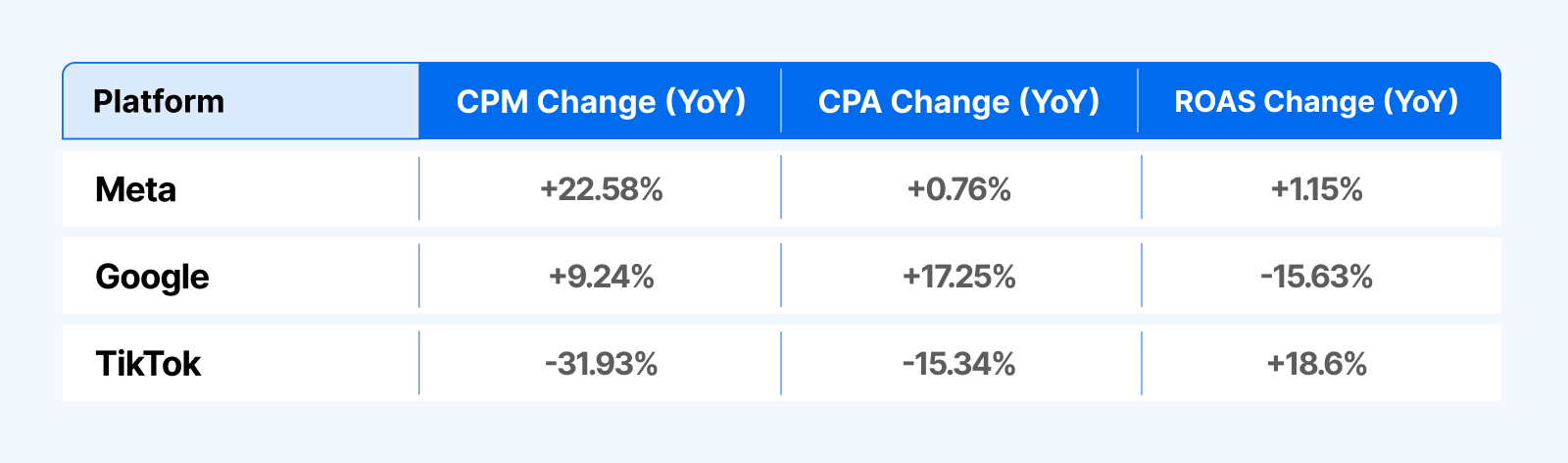
The pure-play DTC model is hitting diminishing returns. Digital acquisition costs continue to rise (Meta CPM up 22.58% YoY, Google CPA up 17.25% YoY), and consumers increasingly crave tangible brand experiences. Adding physical retail experience doesn’t diminish the online retail, but it does expand the customer journey in a way that unlocks acquisition channels that traditional paid media can’t reach.
Why physical retail is back for mid-market brands
Eight-figure brands are uniquely positioned for physical retail success. They're large enough to absorb the investment, small enough to remain agile, established enough to have loyal customer bases who will show up, and digitally-native enough to integrate online and offline seamlessly.
Physical retail in 2026 takes multiple forms:
Pop-ups as acquisition channels. Short-term activations in high-traffic areas without long-term lease commitments.
Wholesale partnerships for discovery. Placing select products in established retailers to reach new audiences.
Flagship stores in strategic markets. Single locations that serve as brand headquarters, content studios, and community hubs.
IRL events tied to drops and launches. Creating urgency and FOMO through in-person experiences.
The measurement challenge
Physical retail creates attribution complexity. Brands need geo-lift studies, post-purchase surveys asking "How did you first hear about us?", cohort analysis comparing physical vs. digital acquisition, and incremental revenue modeling to understand the halo effect of physical presence.
"Physical retail will continue to make a stronger and stronger return for the mid-market of eight-figure brands. That might be through pop-ups as an acquisition source, wholesale partnerships for discovery, launching flagship stores, or in-person events tied to drops and creators. I think this will be a huge focus for the mid-market in how they deploy their budget and how they need to think about measurement in 2026."
- Zach Rego, CRO at Triple Whale
How to adopt this trend
Start small, measure everything, scale what works:
Test a weekend pop-up in a high-traffic area and measure foot traffic, conversions, and post-event online sales lift
Partner with complementary retailers for limited wholesale placement of hero products
Host IRL events tied to product launches to capture emails and measure attendee LTV vs. digital-only customers
Implement post-purchase surveys to understand how many customers discovered you through physical touchpoints
Track cohorts acquired through physical channels vs. digital and compare LTV, retention, and advocacy
Invest in measurement infrastructure that connects online and offline data before scaling physical presence
The brands that win in 2026 will appeal to customers seeking the full brand experience by creating an omnichannel presence that uses each medium’s strengths to reinforce the others.
3. Artificial Intelligence will evolve from a tool to long-running agents that execute end-to-end workflows
AI in ecommerce isn’t new, but 2026 marks the year it stops being a feature and becomes the foundation. The AI-enabled ecommerce market reached $8.65 billion in 2025 and is projected to hit $64 billion by 2034 — a 24.3% CAGR. This reflects AI’s transformation from experimental technology to business imperative.
Our prediction: The new class of AI models unlocks long-running agents capable of executing complex, multi-step workflows without human intervention. While no one has them in full production yet, expect to see significant change at the start of 2026. End-to-end agents are systems that not only analyze data or answer questions, but actively manage entire business processes from start to finish.
What long-running agents mean for ecommerce
Traditional AI tools require humans to prompt them, review outputs, and take action. Long-running agents operate autonomously over extended periods, make decisions, adjust strategies, and execute tasks continuously. For ecommerce, this means:
Campaign management agents that monitor performance 24/7, automatically adjusting bids, budgets, and targeting based on real-time results
Inventory optimization agents that predict demand, coordinate purchasing, and manage stock levels across channels without daily oversight
Customer service agents that handle complex multi-turn conversations, escalate appropriately, and learn from every interaction
Pricing agents that dynamically adjust prices based on competition, inventory, demand, and margin targets
Creative testing agents that generate variations, launch tests, analyze results, and iterate continuously
Product recommendations powered by AI can increase revenue by up to 300%, boost conversion by 150%, and raise average order values by 50%
By 2030, AI is expected to manage 80% of customer interactions, and companies leveraging AI see average revenue increased of 10-12%
Agentic AI will become an essential part of operations for ecommerce brands; Ekster reduced reporting time by 65% and improved MER by 20% year-over-year using Triple Whale’s Moby Agents
"The new class of models unlocks long-running agents, I don't think anyone has them in production yet. I expect to see a lot of change happen at the start of 2026. There are now some good tricks for continuous learning. End-to-end agents are coming.”
- AJ Orbach, Co-founder & CEO at Triple Whale
What this means for your business
The shift from AI tools to long-running agents means moving from reactive optimization to proactive, autonomous execution. Instead of asking ‘What happened?’ AI will continuously manage the ‘What should we do?’ and execute it in real-time.
How to adopt this trend
Start with a foundation, then scale to autonomous agents:
Implement AI chatbots for customer service to handle routine inquiries
Add personalized product recommendations to your website
Use predictive analytics tools for demand forecasting and inventory optimization
Use Moby Chat to retrieve and analyze historical data to generate demand and inventory forecasts
Test AI tools for ecommerce content creation, email personalization, and A/B testing at scale
Prepare long-running agents by defining clear parameters, guardrails, and success metrics for autonomous decision-making
4. Platform diversification will be critical to thriving in 2026
Our prediction: Brands relying heavily on any single platform, whether it’s Amazon, Meta, Google, or even Shopify, will face existential risk in 2026. The winners will distribute presence, traffic, and revenue across multiple platforms.
“In 2026, ecommerce growth will come from diversification done intentionally, not reactively,” Mia Healy, Triple Whale’s Director of Tech and Channel Partnerships, said. “What we saw throughout 2025 was that rising costs and declining efficiency on dominant platforms pushed brands to rethink how and where they invest, reducing over-reliance on any single platform.”
This isn’t about hedging bets. It’s about meeting customers where they are. Current ecommerce trends in consumption show that 87% of shoppers use marketplaces as top shopping destinations, but nearly half use both marketplaces and brand sites. Consumers move fluidly between TikTok, Amazon, Instagram, Google, and brand websites without thinking in channels.
The economics demand diversification
Triple Whale’s 2025 advertising performance data (January 1-October 31) reveals a critical shift: major platforms are experiencing cost inflation and efficiency decline simultaneously, while alternative platforms offer better unit economics and improving performance.
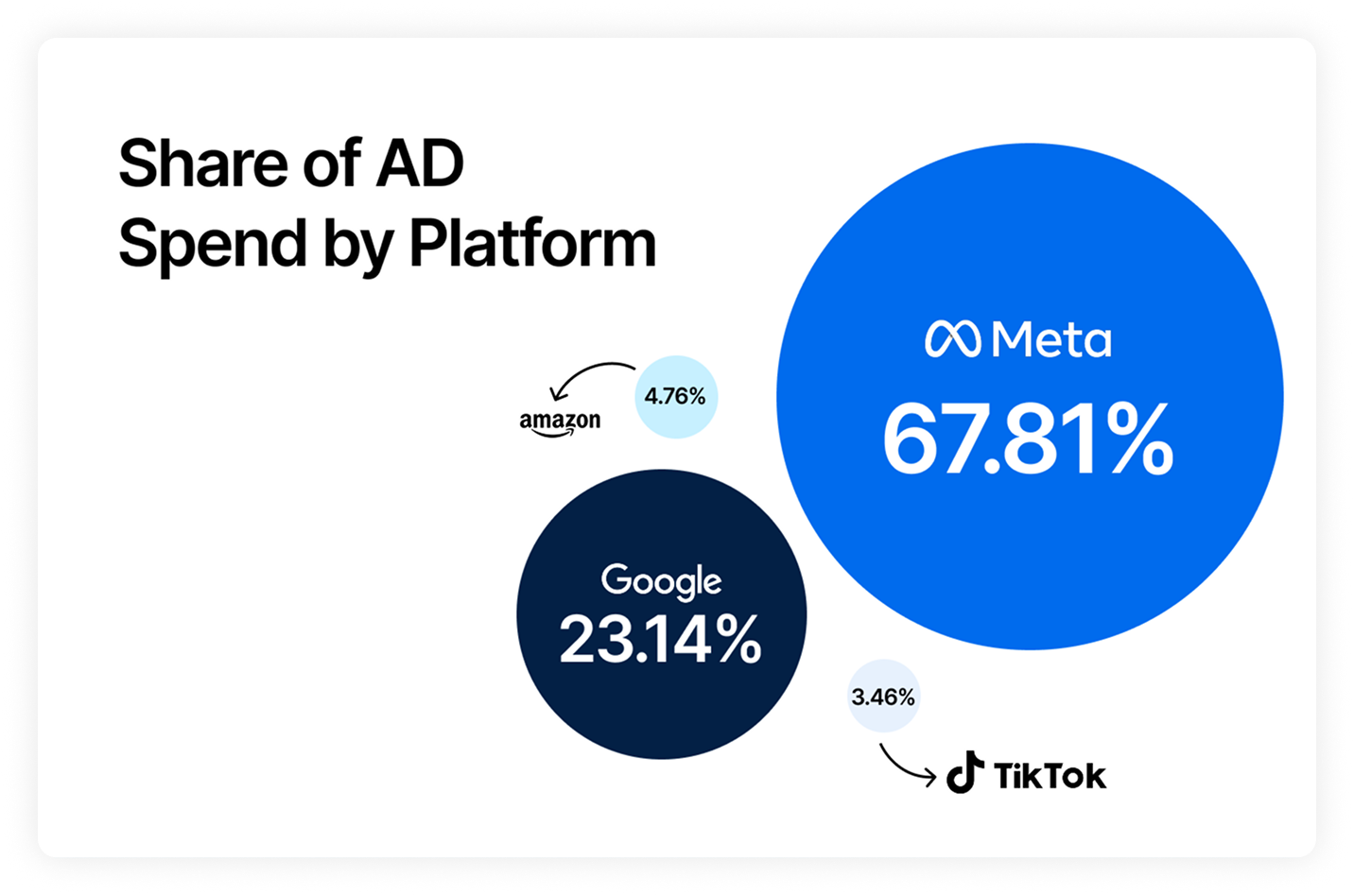
As traditional platforms become more expensive and less efficient, emerging platforms like TikTok are offering better unit economics with improving performance. During BFCM 2025, Meta's share of ad spend dropped to 67.6% while TikTok grew +23.65% and AppLovin surged +36.24% — clear evidence the duopoly is cracking.
“I think we’re going to see other ad channels pop up that didn’t exist before to really start to compete with the incumbents,” says Maxx Blank, Co-Founder & COO of Triple Whale.
The platform landscape for 2026
Marketplaces: Amazon remains dominant but faces growing competition from Walmart Marketplace, TikTok Shop, Temu, and specialized vertical marketplaces
Social platforms: Instagram Shopping, Facebook Shops, TikTok Shop, Pinterest Shopping — each serves different demographics and discovery patterns
Search & Discovery: Google Shopping, Amazon search, TikTok search (43% of Gen Z start here), Pinterest visual search
Owned channels: Your website, email list, mobile app, SMS — the only platforms you truly control
Why diversification matters
Platform risk is real:
Algorithm changes can tank traffic overnight
Ad costs fluctuate based on competition and platform priorities
You never own the customer relationship on third-party platforms
How to adopt this trend
Build strategic platform distribution:
Audit current revenue distribution — if more than 50% comes from one platform, you have concentration risk
Test 2-3 new platforms in 2026 with pilot products or limited catalog
Invest heavily in owned channels (your website, email list, and customer database)
Use unified inventory management to sync stock across platforms in real time
Track attribution across platforms to understand true customer journey
Travelpro discovered that 20% of purchases were influenced by PR channels (like The New York Times and Wirecutter) using Triple Whale
“The next phase of ecommerce is about building balanced channel mixes, testing emerging platforms earlier, and reallocating spend based on real performance signals instead of habit. Brands that treat diversification as a core strategy, not a backup plan, will be the ones that grow more efficiently and stay resilient as the landscape continues to change.”
- Mia Healy, Director of Partnerships at Triple Whale
5. AI will create jobs by turning expertise into scalable systems
Counter to popular fear, our prediction: AI won’t eliminate ecommerce jobs in 2026, but rather transform them into higher-value roles focused on packaging human expertise into repeatable systems. The people who thrive will be those who can translate real-world experience into decision frameworks that AI can apply at scale.
The shift from advice to systematic decision-making
The human decisions made to encode AI so that it can successfully replicate your decisions and judgement over thousands of scenarios is where the future of AI work lies. It used to be that writing a good prompt was the way to make the most of AI. Now, it’s turning years of experience into repeatable rules, frameworks, and decision trees that AI can execute consistently that will be the bread and butter.
For example:
Instead of manually reviewing ad creative performance, you’ll teach AI your framework for what makes winning creative
Instead of deciding daily budget allocation, you’ll encode your decision-making process so AI can apply it in real-time
Instead of analyzing customer segments manually, you’ll build the logic for how you identify high-value cohorts so AI can find them automatically
This will create entirely new roles in AI: decision architects, system designers, and AI workflow engineers who bridge human expertise and machine execution.
AI systems will learn from company history, not just data
The next evolution of AI will feature tools that remember past decisions and learn from them like a company builds institutional knowledge. AI systems in 2026 will track:
What was tried already: Every test, campaign, and strategy
Why decisions were made: The context and reasoning behind choices
What happened next: Outcomes, learnings, and unexpected results
How to apply that experience: Using history to make better decisions over time
How to adopt this trend
Position yourself and your team for AI-augmented work:
Document your decision making processes with the signals you look for, what triggers action, and what makes you pause
Start using AI tools as collaborators and teach them your frameworks
Build feedback loops where recommendations are reviewed, refined, and improved over time
Invest in training teams to work alongside AI rather than fearing replacement
Focus on hiring people who can think systematically about problems, not just execute tasks
Create “decision libraries” in your organization to have documented frameworks for common choices that AI can reference and apply
The competitive advantage in 2026 will be with companies that best translate their human expertise into scalable AI systems. That requires new skills, new roles, and new ways of thinking about work.
“People won’t just give advice, they’ll package how they make decisions so AI systems can use it. The value won’t be in ‘expert opinions’, but in turning real-world experience into repeatable rules that AI can apply at scale.”
- Logan Brown, Product Manager at Triple Whale
6. Social commerce will rise, privacy regulations will tighten, and demand for quick commerce will grow
Three massive ecommerce business trends are converging in 2026, and brands that ignore any of them will fall behind. Let’s break down each force reshaping the ecommerce landscape.
Social commerce goes mainstream
Social commerce has most certainly arrived, with global social sales reaching $699 billion in 2024 and expected to surpass $1 trillion by 2028. The U.S. alone will see social commerce sales exceed $100 billion in 2026, which is expected to account for 7.2% of total ecommerce sales.
The numbers that matter:
59% of global consumers have made at least one purchase on social media
87% say global marketplaces are among their top shopping destinations
TikTok Shop saw 43.8% of US users make purchases in 2024, with 48.8 million projected buyers by the end of 2025
Facebook remains dominant with 89% of marketers using it for social commerce
Our prediction: Social platforms will become primary discovery channels for most consumer categories by the end of 2026. Brands not actively selling where consumers browse will become invisible.
Privacy regulations get serious
As ecommerce customer experience trends emphasize personalization, privacy regulations are tightening. GDPR in Europe, CCPA in California, and emerging legislation worldwide are reshaping how brands collect, store, and use customer data.
63% worry about bias and discrimination in AI algorithms
74% of customers experience leaders say transparency in AI is essential
77% of customer experience leaders feel responsible for protecting customer data privacy
Our prediction: Brands that build trust through transparent data practices will gain competitive advantage. Privacy will become a brand differentiator.
Quick commerce
Quick commerce — delivery in under 30 minutes — is transforming from novelty into expectation. Brands are redefining what ‘fast’ means in ecommerce fulfillment, and it will only get quicker.
Our prediction: By the end of 2026, under-30-minute delivery will be the norm in metro and tier-1 cities. Brands that aren’t present in quick commerce channels will lose market share to those that are, particularly in Beauty, Food & Beverage, and essentials categories.
How to adopt this trend
Address all three forces at once:
Social commerce: Set up Instagram, Facebook, and TikTok Shops and partner with micro-influencers and create shoppable content regularly
Privacy: Audit your data practices, implement clear consent mechanisms, be transparent about data usage, and give customers control over their information
Quick commerce: List products on relevant quick commerce platforms, optimize packaging for rapid fulfillment, consider dark stores in high-density areas
7. 2026 will be the year that ecommerce brands bet big on community
Our boldest prediction? The ecommerce brands that win in 2026 won’t be those with the best products or lowest prices. They’ll be the ones that build genuine communities around their values, mission, and customer service.
Community building represents a fundamental shift from transactional relationships to emotional connections. As customer acquisition costs continue rising and platform algorithms become less predictable, owned communities become invaluable assets. Additionally, owned channels (Iike email and SMS) are the only platforms that brands truly control, and direct communication can strengthen customer relationships better than any paid channel can.
Why community matters more than ever
The economics are compelling:
Loyalty program members spend up to 40% more than non-members, and when actively redeeming rewards, they spend 164% more
They create user-generated content, provide testimonials, and refer friends organically (read: for free)
Community reduces dependence on paid advertising — you own the relationship
Active communities provide real-time product feedback and innovation insights
Community loyalty creates barriers to competition — once you’ve got their loyalty, they’re not swayed by some other brand’s new bells and whistles
What community-first looks like
Community isn’t just a Facebook group or Discord server. It’s weaving customer voices into every aspect of your brand:
Content creation. Featuring customer stories, showcasing user-generated content, creating space for customer creativity.
Product development. Involving community in decisions, beta testing with members, co-creating limited editions.
Customer service. Empowering community members to help each other, celebrating helpful members, creating spaces for peer support.
Brand experience. Hosting events (virtual and physical), creating exclusive experiences, building rituals and traditions.
Product feedback. Use post-purchase surveys to provide a space for customers to provide feedback, so they feel heard and can help you improve your product.
How to adopt this trend
Start building community infrastructure:
Choose a community platform (Facebook Groups, Discord, etc.) based on where your audience already gathers
Create valuable content specifically for community members, like exclusive tips, early access, and behind-the-scenes content
Hire or designate a community manager — this role is too important to be an afterthought
Encourage user-generated content with contests, featured spotlights, and genuine engagement
Measure community health metrics — engagement rates, member growth, sentiment, and retention
Set up Sonar Send by Triple Whale to identify more customers, capture customer behavior that traditional tracking misses, and enable more personalized and timely communication
Origin generated $450K in incremental revenue in one year, which meant $168K in profit generated directly from Sonar Send
Ecommerce Trends 2026: Key Insights
The new trends in ecommerce represent fundamental changes in how brands connect with customers, operate their businesses, and compete in increasingly crowded markets.
The seven trends shaping ecommerce growth in 2026:
AI becomes a shopping channel. AI-powered platforms like ChatGPT enable product discovery, research, and direct purchasing through conversational interfaces, creating an entirely new commerce channel that could bypass traditional search engines and marketplaces.
Mid-market brands go physical. Eight-figure DTC brands will expand through strategic pop-ups, wholesale partnerships, flagship stores, and IRL events that unlock new acquisition channels beyond paid digital media.
AI evolves from tool to autonomous agents. Long-running AI agents will execute end-to-end workflows, managing complex business processes continuously without human intervention while learning from company history.
Platform diversification reduces risk. As Meta and Google costs rise while efficiency declines, diversification across emerging platforms like TikTok and AppLovin becomes mandatory to avoid existential concentration risk.
AI creates higher-value jobs. Automation handles routine tasks while humans focus on encoding decision-making frameworks and building AI systems that learn from company history, creating new roles like decision architects and AI workflow engineers.
Three forces converge. Social commerce reaches mainstream ($100B+ in US by 2026), privacy regulations tighten, and quick commerce becomes expected across major categories.
Community becomes competitive moat. Brands that build genuine communities through owned channels, direct feedback, and authentic engagement will outperform those chasing transactions.
Success in the ecommerce landscape of 2026 won't come from chasing every trend, but from strategically adopting the ones that align with your brand values, customer needs, and operational capabilities. Start with one or two high-impact trends, measure results, and scale what works.
The future of ecommerce belongs to brands that stay agile, invest in understanding their customers deeply, and build infrastructure flexible enough to adapt as technology and expectations continue evolving at unprecedented pace.
FAQs: Ecommerce trends 2026
What are current trends in e-commerce?
The most significant current trends in ecommerce include AI becoming a shopping channel where consumers can research and purchase directly within platforms like ChatGPT, mid-market brands expanding to physical retail through pop-ups and events, long-running AI agents executing autonomous workflows, platform diversification to reduce risk as legacy channel costs rise, social commerce reaching mainstream adoption, privacy regulations tightening, and community-building through owned channels outperforming transactional approaches.
What is the next big thing in e-commerce?
The next big thing in ecommerce is agentic AI — autonomous AI systems that complete complex tasks without human intervention. By 2028, 33% of ecommerce enterprises will use agentic AI for functions like managing entire customer journeys, optimizing supply chains, and making strategic decisions. This represents AI's evolution from reactive tool to proactive business partner.
What are the new trends in ecommerce in 2025?
The latest ecommerce trends in 2025 include social commerce expansion (projected to exceed $100 billion in US sales by 2026), quick commerce becoming mainstream in metro areas, AI handling 80% of customer interactions by 2030, community-building as retention strategy, platform diversification to reduce risk, and brands balancing AI efficiency with human authenticity to differentiate in crowded markets.
What products are trending in ecommerce?
Trending ecommerce product categories include digital products enhanced by AI (prompts, templates, modifications), subscription consumables experiencing 71% CAGR growth, sustainable and recommerce items as environmental consciousness grows, products suitable for quick commerce delivery (groceries, beauty, essentials), and items that benefit from AR visualization (furniture, home decor, fashion, eyewear).
How are ecommerce marketing trends changing in 2026?
Ecommerce marketing trends are shifting toward AI-powered automation for campaign optimization, social commerce as primary discovery channel (87% of consumers use marketplaces), community-building for organic growth, privacy-first personalization balancing customization with transparency, influencer and creator partnerships driving social sales, and authentic human storytelling differentiating brands in AI-saturated content environments.
Component Sales
5.32K
Benchmark your ecommerce brand against industry leaders
The ecommerce landscape continues to shift. From AI disruption to evolving customer behavior and platform changes, staying ahead of ecommerce trends is necessary for a business to survive in 2026.
The global ecommerce market is projected to reach between $6.88 trillion and $8.1 trillion by 2026. This represents approximately 21-24% of total retail sales worldwide.
But, raw numbers don’t tell the full story. The ecommerce industry trends shaping 2026 reflect fundamental shifts in how consumers discover, evaluate, and purchase products, as well as how successful brands are adapting to meet these evolving expectations.
In this guide, we’ll examine the most important retail ecommerce trends for 2026 and beyond, backed by data and real-world examples. Rather than observations, this guide will include bold predictions about where the ecommerce market is heading, and what you need to do about it.
1. AI will emerge as a primary shopping channel, not just a marketing tool
Our prediction: AI will become a channel in its own right (actually, it’s already happening). Large language models (LLMs) will drive purchasing, discovery, and buying decisions directly, creating an entirely new category of customer acquisition that fundamentally changes how consumers find and buy products.
Consumers already use ChatGPT to ask questions about products, so the next logical step is to purchase from directly inside the platform. OpenAI launched two game-changing features in late 2025 that signal the future of ecommerce:
Instant Checkout (September 2025): The first implementation of agentic commerce where AI can not only recommend products but actually complete purchases on your behalf. Users in the United States can purchase directly from Etsy sellers, with the ability to purchase from over a million Shopify stores coming soon, without leaving the chat.
Users tap “Buy”, confirm shipping and payment details, then complete the order directly within ChatGPT.
Shopping Research (November 2025): A feature specifically trained to research products, compare options, and build personalized buyer’s guides. It asks clarifying questions, researches across the internet, reviews quality scores, and delivers detailed recommendations in minutes.
What makes this revolutionary
Conversational rather than keyword-based. Instead of “best running shoes for plantar fasciitis”, consumers can ask “What running shoes should I buy if I have flat feet and run 20 miles per week?”
Contextual and personalized. AI remembers past conversations and preferences to deliver tailored recommendations based on the person.
Comparative and comprehensive. It can compare trade-offs, explain the differences between products, and synthesize information from multiple sources.
Frictionless purchasing. With Instant Checkout, consumers buy without visiting retailer websites and chat directly with checkout.
The race for AI shopping dominance
OpenAI isn’t alone. The entire tech ecosystem is racing to become the AI shopping destination.
ChatGPT: Shopping Research + Instant Checkout (over 700 million weekly users)
Amazon Rufus: Aiming to “purchase on behalf of the customer”
Google: Testing “Buy for Me” features within AI Overviews
Perplexity: Launched agentic shopping that enables “seamless purchase right from the answer”
Microsoft Copilot: Offers merchants in-chat storefront capabilities
“In 2026, I think there’s going to be a lot of discovery and purchasing coming from LLMs. The number of AI-referred orders across Triple Whale brands alone is exploding. We’re watching the first tiny sliver of a massive shift in how consumers discover and buy.”
- Maxx Blank, Co-Founder & COO of Triple Whale
What this means for ecommerce brands
If AI becomes a primary discovery and purchasing channel, brands will need to optimize for AI visibility the same way they once optimized for Google SEO. Traditional search engine traffic during the early discovery phase could decline significantly as consumers delegate research and purchasing tasks to AI assistants.
The new imperatives:
Structured data and schema markup so AI can easily parse your product information
High-quality, detailed product descriptions that AI models can cite and reference with confidence
Authentic reviews and testimonials that AI systems trust and surface in recommendations
Brand authority signals (press coverage, expert endorsements, customer success stories) that AI models use to rank recommendations
Participation in AI shopping platforms Pthrough merchant applications and protocol adoption
Payment system readiness for agentic commerce protocols (Stripe integration simplifies this)
API integrations that allow AI systems to check real-time inventory, pricing, and availability
How to adopt this trend
Prepare for AI as a shopping channel:
Apply for merchant programs. If you’re on Shopify or Etsy in the United States, you’re already eligible for Instant Checkout. Apply through OpenAI’s merchant application.
Audit your product pages for structured data. Ensure all product information is machine-readable and comprehensive.
Invest in detailed, conversational product descriptions that answer common questions naturally.
Build brand authority through PR, expert content, and customer stories that AI can reference and trust.
Monitor AI-driven traffic sources in your analytics. Track referrals from ChatGPT, Perplexity, and AI Overviews.
Test AI shopping experiences yourself to understand how conversational commerce differs from traditional browsing.
Prepare payment systems for agentic commerce. Consider Stripe if you haven’t already.
Stay informed about the Agentic Commerce Protocol and when it expands to new platforms.
The 2026 ecommerce market will have a new primary channel: AI-powered shopping assistants that research, recommend, and facilitate purchases conversationally. Early adopters who optimize for AI visibility and enable seamless purchasing now will capture disproportionate share as this channel scales to hundreds of millions of shoppers.
2. Mid-market DTC brands will go physical through pop-ups and IRL events
Our prediction: 2026 will be the year that eight-figure digitally-native brands go physical at scale. They won’t do this through massive retail rollouts, but rather strategic pop-ups, wholesale partnerships, flagship stores, and IRL events that drive discovery and community.
The pure-play DTC model is hitting diminishing returns. Digital acquisition costs continue to rise (Meta CPM up 22.58% YoY, Google CPA up 17.25% YoY), and consumers increasingly crave tangible brand experiences. Adding physical retail experience doesn’t diminish the online retail, but it does expand the customer journey in a way that unlocks acquisition channels that traditional paid media can’t reach.
Why physical retail is back for mid-market brands
Eight-figure brands are uniquely positioned for physical retail success. They're large enough to absorb the investment, small enough to remain agile, established enough to have loyal customer bases who will show up, and digitally-native enough to integrate online and offline seamlessly.
Physical retail in 2026 takes multiple forms:
Pop-ups as acquisition channels. Short-term activations in high-traffic areas without long-term lease commitments.
Wholesale partnerships for discovery. Placing select products in established retailers to reach new audiences.
Flagship stores in strategic markets. Single locations that serve as brand headquarters, content studios, and community hubs.
IRL events tied to drops and launches. Creating urgency and FOMO through in-person experiences.
The measurement challenge
Physical retail creates attribution complexity. Brands need geo-lift studies, post-purchase surveys asking "How did you first hear about us?", cohort analysis comparing physical vs. digital acquisition, and incremental revenue modeling to understand the halo effect of physical presence.
"Physical retail will continue to make a stronger and stronger return for the mid-market of eight-figure brands. That might be through pop-ups as an acquisition source, wholesale partnerships for discovery, launching flagship stores, or in-person events tied to drops and creators. I think this will be a huge focus for the mid-market in how they deploy their budget and how they need to think about measurement in 2026."
- Zach Rego, CRO at Triple Whale
How to adopt this trend
Start small, measure everything, scale what works:
Test a weekend pop-up in a high-traffic area and measure foot traffic, conversions, and post-event online sales lift
Partner with complementary retailers for limited wholesale placement of hero products
Host IRL events tied to product launches to capture emails and measure attendee LTV vs. digital-only customers
Implement post-purchase surveys to understand how many customers discovered you through physical touchpoints
Track cohorts acquired through physical channels vs. digital and compare LTV, retention, and advocacy
Invest in measurement infrastructure that connects online and offline data before scaling physical presence
The brands that win in 2026 will appeal to customers seeking the full brand experience by creating an omnichannel presence that uses each medium’s strengths to reinforce the others.
3. Artificial Intelligence will evolve from a tool to long-running agents that execute end-to-end workflows
AI in ecommerce isn’t new, but 2026 marks the year it stops being a feature and becomes the foundation. The AI-enabled ecommerce market reached $8.65 billion in 2025 and is projected to hit $64 billion by 2034 — a 24.3% CAGR. This reflects AI’s transformation from experimental technology to business imperative.
Our prediction: The new class of AI models unlocks long-running agents capable of executing complex, multi-step workflows without human intervention. While no one has them in full production yet, expect to see significant change at the start of 2026. End-to-end agents are systems that not only analyze data or answer questions, but actively manage entire business processes from start to finish.
What long-running agents mean for ecommerce
Traditional AI tools require humans to prompt them, review outputs, and take action. Long-running agents operate autonomously over extended periods, make decisions, adjust strategies, and execute tasks continuously. For ecommerce, this means:
Campaign management agents that monitor performance 24/7, automatically adjusting bids, budgets, and targeting based on real-time results
Inventory optimization agents that predict demand, coordinate purchasing, and manage stock levels across channels without daily oversight
Customer service agents that handle complex multi-turn conversations, escalate appropriately, and learn from every interaction
Pricing agents that dynamically adjust prices based on competition, inventory, demand, and margin targets
Creative testing agents that generate variations, launch tests, analyze results, and iterate continuously
Product recommendations powered by AI can increase revenue by up to 300%, boost conversion by 150%, and raise average order values by 50%
By 2030, AI is expected to manage 80% of customer interactions, and companies leveraging AI see average revenue increased of 10-12%
Agentic AI will become an essential part of operations for ecommerce brands; Ekster reduced reporting time by 65% and improved MER by 20% year-over-year using Triple Whale’s Moby Agents
"The new class of models unlocks long-running agents, I don't think anyone has them in production yet. I expect to see a lot of change happen at the start of 2026. There are now some good tricks for continuous learning. End-to-end agents are coming.”
- AJ Orbach, Co-founder & CEO at Triple Whale
What this means for your business
The shift from AI tools to long-running agents means moving from reactive optimization to proactive, autonomous execution. Instead of asking ‘What happened?’ AI will continuously manage the ‘What should we do?’ and execute it in real-time.
How to adopt this trend
Start with a foundation, then scale to autonomous agents:
Implement AI chatbots for customer service to handle routine inquiries
Add personalized product recommendations to your website
Use predictive analytics tools for demand forecasting and inventory optimization
Use Moby Chat to retrieve and analyze historical data to generate demand and inventory forecasts
Test AI tools for ecommerce content creation, email personalization, and A/B testing at scale
Prepare long-running agents by defining clear parameters, guardrails, and success metrics for autonomous decision-making
4. Platform diversification will be critical to thriving in 2026
Our prediction: Brands relying heavily on any single platform, whether it’s Amazon, Meta, Google, or even Shopify, will face existential risk in 2026. The winners will distribute presence, traffic, and revenue across multiple platforms.
“In 2026, ecommerce growth will come from diversification done intentionally, not reactively,” Mia Healy, Triple Whale’s Director of Tech and Channel Partnerships, said. “What we saw throughout 2025 was that rising costs and declining efficiency on dominant platforms pushed brands to rethink how and where they invest, reducing over-reliance on any single platform.”
This isn’t about hedging bets. It’s about meeting customers where they are. Current ecommerce trends in consumption show that 87% of shoppers use marketplaces as top shopping destinations, but nearly half use both marketplaces and brand sites. Consumers move fluidly between TikTok, Amazon, Instagram, Google, and brand websites without thinking in channels.
The economics demand diversification
Triple Whale’s 2025 advertising performance data (January 1-October 31) reveals a critical shift: major platforms are experiencing cost inflation and efficiency decline simultaneously, while alternative platforms offer better unit economics and improving performance.
As traditional platforms become more expensive and less efficient, emerging platforms like TikTok are offering better unit economics with improving performance. During BFCM 2025, Meta's share of ad spend dropped to 67.6% while TikTok grew +23.65% and AppLovin surged +36.24% — clear evidence the duopoly is cracking.
“I think we’re going to see other ad channels pop up that didn’t exist before to really start to compete with the incumbents,” says Maxx Blank, Co-Founder & COO of Triple Whale.
The platform landscape for 2026
Marketplaces: Amazon remains dominant but faces growing competition from Walmart Marketplace, TikTok Shop, Temu, and specialized vertical marketplaces
Social platforms: Instagram Shopping, Facebook Shops, TikTok Shop, Pinterest Shopping — each serves different demographics and discovery patterns
Search & Discovery: Google Shopping, Amazon search, TikTok search (43% of Gen Z start here), Pinterest visual search
Owned channels: Your website, email list, mobile app, SMS — the only platforms you truly control
Why diversification matters
Platform risk is real:
Algorithm changes can tank traffic overnight
Ad costs fluctuate based on competition and platform priorities
You never own the customer relationship on third-party platforms
How to adopt this trend
Build strategic platform distribution:
Audit current revenue distribution — if more than 50% comes from one platform, you have concentration risk
Test 2-3 new platforms in 2026 with pilot products or limited catalog
Invest heavily in owned channels (your website, email list, and customer database)
Use unified inventory management to sync stock across platforms in real time
Track attribution across platforms to understand true customer journey
Travelpro discovered that 20% of purchases were influenced by PR channels (like The New York Times and Wirecutter) using Triple Whale
“The next phase of ecommerce is about building balanced channel mixes, testing emerging platforms earlier, and reallocating spend based on real performance signals instead of habit. Brands that treat diversification as a core strategy, not a backup plan, will be the ones that grow more efficiently and stay resilient as the landscape continues to change.”
- Mia Healy, Director of Partnerships at Triple Whale
5. AI will create jobs by turning expertise into scalable systems
Counter to popular fear, our prediction: AI won’t eliminate ecommerce jobs in 2026, but rather transform them into higher-value roles focused on packaging human expertise into repeatable systems. The people who thrive will be those who can translate real-world experience into decision frameworks that AI can apply at scale.
The shift from advice to systematic decision-making
The human decisions made to encode AI so that it can successfully replicate your decisions and judgement over thousands of scenarios is where the future of AI work lies. It used to be that writing a good prompt was the way to make the most of AI. Now, it’s turning years of experience into repeatable rules, frameworks, and decision trees that AI can execute consistently that will be the bread and butter.
For example:
Instead of manually reviewing ad creative performance, you’ll teach AI your framework for what makes winning creative
Instead of deciding daily budget allocation, you’ll encode your decision-making process so AI can apply it in real-time
Instead of analyzing customer segments manually, you’ll build the logic for how you identify high-value cohorts so AI can find them automatically
This will create entirely new roles in AI: decision architects, system designers, and AI workflow engineers who bridge human expertise and machine execution.
AI systems will learn from company history, not just data
The next evolution of AI will feature tools that remember past decisions and learn from them like a company builds institutional knowledge. AI systems in 2026 will track:
What was tried already: Every test, campaign, and strategy
Why decisions were made: The context and reasoning behind choices
What happened next: Outcomes, learnings, and unexpected results
How to apply that experience: Using history to make better decisions over time
How to adopt this trend
Position yourself and your team for AI-augmented work:
Document your decision making processes with the signals you look for, what triggers action, and what makes you pause
Start using AI tools as collaborators and teach them your frameworks
Build feedback loops where recommendations are reviewed, refined, and improved over time
Invest in training teams to work alongside AI rather than fearing replacement
Focus on hiring people who can think systematically about problems, not just execute tasks
Create “decision libraries” in your organization to have documented frameworks for common choices that AI can reference and apply
The competitive advantage in 2026 will be with companies that best translate their human expertise into scalable AI systems. That requires new skills, new roles, and new ways of thinking about work.
“People won’t just give advice, they’ll package how they make decisions so AI systems can use it. The value won’t be in ‘expert opinions’, but in turning real-world experience into repeatable rules that AI can apply at scale.”
- Logan Brown, Product Manager at Triple Whale
6. Social commerce will rise, privacy regulations will tighten, and demand for quick commerce will grow
Three massive ecommerce business trends are converging in 2026, and brands that ignore any of them will fall behind. Let’s break down each force reshaping the ecommerce landscape.
Social commerce goes mainstream
Social commerce has most certainly arrived, with global social sales reaching $699 billion in 2024 and expected to surpass $1 trillion by 2028. The U.S. alone will see social commerce sales exceed $100 billion in 2026, which is expected to account for 7.2% of total ecommerce sales.
The numbers that matter:
59% of global consumers have made at least one purchase on social media
87% say global marketplaces are among their top shopping destinations
TikTok Shop saw 43.8% of US users make purchases in 2024, with 48.8 million projected buyers by the end of 2025
Facebook remains dominant with 89% of marketers using it for social commerce
Our prediction: Social platforms will become primary discovery channels for most consumer categories by the end of 2026. Brands not actively selling where consumers browse will become invisible.
Privacy regulations get serious
As ecommerce customer experience trends emphasize personalization, privacy regulations are tightening. GDPR in Europe, CCPA in California, and emerging legislation worldwide are reshaping how brands collect, store, and use customer data.
63% worry about bias and discrimination in AI algorithms
74% of customers experience leaders say transparency in AI is essential
77% of customer experience leaders feel responsible for protecting customer data privacy
Our prediction: Brands that build trust through transparent data practices will gain competitive advantage. Privacy will become a brand differentiator.
Quick commerce
Quick commerce — delivery in under 30 minutes — is transforming from novelty into expectation. Brands are redefining what ‘fast’ means in ecommerce fulfillment, and it will only get quicker.
Our prediction: By the end of 2026, under-30-minute delivery will be the norm in metro and tier-1 cities. Brands that aren’t present in quick commerce channels will lose market share to those that are, particularly in Beauty, Food & Beverage, and essentials categories.
How to adopt this trend
Address all three forces at once:
Social commerce: Set up Instagram, Facebook, and TikTok Shops and partner with micro-influencers and create shoppable content regularly
Privacy: Audit your data practices, implement clear consent mechanisms, be transparent about data usage, and give customers control over their information
Quick commerce: List products on relevant quick commerce platforms, optimize packaging for rapid fulfillment, consider dark stores in high-density areas
7. 2026 will be the year that ecommerce brands bet big on community
Our boldest prediction? The ecommerce brands that win in 2026 won’t be those with the best products or lowest prices. They’ll be the ones that build genuine communities around their values, mission, and customer service.
Community building represents a fundamental shift from transactional relationships to emotional connections. As customer acquisition costs continue rising and platform algorithms become less predictable, owned communities become invaluable assets. Additionally, owned channels (Iike email and SMS) are the only platforms that brands truly control, and direct communication can strengthen customer relationships better than any paid channel can.
Why community matters more than ever
The economics are compelling:
Loyalty program members spend up to 40% more than non-members, and when actively redeeming rewards, they spend 164% more
They create user-generated content, provide testimonials, and refer friends organically (read: for free)
Community reduces dependence on paid advertising — you own the relationship
Active communities provide real-time product feedback and innovation insights
Community loyalty creates barriers to competition — once you’ve got their loyalty, they’re not swayed by some other brand’s new bells and whistles
What community-first looks like
Community isn’t just a Facebook group or Discord server. It’s weaving customer voices into every aspect of your brand:
Content creation. Featuring customer stories, showcasing user-generated content, creating space for customer creativity.
Product development. Involving community in decisions, beta testing with members, co-creating limited editions.
Customer service. Empowering community members to help each other, celebrating helpful members, creating spaces for peer support.
Brand experience. Hosting events (virtual and physical), creating exclusive experiences, building rituals and traditions.
Product feedback. Use post-purchase surveys to provide a space for customers to provide feedback, so they feel heard and can help you improve your product.
How to adopt this trend
Start building community infrastructure:
Choose a community platform (Facebook Groups, Discord, etc.) based on where your audience already gathers
Create valuable content specifically for community members, like exclusive tips, early access, and behind-the-scenes content
Hire or designate a community manager — this role is too important to be an afterthought
Encourage user-generated content with contests, featured spotlights, and genuine engagement
Measure community health metrics — engagement rates, member growth, sentiment, and retention
Set up Sonar Send by Triple Whale to identify more customers, capture customer behavior that traditional tracking misses, and enable more personalized and timely communication
Origin generated $450K in incremental revenue in one year, which meant $168K in profit generated directly from Sonar Send
Ecommerce Trends 2026: Key Insights
The new trends in ecommerce represent fundamental changes in how brands connect with customers, operate their businesses, and compete in increasingly crowded markets.
The seven trends shaping ecommerce growth in 2026:
AI becomes a shopping channel. AI-powered platforms like ChatGPT enable product discovery, research, and direct purchasing through conversational interfaces, creating an entirely new commerce channel that could bypass traditional search engines and marketplaces.
Mid-market brands go physical. Eight-figure DTC brands will expand through strategic pop-ups, wholesale partnerships, flagship stores, and IRL events that unlock new acquisition channels beyond paid digital media.
AI evolves from tool to autonomous agents. Long-running AI agents will execute end-to-end workflows, managing complex business processes continuously without human intervention while learning from company history.
Platform diversification reduces risk. As Meta and Google costs rise while efficiency declines, diversification across emerging platforms like TikTok and AppLovin becomes mandatory to avoid existential concentration risk.
AI creates higher-value jobs. Automation handles routine tasks while humans focus on encoding decision-making frameworks and building AI systems that learn from company history, creating new roles like decision architects and AI workflow engineers.
Three forces converge. Social commerce reaches mainstream ($100B+ in US by 2026), privacy regulations tighten, and quick commerce becomes expected across major categories.
Community becomes competitive moat. Brands that build genuine communities through owned channels, direct feedback, and authentic engagement will outperform those chasing transactions.
Success in the ecommerce landscape of 2026 won't come from chasing every trend, but from strategically adopting the ones that align with your brand values, customer needs, and operational capabilities. Start with one or two high-impact trends, measure results, and scale what works.
The future of ecommerce belongs to brands that stay agile, invest in understanding their customers deeply, and build infrastructure flexible enough to adapt as technology and expectations continue evolving at unprecedented pace.
FAQs: Ecommerce trends 2026
What are current trends in e-commerce?
The most significant current trends in ecommerce include AI becoming a shopping channel where consumers can research and purchase directly within platforms like ChatGPT, mid-market brands expanding to physical retail through pop-ups and events, long-running AI agents executing autonomous workflows, platform diversification to reduce risk as legacy channel costs rise, social commerce reaching mainstream adoption, privacy regulations tightening, and community-building through owned channels outperforming transactional approaches.
What is the next big thing in e-commerce?
The next big thing in ecommerce is agentic AI — autonomous AI systems that complete complex tasks without human intervention. By 2028, 33% of ecommerce enterprises will use agentic AI for functions like managing entire customer journeys, optimizing supply chains, and making strategic decisions. This represents AI's evolution from reactive tool to proactive business partner.
What are the new trends in ecommerce in 2025?
The latest ecommerce trends in 2025 include social commerce expansion (projected to exceed $100 billion in US sales by 2026), quick commerce becoming mainstream in metro areas, AI handling 80% of customer interactions by 2030, community-building as retention strategy, platform diversification to reduce risk, and brands balancing AI efficiency with human authenticity to differentiate in crowded markets.
What products are trending in ecommerce?
Trending ecommerce product categories include digital products enhanced by AI (prompts, templates, modifications), subscription consumables experiencing 71% CAGR growth, sustainable and recommerce items as environmental consciousness grows, products suitable for quick commerce delivery (groceries, beauty, essentials), and items that benefit from AR visualization (furniture, home decor, fashion, eyewear).
How are ecommerce marketing trends changing in 2026?
Ecommerce marketing trends are shifting toward AI-powered automation for campaign optimization, social commerce as primary discovery channel (87% of consumers use marketplaces), community-building for organic growth, privacy-first personalization balancing customization with transparency, influencer and creator partnerships driving social sales, and authentic human storytelling differentiating brands in AI-saturated content environments.
Share
Allie Mistakidis
Allie Mistakidis
Allie Mistakidis is a Content Writer at Triple Whale, silversmith at Aloraflora Jewelry, and retail store co-owner at Whiskeyjack Boutique in Windsor, ON, Canada. She has a Masters degree in plumage evolution in birds, and spent several years doing technical support, including at Shopify. You can connect with her on LinkedIn.
Body Copy: The following benchmarks compare advertising metrics from April 1-17 to the previous period. Considering President Trump first unveiled his tariffs on April 2, the timing corresponds with potential changes in advertising behavior among ecommerce brands (though it isn’t necessarily correlated).


 Moby AIAsk questions, analyze performance, and work with your business context.
 ActionsTake governed action across the tools that run your business.
 AutomationsSchedule recurring analysis and work that runs on your terms.
 Landing PagesCreative conversion-focused ecommerce pages with Moby.
 Creative StudioGenerate and refine creative grounded in your brand.






.jpg)





.webp)

.webp)
